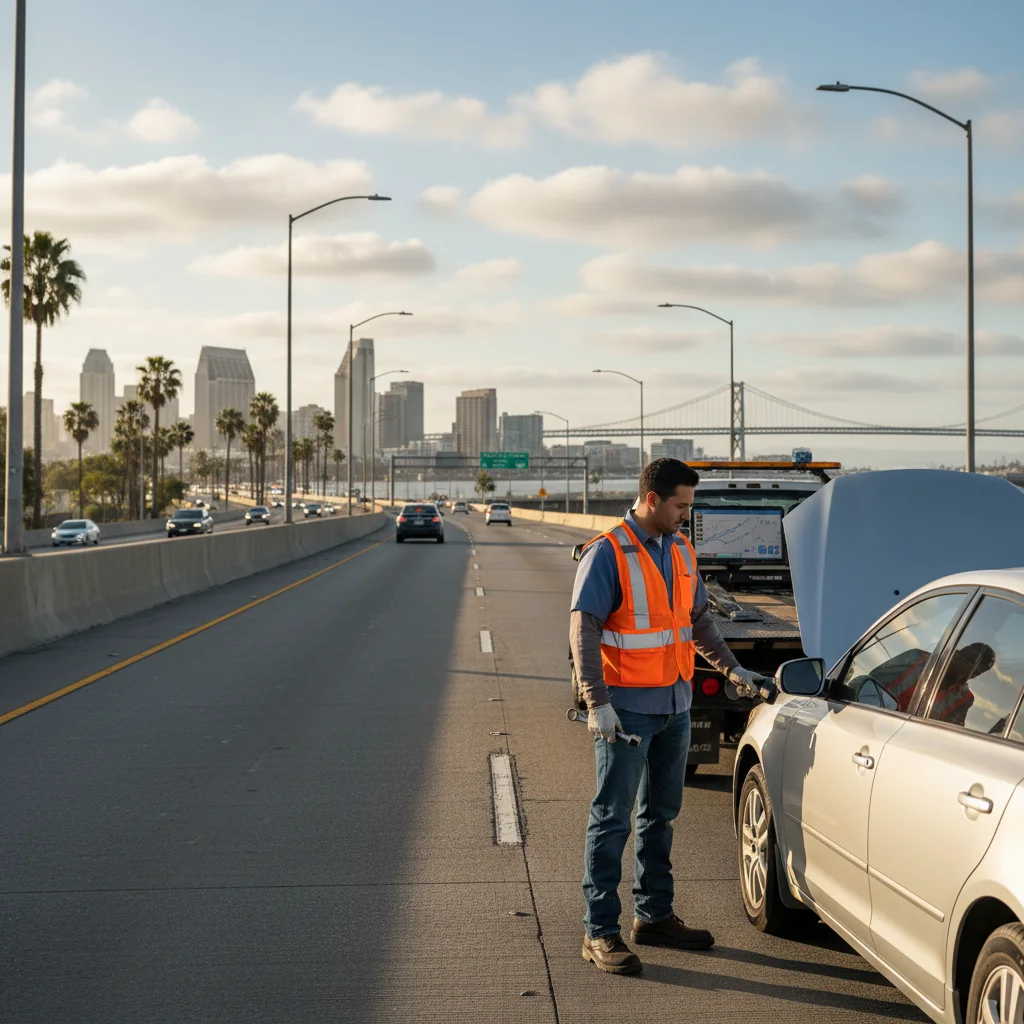
TL;DR
- AAA handles approximately 32 million roadside assistance calls per year in the U.S. - roughly 62 calls per minute. Dead battery is the #1 cause at 35% of all calls.
- FHWA data shows roughly 1 in 3 vehicle breakdowns occurs on a freeway shoulder - the most dangerous breakdown location.
- Response time in urban areas is a good deal shorter than in the backcountry, but no verified countywide average is published. In suburban and rural San Diego County, 45-75 minutes.
- San Diego average tow cost for light-duty under 10 miles: $95-$175. National average is comparable at $109-$170.
- I-8, I-15, I-805, and SR-163 are the highest-volume breakdown corridors in San Diego County based on Caltrans call logs.
Every driver has thought about it: what happens if the car stops running on the 8? Or the battery dies in a parking structure downtown at 11 p.m.? Most people don’t know the odds until they’re living one.
This post pulls together the best available data on vehicle breakdowns and towing in the U.S. and San Diego County specifically - from AAA, the Federal Highway Administration, Caltrans, the National Safety Council, and insurance industry sources - to give drivers an accurate picture of the risks, the costs, and what to expect.
How often do vehicles break down?
AAA’s roadside assistance program handled 32 million calls in 2024 - roughly 88,000 per day, or one call every 2 seconds in the U.S. This is one of the most reliable benchmarks available because AAA’s call volume is consistent and covers a large enough sample to be statistically meaningful.
The Federal Highway Administration estimates that vehicle breakdowns account for approximately 14% of all traffic incidents on U.S. highways - a share that has remained relatively stable despite improvements in vehicle reliability. Newer vehicles have fewer mechanical failures but more complex electrical systems and software-dependent components that create new failure modes.
The National Safety Council estimates that 1 in 3 drivers will experience at least one roadside emergency per year - including breakdowns, flat tires, dead batteries, lockouts, and running out of fuel. Over a 5-year vehicle ownership cycle, the majority of drivers will call for roadside assistance at least once.
What causes breakdowns? Breakdown data by category
AAA’s annual breakdown data provides the most comprehensive category breakdown available. Their research consistently finds:
| Cause | Share of Roadside Calls |
|---|---|
| Dead battery / battery failure | ~35% |
| Flat tire or blowout | ~20% |
| Keys locked inside vehicle | ~12% |
| Out of fuel | ~7% |
| Engine overheating | ~5% |
| Other mechanical failure | ~21% |
Dead battery at 35% is the dominant cause - and it’s accelerating. The National Safety Council notes that the average age of vehicles on U.S. roads reached an all-time high of 12.6 years in 2024. Older vehicles mean older batteries, and batteries have a median replacement cycle of 3-5 years. In San Diego’s heat, that skews toward the shorter end of the range - high ambient temperatures accelerate battery sulfation.
Flat tires at 20% are the second-largest category. California’s roads have significant road debris issues - FHWA debris-related incident data shows California consistently in the top five states for road debris incidents on state highways. For San Diego specifically, I-8 east of El Cajon (heavily trafficked by commercial vehicles) and the SR-94 / I-805 interchange show elevated tire-related call concentrations.
Lockouts at 12% are more common in warmer climates where people leave windows down and keys inside more frequently - and where the psychology of “I’ll just be a second” leads to door-lock habits that create problems. San Diego’s year-round mild weather is a contributor.
Which San Diego freeways generate the most breakdown calls?
Caltrans maintains incident logs through its SWITRS (Statewide Integrated Traffic Records System) and the 511 real-time traffic management system. While Caltrans doesn’t publish detailed breakdown-by-freeway data publicly, the following corridors are the consistently highest-volume based on:
- CHP call logs (available through public records requests)
- Caltrans Traffic Management Center incident data
- Freeway Service Patrol (FSP) deployment patterns - Caltrans prioritizes FSP on the highest-breakdown corridors
I-5 (the primary north-south spine): Highest call volume overall, driven by sheer traffic density - I-5 through downtown San Diego handles 200,000+ vehicles per day. Battery failures and tire incidents dominate. The I-5 / SR-163 interchange and the approaches to the Coronado Bridge are disproportionately represented.
I-8 (east-west, coastal to mountains): High breakdown concentration east of El Cajon toward Alpine and Pine Valley. The elevation gain (from sea level to 4,000 feet) creates thermal stress on cooling systems. Engine overheating calls are a notably higher share of the mix than on other corridors. Commercial traffic is heavy in the El Cajon and La Mesa sections.
I-15 (north-south, inland): The primary inland commuter corridor. High volume through Mira Mesa, Poway, and Escondido. The Miramar Road / Mira Mesa Boulevard interchange is among the highest-call intersections in the county during morning rush. Battery and starter failures dominate in the hot-weather months.
I-805 (parallel to I-5, mid-county): High breakdown concentration at the I-8 split and through the Sweetwater River corridor. The I-805 / SR-54 interchange in Chula Vista is one of the top five highest-incident intersections in the county.
SR-163 (connecting I-8 and I-15 through Mission Valley): Shorter corridor but extremely high traffic density. Breakdown events have outsized impact on the broader network due to the limited shoulder space and heavy merge traffic.
SR-94 / I-5 corridor: The eastbound SR-94 grade east of downtown generates overheating calls at higher than average rates, particularly in summer months.
Average wait times for a tow truck in San Diego
Wait time data is difficult to standardize because it varies by time of day, location, and demand patterns. The most useful benchmarks:
AAA service data: AAA reports a national average wait time of 35-45 minutes for roadside assistance (including towing, jump starts, and tire changes). Urban markets with dense coverage - San Diego qualifies - tend to run at the shorter end.
FSP (Freeway Service Patrol) response: Caltrans FSP trucks patrol designated freeway segments during peak hours. FSP average response time on patrolled segments in San Diego is approximately 15-20 minutes during active patrol hours. The FSP is not a full-service tow - they’ll push disabled vehicles to the nearest exit and perform minor repairs. If you need a tow, they call one for you.
Private tow company response in San Diego: no verified figure is published, by us or by anyone else. The two numbers above are AAA’s and Caltrans’, measured on their own programmes; neither describes a private tow dispatched to your address, and no comparable study exists for San Diego’s private operators. What the geography does tell you is the ordering, which is uncontroversial: central San Diego sits closest to the largest pool of trucks, the coastal and East County suburbs sit further out, North County inland further still, and the backcountry, Ramona, Alpine, Boulevard and Borrego Springs, is in a different category altogether because of raw travel distance.
That ordering is the useful part. A specific number is only worth anything once an operator has your exact address and knows where their nearest available truck is, which is why the estimate you should trust is the one given on the call and not one published on a website.
Towing cost data: what you’ll actually pay in San Diego
National benchmarks: AAA’s 2024 Cost of Vehicle Ownership study puts the average American tow at $109 for a basic service call. Insurance industry data from J.D. Power places the average tow reimbursement claim at $165-$185, which tends to capture longer-distance and more complex tows.
San Diego specific: The San Diego towing market is competitive, and prices have remained relatively stable for light-duty local tows. For a standard light-duty vehicle under 10 miles:
| Service | Typical Range |
|---|---|
| Light-duty tow (under 10 miles) | $95 - $175 |
| Per-mile beyond the included distance | $3.50 - $6.50 |
| Heavy-duty tow (box truck, RV, bus) | $285 - $485+ |
| Motorcycle tow | $105 - $165 |
| Long-distance SD to LA | $285 - $385 |
| Long-distance SD to Las Vegas | $585 - $785 |
| Accident/winch recovery | $165 - $450+ |
| Exotic/classic vehicle transport | $185 - $285 base |
The insurance coverage question: Most roadside assistance plans - AAA, Progressive, Allstate, Geico, USAA - include towing up to a mileage limit. AAA Basic covers 5 miles, AAA Plus covers 100 miles, AAA Premier covers 200 miles. If you exceed your plan’s limit, you pay the difference.
J.D. Power’s 2024 Roadside Assistance Satisfaction Study found that 63% of drivers who needed a tow in the past year had some form of roadside coverage - meaning 37% were paying fully out of pocket.
What San Diego’s specific conditions mean for drivers
Year-round heat: San Diego’s coastal temperatures are mild, but Escondido, El Cajon, Santee, and La Mesa regularly hit 95°F+ in summer. Battery failure is more common in heat than cold - high temperatures accelerate battery plate degradation. The AAA battery data skews toward hot-weather markets.
Minimal rain, but when it rains it matters: San Diego averages 10.3 inches of rain per year, but the first heavy rain of the season (typically October-November) consistently generates a spike in accidents and breakdowns. Tires that haven’t been rotated, brakes that haven’t been tested in dry conditions, and drivers unaccustomed to wet roads all combine. CHP incident logs show a consistent first-rain spike of 20-40% in collision-related calls.
Santa Ana events: When Santa Ana winds push through inland valleys at 60-80+ mph, road debris incidents and tire failures spike on I-8, I-15, and SR-78. These events also cause more stress on cooling systems and create visibility hazards that increase collision rates.
Military traffic corridors: San Diego is home to the largest concentration of military installations in the U.S. Significant commercial and heavy-vehicle traffic runs on I-5, I-15, and SR-56 associated with base access. Heavy vehicle traffic correlates with increased road debris and higher tire-related breakdown rates for civilian vehicles.
What to do when you break down on a San Diego freeway
The National Safety Council’s freeway breakdown protocol, adapted for San Diego:
- Move as far right as possible - get off the travel lane onto the shoulder. If you can’t reach the shoulder, turn on hazards and coast as far right as you can.
- Turn on hazard lights immediately - before you assess anything else.
- If it’s safe to exit the vehicle, exit on the passenger side - freeway shoulders are active with passing traffic at 65+ mph. The passenger door faces away from traffic.
- Stay behind the vehicle’s guardrail if one exists - guardrails absorb errant vehicles. Standing in front of one does not protect you.
- Call 911 first on freeways - CHP will dispatch FSP or direct a tow to you. Then call your tow company or roadside provider. Having CHP on the scene protects you legally and physically.
- Don’t push the car or walk along the freeway - NHTSA data shows that a significant share of freeway breakdown fatalities involve pedestrians on or near the travel lanes. Wait for the tow.
Frequently asked questions
How long does a tow truck take to arrive in San Diego?
No verified average is published for San Diego’s private tow operators, so treat any confident countywide number as marketing. Central San Diego sits closest to the largest pool of trucks and is the quickest part of the county to reach; the coastal and East County suburbs take longer, North County inland longer again, and backcountry addresses like Alpine, Ramona or Borrego Springs are in a different category entirely because of travel distance. Ask for an estimate for your exact address on the call, and be wary of a dispatch broker that quotes a fast time before asking where you are.
What’s the most common reason for a breakdown?
AAA’s national data consistently shows dead battery at approximately 35% of all roadside calls. Flat tire is second at around 20%. In San Diego’s summer heat, battery failures and overheating are more prevalent than in cooler climates - high temperatures accelerate battery plate degradation.
Does AAA cover the full cost of a tow in San Diego?
It depends on your tier. AAA Basic covers towing up to 5 miles (just enough to clear a freeway). AAA Plus covers up to 100 miles per call. AAA Premier covers up to 200 miles. Beyond your tier’s limit, you pay the overage directly to the tow company. Check your plan before you need it.
Which San Diego freeways have the most breakdowns?
Based on Caltrans FSP deployment patterns and CHP incident data, I-5 (central and south), I-8 (east of El Cajon), I-15 (through Mira Mesa and Escondido), and I-805 (at the SR-54 interchange) are the highest-concentration corridors. SR-163 has a high incident-per-mile rate due to its short length and dense traffic.
Is surge pricing normal for San Diego tow companies?
It shouldn’t be. Reputable San Diego tow companies - Quick Tow SD included - charge the same flat rate 24/7. No midnight multiplier, no weekend premium. If a dispatcher mentions “after-hours rates,” that’s a red flag. Flat-rate pricing quoted before dispatch is the standard.
Planning ahead? Our pricing guide covers the full range of tow types and what each costs in San Diego County. If you’ve been in an accident, see what to do after a car accident in California. For safe freeway breakdown procedure, our freeway breakdown guide has the step-by-step.
Stranded in San Diego County right now? Call Quick Tow SD at (858) 923-5787. Ask for the flat rate on the call, the line takes calls 24/7, and you get an arrival estimate for your exact location, with the total confirmed before the truck rolls.