Someone buying a car to tow behind a motorhome usually starts with the wrong question. They ask what the best towed vehicle is, when the real question is what their specific vehicle’s manufacturer allows, in writing, in the owner’s manual. That document decides more of this than any forum post or dealer opinion does.
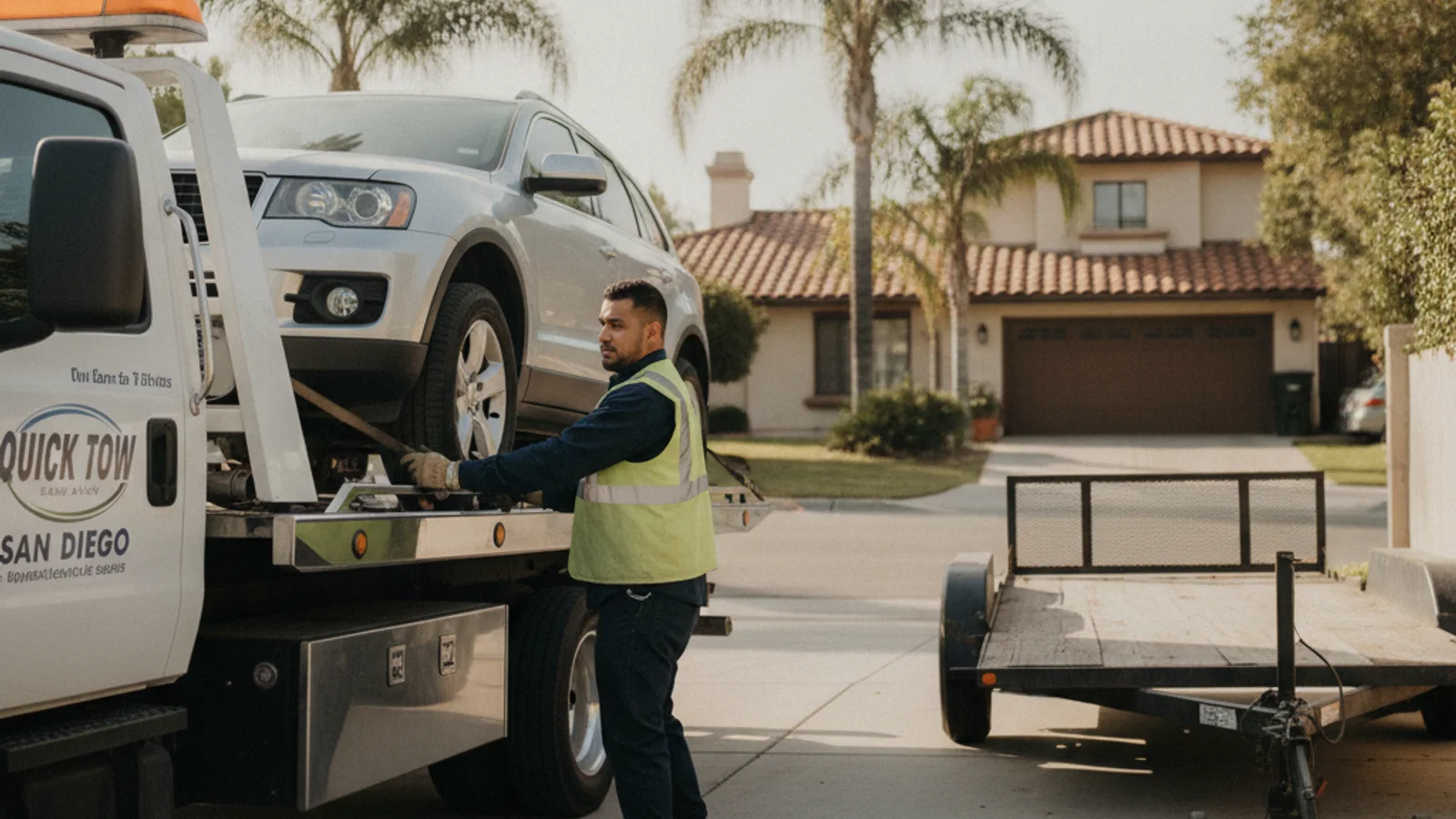
Four ways to move a car, and one document that decides
There are four real options: flat towing (all four wheels on the ground), a tow dolly (front wheels up, rear wheels down), a full trailer (all four wheels off the ground), or shipping the car separately on its own transport. Each has a different cost, setup time, and wear profile. But before any of those choices matters, there’s a gating question: can this specific vehicle, in this specific drivetrain configuration, be flat towed at all. The owner’s manual is the only source that answers that reliably, because eligibility depends on internal details of the transmission and drivetrain that a forum thread or a dealer’s sales floor guess can’t verify. If the manual doesn’t address flat towing directly, call the manufacturer before assuming either way.
The flat-tow eligibility test
A vehicle that’s actually rated for flat towing needs to clear a few requirements. The manufacturer has to confirm the transmission or transfer case can handle rolling wheels without the engine running, which is the “four-down” requirement: all four tires on the pavement the entire trip, not just two. Beyond the vehicle itself, flat towing needs hardware: a base plate bolted to the car’s frame that the tow bar connects to, and in most cases a supplemental braking system so the towed car’s brakes engage along with the motorhome’s. Requirements for supplemental brakes vary by state and by the combined weight involved, so check the current rule for where you’re driving before you tow, rather than assuming your home state’s rule travels with you.
Why most automatics and EVs fail that test
A lot of modern automatic transmissions aren’t built to have their wheels turn without the engine running and the fluid pump circulating, and towing one that way can cause real transmission damage. That’s a manufacturer-specific detail, not a blanket rule for all automatics, so again, the manual is what settles it for your exact model. Electric vehicles raise a similar but separate issue: most EVs can’t be flat towed at all, because rolling the wheels spins the drive motor with no way to disengage it, and that generates damage even at low speed over a short distance. We see this question a lot with Tesla owners specifically, and we don’t have a manufacturer statement here confirming flat-tow eligibility for any particular Tesla model, so don’t take a plausible-sounding answer at face value. Our guide on why Teslas and EVs need a flatbed and our walkthrough of enabling transport mode both cover what a flatbed move actually requires instead.
Dolly, trailer, or ship it separately
If your car isn’t flat-tow eligible, a dolly lifts the drive wheels off the ground, which sidesteps the drivetrain issue for most front-wheel-drive cars but isn’t right for all-wheel drive or rear-wheel-drive vehicles, since the wheels still on the ground would spin the wrong axle. A full trailer takes all four wheels off the road entirely, which works for nearly any vehicle including AWD and EVs, at the cost of more length, weight, and a bigger vehicle to store when you’re not towing. Shipping the car separately, on someone else’s long-distance transport, removes towing from your trip altogether: no extra length behind the motorhome, no daily hookup and disconnect, but it means arriving at your destination without your second vehicle until the transport catches up.
Cost and convenience trade off differently across all three non-flat-tow options, and there’s no single right answer independent of your vehicle and your trip. A dolly is the lightest and cheapest of the physical options but narrows the field of eligible cars. A trailer opens up nearly any vehicle but adds real length and weight to what you’re already pulling, which matters on tight campground roads and mountain switchbacks alike. A separate shipment costs differently again and runs on its own schedule, which only works if your trip plan can absorb the car arriving before or after you do.
A checklist before you connect anything
Before hooking up for a trip, confirm four things regardless of which of the four methods you’re using. First, the manual’s flat-tow rating, or the dolly and trailer weight limits, for your exact vehicle and trim, not a similar model. Second, the tow bar and base plate are rated for your vehicle’s actual weight, since a base plate is bolted to specific frame points that vary by model year. Third, the wiring connection between the motorhome and the towed vehicle is functioning, so brake lights and turn signals on the towed car mirror the motorhome’s. Fourth, safety cables or chains are attached as a backup in case the primary connection fails. None of these are optional add-ons. Skipping any one of them turns a routine tow into the kind of roadside call that happens on a shoulder with traffic passing at speed.
What changes on a long haul out of San Diego
Towing behind an RV out of San Diego means real grade before you clear the county. Heading east on I-8 toward Jacumba, the road climbs steadily into the mountains, and a heavier combined rig, motorhome plus a full trailer and car, feels that grade in both directions: harder pulling uphill, more brake work coming back down. Heading north on I-15, the climb is gentler through San Diego County itself, but the same combined-weight math applies further up the route as I-15 approaches the Cajon Pass region. A car that’s fine on flat streets can expose a marginal hitch, a soft tire, or an undersized brake controller on grades like these, so it’s worth checking hitch weight ratings and tire condition before a trip with real elevation change, not just before a flat freeway run.
Combined length matters on these grades too. A motorhome towing a trailer with a car on it is a longer, heavier vehicle than most drivers are used to managing, and mountain grades ask more of both the brakes and the driver’s judgment about following distance. Pulling off to let brakes cool on a long descent isn’t a sign something’s wrong; it’s routine practice for a rig this size, and skipping it is what turns a manageable descent into an overheated brake system partway down the grade.
When to call us
If a towed car comes loose, overheats a dolly or trailer tire on a grade, or a flat-tow setup shows signs of drivetrain trouble mid-trip, that’s not something to diagnose on the shoulder. Call (858) 923-5787 to reach dispatch.