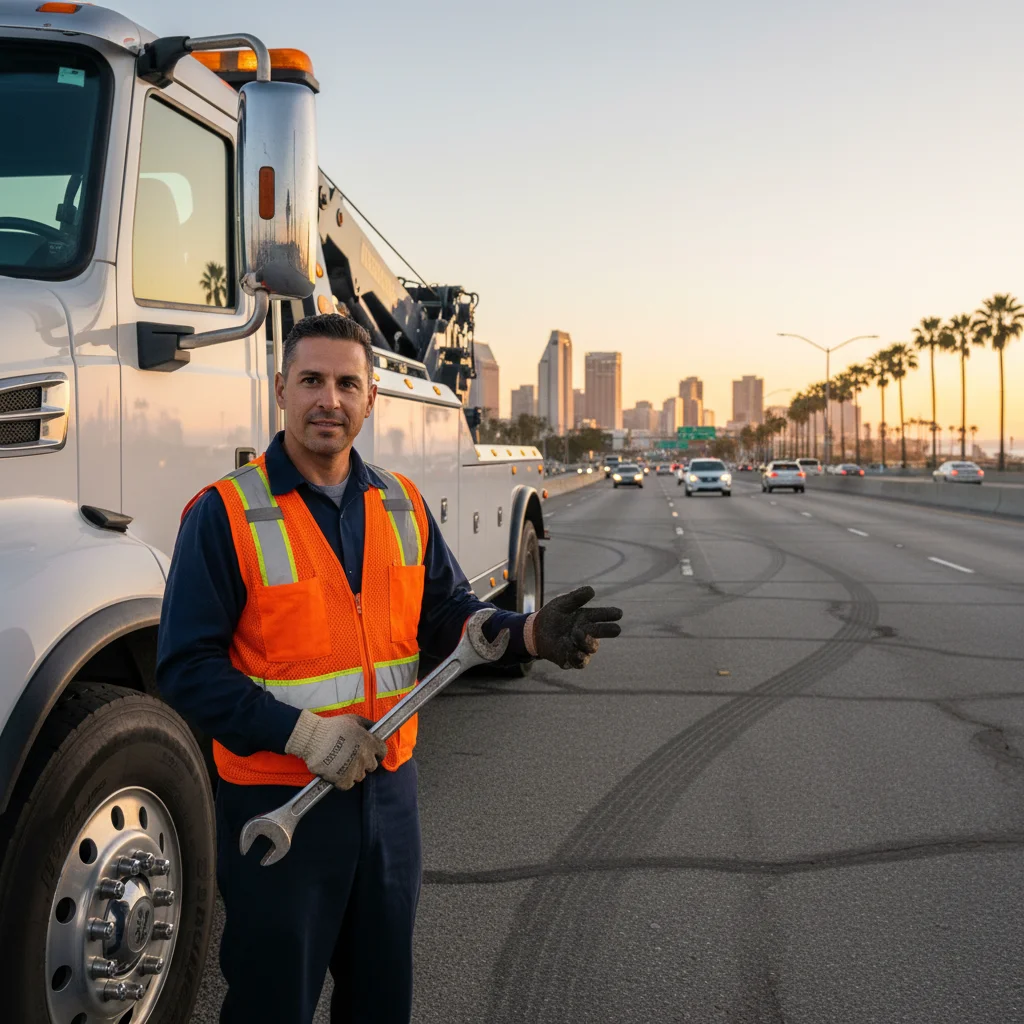
Your engine dies on I-15 near Escondido. A tire blows out on SR-52 in Mission Valley. You’ve locked your keys in your car at a beach parking lot in La Jolla. In moments like these, one thought takes over: “I need a tow truck near me now.” When you’re stranded on the side of a busy San Diego freeway or a quiet suburban street, immediate, reliable help isn’t just convenient, it’s essential for your safety and peace of mind.
Finding that help quickly means knowing what to look for and understanding the local towing landscape. San Diego County is vast. It spans from the bustling border crossings of Otay Mesa to the mountain peaks of Julian, and from the coastal stretch of Camp Pendleton to the desert edges near Borrego Springs. Each area presents its own challenges for drivers and tow operators. This guide helps you navigate those urgent moments and connect with the right service.
When you need a tow truck now in San Diego
A vehicle breakdown or accident often happens without warning. These situations demand immediate attention. Understanding when to call for a tow can save you time, stress, and potential further damage.
You likely need a tow if your vehicle experiences:
- Engine failure: Overheating, knocking sounds, or a sudden loss of power often means serious internal issues. Driving it further risks catastrophic damage.
- Transmission problems: If your car won’t shift gears, slips out of gear, or refuses to move, the transmission is likely failing. Towing is the safest transport.
- Major tire damage: A blowout that shreds the tire, or multiple flat tires, can leave your vehicle immobile. Sometimes a simple tire change isn’t possible or safe on the roadside.
- Brake system failure: Loss of braking power makes your vehicle unsafe to drive. Do not attempt to move it.
- Electrical system issues: A dead battery is often a simple jump start. But if your car won’t start after a jump, or if there are widespread electrical failures, a tow is needed.
- Accident damage: Even minor collisions can cause hidden damage that makes driving unsafe. Always have a professional inspect your vehicle if you’ve been in a crash. For guidance after an accident, see our post on /blog/after-car-accident-san-diego/.
- Vehicle stuck: Whether in sand at Imperial Beach, mud in East County, or a ditch anywhere, a tow truck can provide the recovery power you need.
- Lost keys or immobilizer issues: If you’re locked out and roadside assistance can’t get you in, or if your car’s immobilizer system is preventing it from starting, a tow to a dealership or locksmith may be necessary.
In San Diego, breakdowns can be particularly stressful on our busy freeways like I-5, I-805, and I-8. The speed of traffic and limited shoulder space make waiting for help a high-risk situation. Quick response times are not just a convenience, they’re a safety imperative.
Finding a reliable tow truck near me now
When searching for “tow truck near me now,” you’re looking for more than just proximity. You need a company that is responsive, professional, and equipped for your specific situation.
Here’s what makes a difference:
- 24/7 availability: Breakdowns don’t stick to business hours. A company that operates around the clock ensures you’re never stranded.
- Live dispatch: Automated systems can be frustrating in an emergency. A real person answering your call, understanding your situation, and dispatching the right truck is invaluable.
- Local knowledge: A towing company familiar with San Diego’s geography, traffic patterns, and common breakdown spots can get to you faster. They know the quickest routes around congestion on SR-163 or how to navigate the winding roads of East County.
- Proper licensing and insurance: This protects you, your vehicle, and the tow operator. Always choose a company that is fully compliant with state regulations.
- Transparent pricing: Reputable companies offer clear, upfront pricing without hidden fees or surge charges for nights, weekends, or holidays.
- Appropriate equipment: Not all tow trucks are the same. A company with a diverse fleet can handle everything from a compact car to a heavy-duty RV.
Quick Tow SD meets these standards and works only with licensed, insured operators, providing reliable 24/7 towing and roadside assistance across San Diego County.
Types of tow trucks and why it matters for your vehicle
The kind of tow truck dispatched to your location is a critical detail. Using the wrong type of truck can cause significant damage to your vehicle, especially with modern drivetrains.
Flatbed tow trucks (rollback)
A flatbed tow truck has a hydraulic bed that tilts and slides back, allowing a vehicle to be driven or winched onto it. The entire vehicle rests securely on the flat platform during transport.
- Benefits: This is the safest and most secure method for nearly all vehicles. It eliminates wear and tear on the drivetrain, suspension, and tires.
- When it’s essential:
- All-Wheel Drive (AWD) vehicles: Subaru, Audi, Tesla, Rivian, and many SUVs require flatbed towing. Towing an AWD vehicle with its drive wheels on the ground can severely damage its drivetrain, potentially leading to a $2,500–$5,000 repair bill.
- Electric Vehicles (EVs): EVs like Teslas, Ford Lightnings, or Rivians must be flatbed towed. Their electric motors remain engaged even when powered down or in neutral, and dragging them can cause irreversible damage to the motors and inverter, costing $8,000–$18,000 or more. See our specific guide on /blog/ev-towing-tesla-flatbed/.
- Luxury, exotic, and classic cars: Low-clearance vehicles, expensive sports cars, or delicate classics benefit from the gentle loading and secure transport of a flatbed.
- Motorcycles: Flatbeds provide a stable platform for securing motorcycles upright, preventing falls or damage during transit. For expert motorcycle towing, read our post on /blog/motorcycle-towing-done-right/.
- Accident recovery: Damaged vehicles often cannot be safely towed with a wheel-lift.
- Long-distance towing: Flatbeds offer superior stability and protection for extended journeys.
- San Diego context: With many AWD SUVs in North County and EVs prevalent across the county, flatbed towing is increasingly the standard for safe transport.
Wheel-lift tow trucks
A wheel-lift tow truck uses a metal yoke that hooks under the front or rear wheels of a vehicle, lifting that end off the ground while the other two wheels remain on the road.
- Benefits: Wheel-lifts are compact and agile, making them ideal for tight spaces like parking garages, crowded city streets in downtown San Diego, or residential driveways. They are quicker to hook up for short-distance tows.
- When it’s appropriate:
- Front-Wheel Drive (FWD) or Rear-Wheel Drive (RWD) vehicles: If the non-drive wheels are lifted, a wheel-lift can be used without damaging the drivetrain.
- Short-distance local tows: For quick moves to a nearby repair shop or home.
- Repossessions or private property towing: Their quick hook-up is often preferred in these scenarios.
- When NOT to use it: Never use a wheel-lift for AWD or EV vehicles, as explained above.
Heavy-duty wreckers
Heavy-duty wreckers are large, powerful tow trucks designed to handle commercial trucks, buses, RVs, and other oversized vehicles. They use under-reach and boom attachments to lift and tow heavy loads.
- Benefits: These trucks have the immense power and specialized equipment required for the weight and size of large vehicles. They can perform complex recoveries, such as uprighting overturned trucks.
- When it’s essential:
- Commercial trucks: From semi-trucks on I-8 heading east to the Imperial Valley, to delivery vans in Otay Mesa, heavy-duty wreckers are the only option.
- RVs and motorhomes: Whether you’re stuck near Anza-Borrego Desert State Park or broken down on I-5 heading to Camp Pendleton, these require heavy-duty equipment.
- Buses and heavy construction equipment: Specialized recovery for large machinery.
- San Diego context: The I-8 grade through East County and the commercial corridors near the border often see heavy-duty calls. Quick Tow SD has a full fleet, including these specialized vehicles, ensuring we can handle any vehicle breakdown.
Safety first: what to do while waiting for your tow
Being stranded on the roadside, especially on a busy San Diego freeway, is dangerous. Your safety is the top priority.
- Move to a safe location: If your vehicle is still operational, try to steer it to the furthest right shoulder, an emergency turnout, or ideally, off the freeway entirely at the next exit. If you’re on a two-lane road, pull as far off the road as possible.
- Turn on hazard lights: Make your vehicle as visible as possible, day or night.
- Deploy safety devices: If you have flares, reflective triangles, or cones, place them behind your vehicle to warn approaching traffic.
- Stay inside your vehicle: Unless there’s an immediate fire hazard or you’re in an extremely dangerous spot where exiting to a safer area (like behind a guardrail) is possible. Staying in your car, with your seatbelt on, offers protection from distracted drivers.
- Call 911 if necessary: If you’re involved in an accident, if your vehicle is blocking traffic, or if you feel unsafe, call 911 immediately. The California Highway Patrol (CHP) will respond to freeway incidents. You can find more safety tips from the NHTSA on roadside safety here.
- Provide clear information: When you call Quick Tow SD, give your exact location (freeway name, nearest exit, mile marker, cross street), vehicle make/model, and a clear description of the problem. This helps us dispatch the right truck quickly.
Understanding tow truck costs in San Diego
Towing costs vary. Ask for a clear flat rate on the call, especially when you’re in a stressful situation and least likely to question a bill later.
Here’s what goes into a quote:
- Hook fee (or base rate): This is the initial charge for the tow truck to arrive and hook up your vehicle. It varies by vehicle weight and type, light-duty cars and SUVs cost less to hook than heavy-duty trucks and RVs, which need specialized equipment.
- Mileage rate: This is a per-mile charge for the distance your vehicle is towed. It typically applies after a certain initial mileage (e.g., the first 5-10 miles might be included in the hook fee).
- Special services:
- Winch-out/recovery: If your vehicle is stuck in a ditch, mud, or sand, there may be an additional charge for the time and effort required to extract it before towing.
- After-hours/weekend/holiday: Ask dispatch for your rate when you call, regardless of the time of day.
- Long-distance towing: For trips outside the immediate San Diego area, ask for a written flat quote upfront. You can learn more about long-distance towing costs in our blog post /blog/long-distance-tow-cost/.
- Storage fees: If your vehicle needs to be stored at a tow yard, daily storage fees will apply. Quick Tow SD aims to get your vehicle to its destination promptly to minimize these costs.
Always ask for a clear breakdown of costs before the tow truck arrives. A trustworthy company will provide this information without hesitation. For a more detailed look at towing expenses, check out our article on /blog/tow-cost-san-diego/.
San Diego towing cost factors
| Service Type | Vehicle Type | Pricing | Notes |
|---|---|---|---|
| Standard Local Tow | Car, light SUV | Flat rate, quoted before dispatch | Flatbed often recommended for safety. |
| Motorcycle Tow | Motorcycle | Flat rate, quoted before dispatch | Always flatbed for security. |
| RV/Heavy Truck Tow | RV, commercial truck | Flat rate, quoted before dispatch | Requires heavy-duty wrecker. |
| Winch-out (light) | Car, light SUV | Quoted based on time and effort | For vehicles stuck in minor ditch/mud. |
| Private Property Tow | Unauthorized vehicle | Set by the property/tow company | Subject to CVC 22658 regulations, paid by vehicle owner. |
Note: Ask dispatch for a written flat-rate quote before the truck is sent. Actual costs depend on specific circumstances, distance, and recovery complexity.
San Diego’s unique towing landscape
Towing in San Diego isn’t just about showing up with a truck. It requires an understanding of the region’s diverse geography, traffic patterns, and local regulations. Quick Tow SD operates in 67 cities and communities across San Diego County, giving us unparalleled local expertise.
Freeway challenges and breakdown hotspots
San Diego’s extensive freeway system is the backbone of our transportation. It’s also where many breakdowns occur.
- I-5 (Coastal Freeway): Runs north-south along the coast. Heavy commuter traffic, especially around downtown, La Jolla, and Del Mar. The 20-mile stretch between Oceanside and San Clemente, through Camp Pendleton, can feel isolated for military families needing POV breakdown response.
- I-15 (Inland North-South): A major commuter corridor connecting North County Inland cities like Escondido, San Marcos, and Poway to downtown. Hot summer days here often lead to overheating vehicles.
- I-8 (East-West Grade): Ascends into East County and continues east towards the desert. The long, steep grades near Alpine and Pine Valley eat engines and transmissions, making it a common spot for heavy-duty calls.
- SR-163, SR-52, SR-56: Connectors and cross-county routes with high traffic density, especially during rush hour. Limited shoulders can make breakdowns particularly hazardous.
- I-805 (Border Corridor): Runs parallel to I-5, especially busy through South Bay cities like Chula Vista and National City, and towards the Otay Mesa commercial truck terminals.
- SR-94, SR-78: Important east-west routes. SR-78 connects Oceanside, Vista, San Marcos, and Escondido in North County.
When you’re stuck on one of these, quick dispatch and local knowledge are essential. The drivers we send know these roads intimately. For more on freeway breakdowns, check out /blog/freeway-breakdown-san-diego/.
Regional towing needs
Different parts of San Diego County present distinct towing scenarios:
- Coastal Cities (La Jolla, Del Mar, Encinitas, Carlsbad, Ocean Beach, Pacific Beach, Coronado): Beach parking lots see spikes in lockouts during summer. Driving on Pacific Coast Highway (PCH) shoulders can be dangerous due to narrow lanes and high speeds. Many residents here drive luxury vehicles or EVs, requiring careful flatbed towing.
- North County Inland (San Marcos, Escondido, Vista, Poway): This I-15 commuter corridor experiences frequent breakdowns, especially during hot weather. Overheating is a common issue.
- East County (El Cajon, La Mesa, Santee, Lakeside, Alpine): The I-8 grade through this region stresses engines. Canyon roads like Crestwood and Sunrise Highway are popular for motorcycles, but also where accidents or mechanical failures can leave riders stranded.
- South Bay (Chula Vista, National City, Imperial Beach): The I-5/I-805 border corridor is busy with both passenger vehicles and commercial trucks. The Otay Mesa area is a hub for commercial truck terminals, requiring specialized heavy-duty services.
- Mountain Areas (Julian, Pine Valley, Ramona, Mt Laguna, Borrego Springs): These more remote areas take considerably longer to reach than the urban core. Winter months on Sunrise Highway (SR-79/S1) often require chains, and drivers can get stuck in snow or ice.
- Camp Pendleton Corridor: The 20-mile stretch of I-5 through Camp Pendleton is a common spot for military families in private vehicles (POVs) to experience breakdowns. Quick Tow SD provides responsive service to this crucial area.
Vehicle specifics in San Diego
San Diego’s diverse population drives a wide range of vehicles. We commonly see:
- AWD vehicles: Subarus, Audis, Teslas, and many SUVs are popular here. As noted, these MUST go on a flatbed to prevent drivetrain damage.
- EVs: Tesla, Rivian, Ford, Hyundai, and other EVs are increasingly common. These MUST go on a flatbed to protect their electric motors and inverters.
- RVs: Many San Diegans own RVs for trips to the desert or mountains. These require heavy-duty towing.
Quick Tow SD ensures the right truck is sent for your specific vehicle type.
Navigating private property towing and accident recovery
Beyond standard breakdowns, San Diego towing companies also handle specific situations governed by state law.
Private property towing (California Vehicle Code 22658)
If your vehicle is illegally parked on private property, it may be towed. This is governed by California Vehicle Code (CVC) 22658. This code outlines specific requirements for property owners and towing companies, including:
- Signage: Clear signage must be posted indicating private property and towing enforcement.
- No general waiting period: CVC 22658 sets no waiting period. The one-hour rule people cite is CVC 22953, it covers only lots held open to the public for free parking, and it expressly exempts residential parking.
- Release rules: Tow companies must release a vehicle immediately if the owner arrives before it’s off the property, for a reduced “drop fee.”
- Notification: The towing company must notify local law enforcement within a certain timeframe.
Quick Tow SD is fully compliant with CVC 22658 when performing private property tows. For more details, refer to the official California Vehicle Code here or our blog post /blog/cvc-22658-private-property-towing/.
Accident recovery and CHP rotation
When an accident occurs on a freeway or public road, the California Highway Patrol (CHP) often manages the scene. They operate a CHP-rotation system, where tow companies are assigned calls on a rotating basis. This ensures fair distribution of work and quick response.
Quick Tow SD participates in this rotation, meaning we are regularly dispatched by CHP to accident scenes across San Diego County. The drivers we send are experienced in accident recovery, working safely and efficiently under the direction of law enforcement.
Quick Tow SD: your local San Diego partner
When you’re searching for “tow truck near me now” in San Diego, you need a partner you can trust. Quick Tow SD is that partner. We are committed to providing prompt, professional, and reliable towing and roadside assistance across the entire county.
- Calls taken 24/7: The line takes calls at any hour and routes your emergency to the operator covering your zone.
- Countywide Coverage: From coastal communities to the mountains, from North County to the South Bay, we serve all 67 cities and communities in San Diego County.
- Diverse Fleet: We operate a full range of flatbed, wheel-lift, and heavy-duty wreckers, ensuring we have the right equipment for any vehicle, any situation.
- Experienced Drivers: Our team consists of skilled, experienced operators who prioritize your safety and your vehicle’s integrity.
- Transparent Pricing: Flat-rate pricing, quoted before we dispatch.
Our services extend beyond just towing. We also offer:
- /services/roadside-assistance/ (jump starts, tire changes, fuel delivery, lockouts)
- /services/junk-car-removal/
- /services/exotic-classic-towing/
- And many more specialized towing options.
When your vehicle gives out, don’t just search for “tow truck near me now.” Search for reliability, expertise, and local knowledge.
Frequently asked questions
How long does a tow truck take to arrive in San Diego?
For standard calls across San Diego County, arrival time depends on where you are and what is on the road. More remote areas like the mountains and backcountry take considerably longer because of travel distance and road conditions. We prioritize quick dispatch.
What payment methods do you accept?
Quick Tow SD accepts all major credit cards (Visa, MasterCard, American Express, Discover) and cash. We can also work with your insurance provider or roadside assistance club, though payment is typically due at the time of service.
Do you tow electric vehicles or AWD cars?
Yes, absolutely. We specialize in towing electric vehicles (EVs) and All-Wheel Drive (AWD) cars. For these vehicles, we always dispatch a flatbed tow truck to ensure safe transport and prevent any damage to their sensitive drivetrains or electric motors.
Can you tow my car if I don’t have keys?
Yes, we can tow your car even if you do not have the keys. Our professional operators are equipped to load vehicles safely onto a flatbed truck without needing access to the ignition. We can transport it to a dealership, locksmith, or your preferred location.
What if I need a tow after an accident?
If you’re involved in an accident in San Diego, first ensure your safety and call 911 if necessary. If the CHP is on scene, they may dispatch a tow company from their rotation, which could be Quick Tow SD. If not, you can call us directly for accident recovery.
When you need a tow truck near me now in San Diego, trust the local experts who understand the roads, the vehicles, and the urgency of your situation. For fast, reliable, and professional emergency towing and roadside assistance, call Quick Tow SD anytime, day or night.
Call Quick Tow SD at (858) 923-5787 or visit our /services/emergency-towing/ page for immediate help.