A tow truck in Sorrento Valley needs a precise pickup type first. A freeway shoulder, interchange ramp, office lot, and parking structure require different access details. Before dispatch, identify exactly where the disabled vehicle stopped.
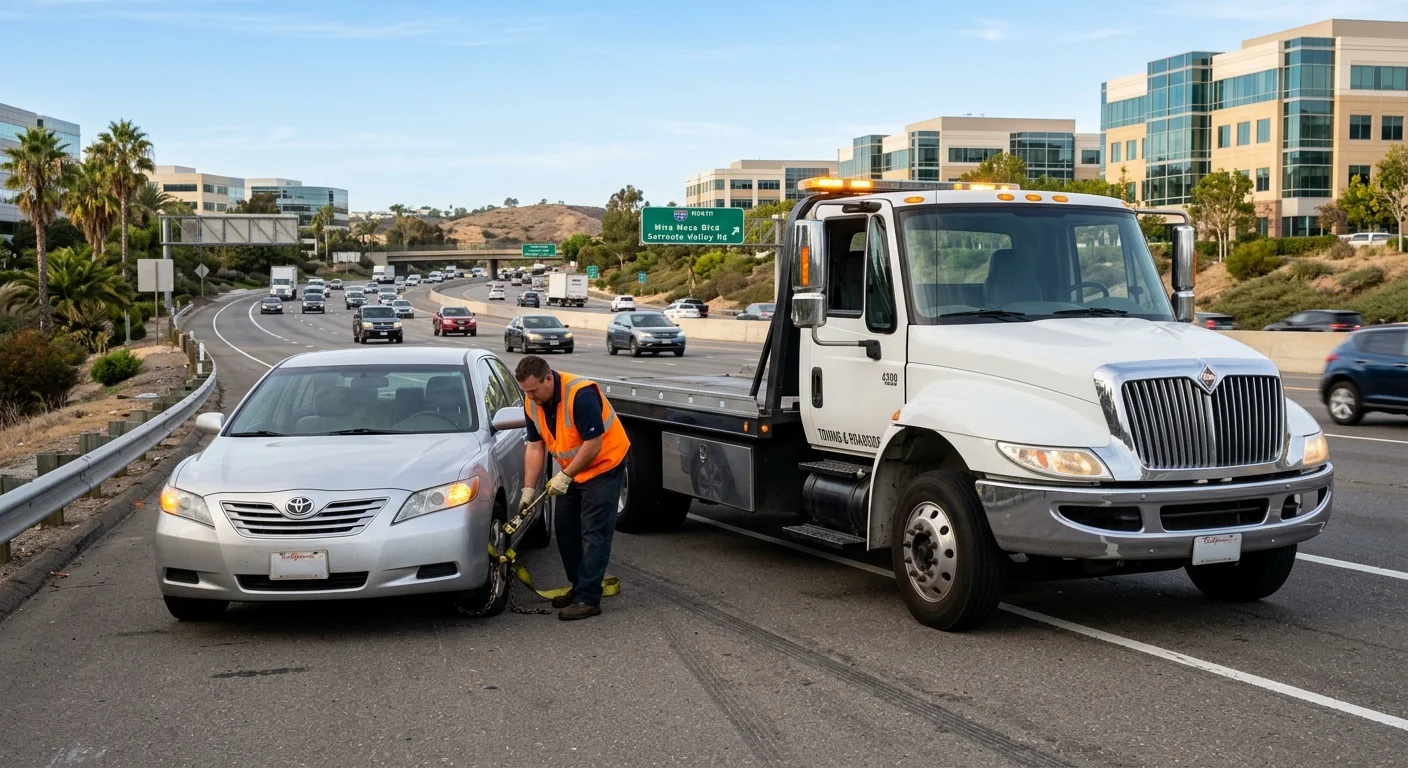
Start with the exact Sorrento Valley pickup point
Start with the road, direction, nearest cross street, and pickup setting. “Sorrento Valley” alone covers several access patterns around I-5, I-805, Mira Mesa Boulevard, Sorrento Valley Road, and Vista Sorrento Parkway.
For a freeway call, say which freeway and direction you were traveling. Identify whether the vehicle is before or after the I-5 and I-805 split. Include the last exit, visible sign, and whether you’re on a shoulder or ramp. A dropped map pin helps, but pair it with those details.
For an office park, provide the property name shown at the entrance. Add the building address, suite area, lot level, or parking row. Tell dispatch about a gate, security desk, loading entrance, or posted garage clearance. If your phone’s location marker lands on a nearby road, explain where the vehicle actually sits.
Sorrento Valley Road and Vista Sorrento Parkway run close in places. A vague pickup description can point toward the wrong approach. Roselle Street also reaches parking areas near freeway access and the rail corridor. Naming the entrance you used gives the dispatched operator a clearer route.
Include your vehicle’s color, make, model, and visible condition. Mention if it won’t start, won’t roll, has collision damage, or has a damaged wheel. Those details help us connect you with a local operator suited to the call.
What changes near the I-5 and I-805 interchange
The I-5 and I-805 interchange creates an important location problem. A map pin near the split doesn’t always show which roadway holds the vehicle. The operator needs your travel direction and exact road position.
Say “northbound I-5,” “southbound I-805,” or the specific transition ramp. Don’t describe the location only as “near Mira Mesa Boulevard.” That road connects with the freeway network from several directions, so the phrase leaves too much uncertainty.
Traffic conditions can also affect how a freeway scene is handled. If law enforcement or emergency personnel are present, follow their directions. Tell dispatch which agency vehicles you can see and whether anyone has already arranged a tow. That helps prevent duplicate requests.
Your safety comes before the tow. The National Highway Traffic Safety Administration recommends moving over for stopped vehicles with warning lights. When moving over isn’t safe, drivers should slow down. That guidance matters around the interchange, where lanes merge and separate quickly.
Don’t describe a freeway shoulder as an office-park pickup because a building appears nearby. The tow request should reflect where the vehicle physically stopped. If the vehicle reaches a surface street or parking lot before you call, share the new location rather than the original breakdown point.
Our emergency towing referral service connects stranded drivers with independent local operators. The operator taking the job provides an arrival estimate for your exact position. Quick Tow SD doesn’t publish a blanket response time for the interchange.
How an office-park pickup differs from a freeway call
An office-park pickup usually offers more time to confirm access details. It can still become complicated when the vehicle is behind a gate, inside a garage, or parked far from the street address.
Look for the exact building number and the entrance nearest your vehicle. If the property has several driveways, say which one you used. A nearby street name or visible entrance sign can make the pickup easier to locate.
Parking structures need extra detail. Read the posted clearance at the entrance and provide the level where the vehicle sits. Mention tight turns, steep ramps, low overhead fixtures, or a space against a wall. Don’t guess the clearance. Use the number posted on the property.
Tell security or property staff that an operator is being dispatched if they control entry. Ask where the vehicle should be met and whether a service entrance is required. These aren’t universal rules for Sorrento Valley properties. Each office campus controls its own access, so confirm the process onsite.
Vehicle condition matters here too. State whether the steering works, the wheels turn, and the keys are available. Report a damaged tire, suspension problem, leaking fluid, or collision damage without trying to diagnose it yourself. Photos can help the operator understand the space and vehicle position.
A surface lot usually differs from a garage because overhead clearance isn’t the main issue. Gates, medians, reserved lanes, and building access may still shape the approach. Accurate details let the operator evaluate the pickup before reaching the property.
When roadside help may avoid a tow
Some breakdowns don’t require vehicle transport. A discharged battery, empty fuel tank, or changeable flat tire may be resolved where the vehicle sits. Our roadside assistance service can connect you with a local operator who evaluates the problem.
Share what happened before the vehicle stopped. Tell dispatch whether the engine cranks, warning lights appeared, the tire left the rim, or the car lost steering. Don’t keep driving a vehicle with collision damage or a serious mechanical problem just to avoid a tow.
Free help may also be available on eligible San Diego freeway segments. The Freeway Service Patrol is operated by SANDAG with Caltrans and the California Highway Patrol. Its published services include a jump start, one gallon of gas, radiator water, and a flat tire change.
Coverage depends on the segment, time, and operating schedule. The service isn’t available on federal holidays. Confirm current coverage through official Freeway Service Patrol information or the California Highway Patrol before relying on it.
Roadside assistance won’t solve every breakdown. A vehicle that can’t roll safely, repeatedly stalls, or has wheel, steering, or collision damage may need transport. The operator can assess the condition and discuss the appropriate next step.
For more freeway-specific preparation, read our guide to a freeway breakdown in San Diego. It explains what information helps when your vehicle stops beside moving traffic.
What to confirm before dispatch
Give dispatch six clear facts: exact location, travel direction, pickup setting, vehicle description, vehicle condition, and destination. For Sorrento Valley towing, those details matter more than a broad neighborhood name.
Confirm whether the vehicle is on I-5, I-805, a transition ramp, or a surface street. For an office park, provide the full address and entrance. For a garage, add its posted clearance and parking level. If access requires help from property staff, arrange that before the operator arrives.
Describe the vehicle accurately. Include its make, model, color, and approximate position. Mention missing keys, locked steering, damaged wheels, collision damage, or anything blocking access. Don’t move loose parts or work beneath the vehicle.
Choose a destination before dispatch when possible. Confirm that the repair shop, dealership, home, or other destination is correct. If another person will receive the vehicle, share their contact details directly with the operator.
Ask the independent operator to explain the current price and what could change it. Quick Tow SD doesn’t publish its own towing rate card. The operator performs the work, sets the price, and receives payment directly from the customer.
Also ask for the operator’s arrival estimate for your exact location. That estimate comes from the operator handling the call. It isn’t a guaranteed Sorrento Valley response window.
Quick Tow SD is a referral brand. We connect customers with vetted, licensed and insured independent operators serving every city in San Diego County. We don’t own tow trucks or operate an impound yard.
When to call us
Call when your vehicle can’t be driven safely, needs transport, or sits in a location requiring professional handling. Quick Tow SD will connect you with a local towing operator based on the pickup details you provide. Call (858) 923-5787 to reach dispatch.