A disabled car in Del Mar can create very different pickup conditions. An I-5 shoulder, Camino Del Mar, and fairgrounds parking each need different details. Quick Tow SD connects stranded drivers with independent local towing operators.
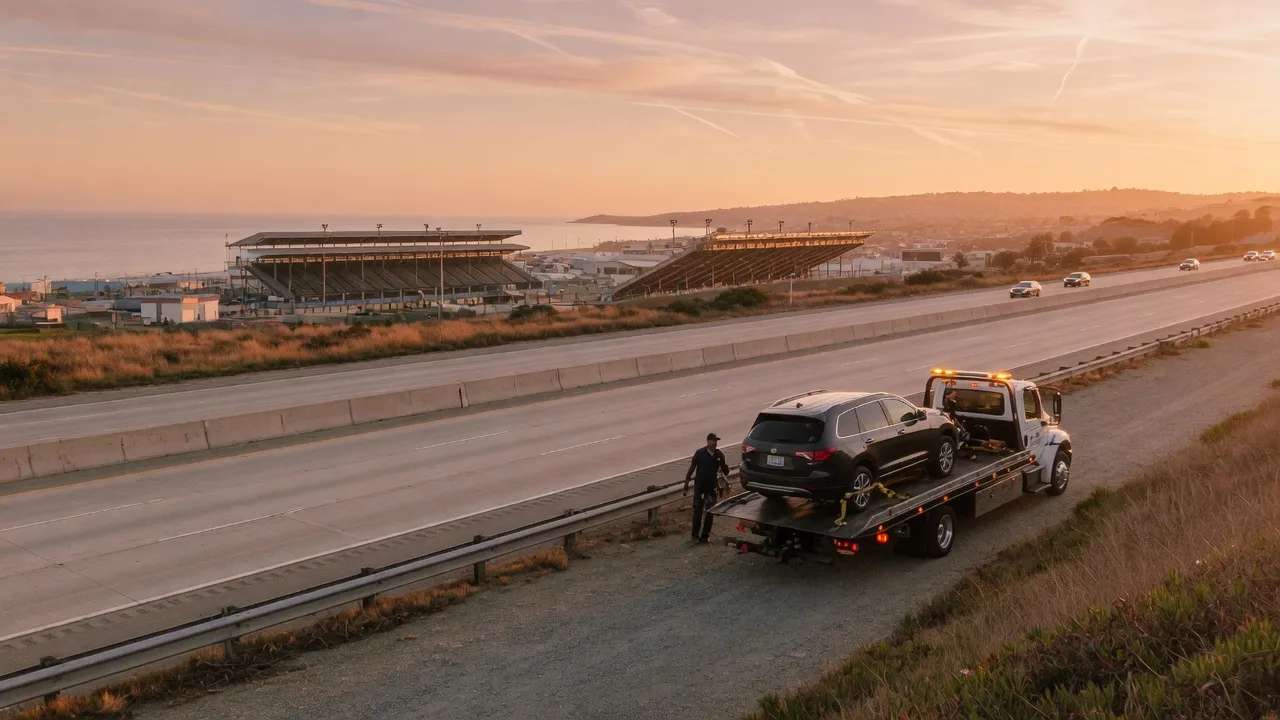
Share whether you are on I-5, Camino Del Mar, or a side street
Start with the road name and your exact position. “Del Mar” alone doesn’t tell dispatch whether you’re on I-5, Camino Del Mar, Via de la Valle, or a neighborhood street. A dropped map pin can help when nearby addresses aren’t visible.
On I-5, share your direction of travel and the nearest exit. Say whether you’re on the shoulder, an off-ramp, or beyond the freeway. Don’t cross traffic lanes to inspect the car. If there’s an injury, fire, collision hazard, or immediate danger, call 911.
For Camino Del Mar, provide the nearest cross street or visible business. Also explain whether the car blocks a travel lane, driveway, or parking entrance. Side streets can present another issue: the operator may need to know which direction offers practical access.
Tell dispatch whether the wheels roll and steer. Mention visible collision damage, a missing wheel, or leaking fluid. Don’t try to identify the mechanical failure yourself. Describe what happened and what you can see.
The vehicle description matters too. Give its year, make, model, drivetrain if known, and current position. Mention modifications or unusually low ground clearance. Those facts help the operator accepting the request choose suitable equipment.
Quick Tow SD’s emergency towing connection is for drivers who need professional vehicle transport. The operator sets the price and provides an arrival estimate for the specific pickup.
What changes during fairgrounds or racetrack events
A request near the Del Mar Fairgrounds needs more detail than “near the track.” Tell dispatch whether the vehicle is on Via de la Valle, in a parking area, or on an access road. Include a parking section, entrance, gate, or nearby sign when one is visible.
Event traffic can affect how an operator reaches you. Parking controls may also change during a fairgrounds or racetrack event. Quick Tow SD can’t promise access to a particular lot or pickup point. The accepting operator must confirm where the driver can enter and meet you.
If event staff direct vehicles inside the property, follow their instructions. Ask where a service vehicle may enter. Then pass that location to dispatch. Don’t assume the public entrance you used remains open for an incoming tow truck.
A vehicle in a structured or covered parking area needs extra measurements. Share the posted height limit and parking level. Mention tight turns, ramps, pillars, or a blocked exit. If the car sits in a marked space, say which side is accessible.
Private-property parking also differs from a driver-requested roadside tow. If someone else ordered the removal, contact the property representative or the towing company named on posted information. Quick Tow SD doesn’t operate an impound lot or release vehicles held elsewhere.
For a tow you request, confirm the meeting point before leaving the car. Keep your phone available for updates from the operator. Availability, equipment, event access, and the final pickup position must be confirmed for that specific job.
When roadside assistance may fit
Roadside help may fit when the vehicle can safely remain where it stopped. Common requests include a jump start, tire change, fuel delivery, or lockout help. Describe the symptom without claiming a diagnosis. A car that clicks may have a different problem than expected.
Check the surroundings before requesting roadside assistance in Del Mar. A parking space offers different working room than an I-5 shoulder. Tell dispatch how close the vehicle sits to moving traffic. Mention whether the driver can reach the affected side safely.
Don’t attempt a tire change beside fast traffic. Don’t stand between vehicles or behind an exposed car. The NHTSA roadside safety guidance is a useful reference for preparing and responding to roadside problems. Immediate roadway hazards belong with emergency authorities.
San Diego County’s Freeway Service Patrol may offer free help on covered freeway segments during its operating hours. SANDAG says that help can include a gallon of gas, a jump start, radiator water, or a flat tire change. Call 511 and say “Roadside Assistance” to request it. Coverage isn’t available on federal holidays, and service varies by segment and schedule.
Roadside service isn’t always enough. The operator may find that the car needs transport after seeing it. Ask what happens if the requested service doesn’t get the vehicle moving. Confirm any price and next step before authorizing additional work.
When arranging a tow makes more sense
Arrange a tow when the vehicle can’t be driven safely to its destination. That includes visible collision damage, steering trouble, a wheel that won’t roll, or a condition that roadside service can’t resolve. Don’t drive merely to clear the space if the vehicle feels unsafe.
A tow may also be the clearer choice when the destination matters immediately. You might need the car moved to a repair shop, dealership, home, or another authorized location. Confirm that destination before the operator begins loading. Make sure someone can receive the vehicle if required.
Tell dispatch what happened just before the car stopped. Warning lights, smoke, an impact, or a sudden loss of steering are useful observations. They aren’t a diagnosis. They help the accepting operator understand the pickup conditions.
If the vehicle was in a collision, emergency authorities may control the scene. Follow their directions and don’t enter an active traffic area. Quick Tow SD doesn’t promise accident-scene access or authority over a police-directed tow.
Del Mar sits between other coastal service areas, but each request stays location-specific. Our Encinitas I-5 and Coast Highway guide covers the corridor farther north. The Carlsbad tow truck guide addresses another North County setting. Neither replaces exact Del Mar pickup details.
Quick Tow SD refers the request to an independent licensed operator. The operator performs the work, sets the price, and receives payment directly.
Confirm access, clearance, and the destination
A clear dispatch request begins with three facts: access, vehicle condition, and destination. Describe where a tow truck can approach the car. A map pin helps, but it doesn’t show a locked gate, narrow driveway, parking structure, or temporary event barrier.
Give the posted clearance for any covered area. Don’t estimate it from memory. Mention the parking level, ramp direction, and whether another vehicle blocks access. If you have a lowered car, roof equipment, trailer, or attached load, disclose it before the operator accepts the job.
Explain the wheel position and surrounding space. Say whether the vehicle is against a curb, facing downhill, or parked nose-first near a wall. Mention locked wheels, missing keys, or a parking brake that won’t release. These details may change the equipment required.
Then provide the full destination address. A repair shop name isn’t enough when businesses have multiple locations. Confirm that the location will accept the vehicle. If it’s closed, ask where the operator may leave the car and keys. Don’t assume unattended delivery is allowed.
Before authorizing service, confirm the operator’s name, quoted price, payment terms, destination, and arrival estimate. Ask whether the quote covers the situation you described. Report any change in location or vehicle condition promptly.
The phone line takes calls around the clock, but provider availability isn’t guaranteed. Quick Tow SD doesn’t own tow trucks or a storage yard. We match callers with operators serving Del Mar and every city in San Diego County.
When to call us
Call when the vehicle can’t be moved safely, roadside help won’t solve the problem, or access requires professional towing equipment. Quick Tow SD will connect your request with an independent local operator, who confirms the job details directly. Call (858) 923-5787 to reach dispatch.