Mission Valley isn’t one road, it’s a knot of five of them stacked over a flood channel, and where exactly your car dies here changes what happens next more than almost anywhere else in the county.
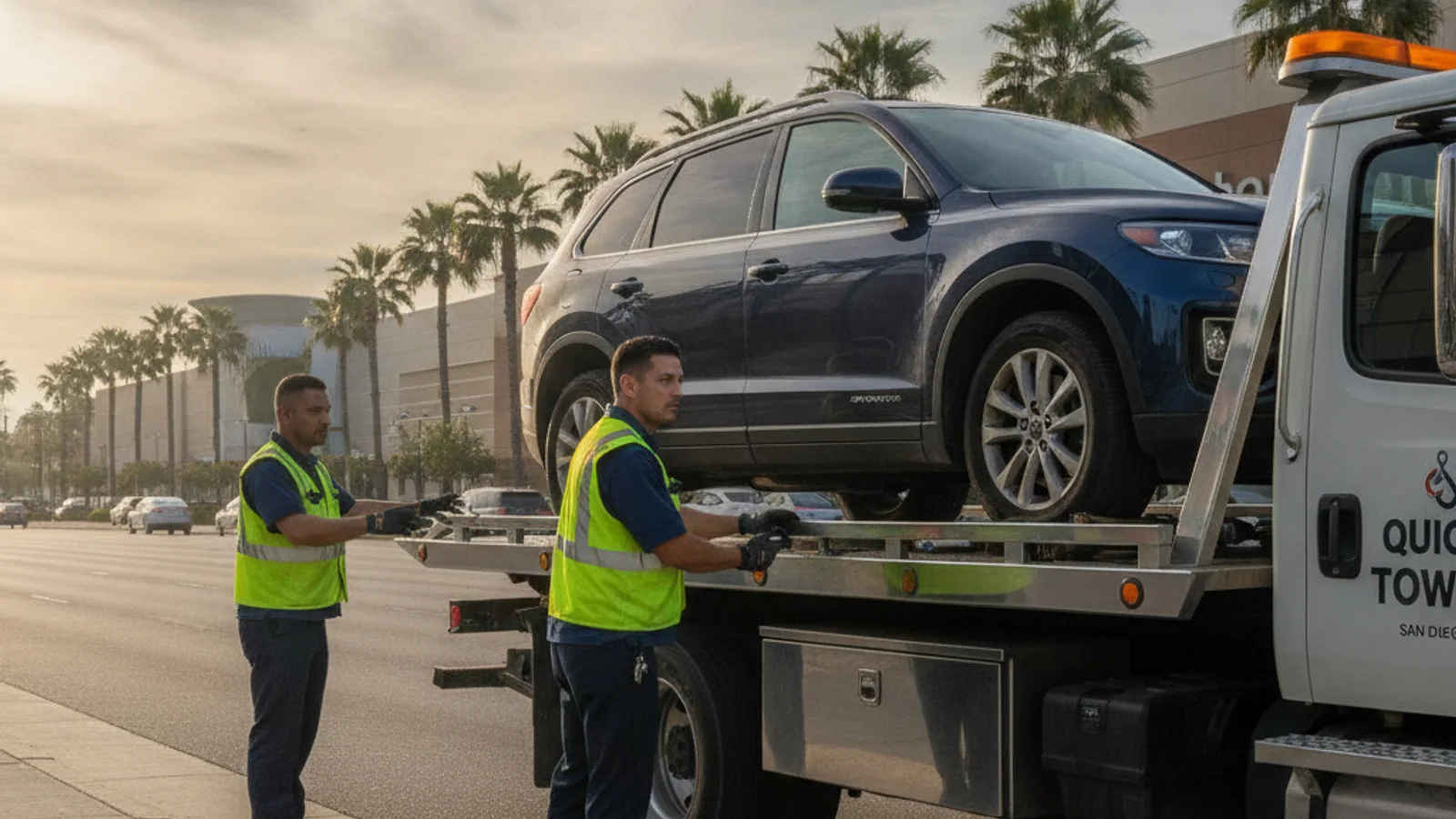
A freeway interchange unlike the rest of the county
I-8, I-805, I-15, and SR-163 all meet in and around Mission Valley, which means a breakdown here is rarely a simple pull-to-the-shoulder job. Depending on which stack or connector ramp a car dies on, the shoulder might be a few feet wide against a concrete wall, or nonexistent. Friars Road and Camino del Rio North and South run the length of the valley floor below the freeway stack and carry their own steady traffic, including drivers cutting between the interchange and the retail corridor. A car stalled on a connector ramp needs a different approach than one stalled on Friars Road at a signal, and telling dispatch exactly which one you’re on, not just “Mission Valley,” changes how fast an operator can find you.
The parking structure clearance problem
Fashion Valley and Westfield Mission Valley both run multi-level parking structures with posted clearance limits, and taller vehicles, SUVs with roof racks, work vans, and larger trucks, occasionally misjudge a low level and get stuck under a beam or a height bar. A car that simply won’t start on an upper deck is a more ordinary job, but access still matters: tight turning radii, low ceilings, and support columns close to parking spaces mean a standard flatbed often can’t get near the vehicle at all. A wheel-lift tow truck is usually the right equipment for a parking structure recovery, since it can maneuver in tighter spaces than a full flatbed needs. Our guide to parking garage towing in San Diego covers how that equipment choice and the extraction process work in more detail; this post is about Mission Valley specifically, not garages generally.
Event-day traffic changes access, not just volume
Snapdragon Stadium sits right in the middle of this corridor, and on a game day or concert night, the surface streets around it, plus the Friars Road and Camino del Rio approaches, can lock up for an hour or more before and after an event. That’s not just slower traffic, it’s a real access problem: an operator who could normally reach a stalled car on Friars Road in a direct line may need to route around closed lanes, rerouted traffic control, or a packed parking structure entrance. If your breakdown happens near the stadium on an event day, mention that when you call, since it changes which streets are realistically open to a tow truck at that hour.
The trolley line and the valley floor
The Green Line trolley runs the length of Mission Valley, generally along the river corridor, and its stations and crossings add another layer to how traffic moves through the area, particularly near the transit stops close to the malls and hotel row. A car that breaks down near a trolley crossing needs to clear the tracks safely, which is a different priority than simply getting out of a traffic lane. If a vehicle is disabled at or near a trolley crossing, treat it like blocking any active rail line: get clear of the tracks first if it’s safe to do so, then call for help.
The flood channel and the valley’s flood history
Mission Valley sits on the floodplain of the San Diego River, and the channel running through it has a real flood history, low-lying parking areas and access roads near the river have flooded during heavy storms in past years. That matters for towing in two ways: some of the lower-lying lots and access points near the channel can flood or hold standing water after rain in a way that higher ground in the same neighborhood won’t, and a vehicle stalled in one of those low spots during or after a storm needs to be treated differently than a normal stall, since water and an electrical system don’t mix safely. If your car stalls in a low spot near the river channel during wet weather, don’t try to restart it repeatedly; get clear of the vehicle if water is rising and call for help once you’re safe.
Hotel row and why cross streets matter here
The hotel corridor along the valley floor near the malls sees a steady stream of visitor traffic unfamiliar with the local interchange, and a rental or unfamiliar car breaking down here often can’t tell dispatch much more than a hotel name. Cross streets, Camino del Rio North versus South, the specific mall parking level, or the nearest freeway exit sign, help an operator find the vehicle far faster than a hotel name alone, especially with the interchange stacking multiple roads within a short distance of each other.
The freeway shoulder versus the surface street decision
A stall on the I-8 or I-15 stack itself is a different priority than one on Friars Road at a red light, even though both sit inside Mission Valley. On the elevated freeway segments, a narrow or nonexistent shoulder means staying with the vehicle can be more dangerous than getting clear of it, especially near the interchange where lanes merge and split within a short distance. On a surface street like Friars Road or Camino del Rio, there’s usually room to pull into a driveway, a parking lot entrance, or at minimum onto a wider shoulder, which changes both the safety calculation and how an operator plans the approach. If you’re not sure whether you’re technically on the freeway or on a connector ramp that feeds it, look for the nearest exit sign or mile marker and read it to dispatch, since Mission Valley’s ramps can look similar to a surface road from inside the car. For the general safety sequence on any San Diego freeway shoulder, see what to do if your car breaks down on the freeway.
Why this isn’t the same job as a suburban breakdown
A car that dies in a quiet residential neighborhood usually has a straightforward path: pull over, wait, get towed. Mission Valley strips that simplicity away because so much of the area is built vertically, stacked freeways, multi-level parking, an elevated trolley line, over a river channel at the bottom. An operator working this corridor needs to think in three dimensions: which level of the structure, which stack of the interchange, which side of the channel, not just which street. That’s also why a description like “I’m near the mall” undersells how much detail actually helps here compared with a flatter part of the county.
When to call us
A breakdown in Mission Valley’s interchange, a stuck vehicle in a mall parking structure, or a stall near the river channel each call for a slightly different approach, and telling dispatch exactly where you are, which freeway, which mall level, which side of the valley, gets the right equipment moving. Call (858) 923-5787 to reach dispatch.