If you’re deciding whether to tow a car with another car, start with the disabled vehicle. A private parking lot isn’t the same as I-5, I-805, or an East County grade. When its condition or transport instructions are unclear, call a tow truck.
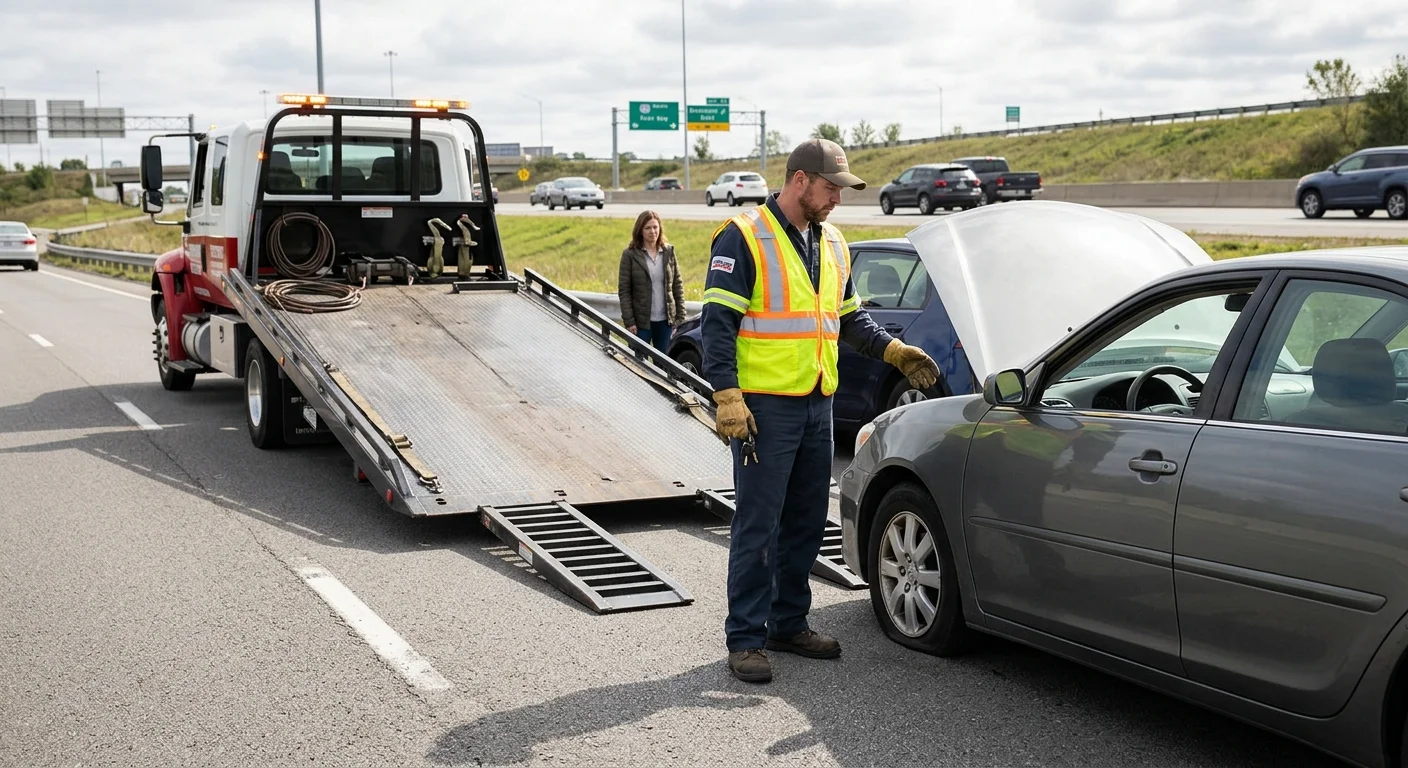
Start with the disabled car’s condition
Before considering any move, identify what failed and what still works. A dead battery differs from collision damage, a broken wheel, or failed steering.
Start with the basic condition of the car. Can it roll, steer, and stop as designed? Are its wheels and tires intact? Is there visible damage, smoke, leaking fluid, or contact between a tire and the body? If you can’t confirm an answer, don’t test the car by dragging it.
Keys matter too. The operator needs to know whether a key or working fob is present. That detail can affect access to the steering, controls, and manufacturer transport settings. Our guide to towing a car without keys explains what information helps before pickup.
The powertrain also changes the decision. Tell dispatch whether the car is front-wheel drive, rear-wheel drive, all-wheel drive, hybrid, or electric. If you don’t know, provide the year, make, model, and trim.
Damaged electric and hybrid vehicles need special attention. Ford’s guidance for damaged high-voltage vehicles recommends contacting an authorized service center or manufacturer representative. Manufacturer procedures vary, so one vehicle’s instructions shouldn’t be applied to another.
When damage, controls, or wheel movement remain uncertain, a roadside experiment adds more unknowns. A professional operator can review the vehicle’s condition and select appropriate transport equipment.
Why roads and distance change the decision
Distance isn’t the only concern. The route determines how much traffic, turning, braking, and lane movement the vehicles would encounter.
Moving a car within closed private property is one situation. Entering a public road is another. Even a nearby destination may involve intersections, slopes, narrow lanes, or freeway traffic. Those conditions leave little margin when one vehicle can’t operate normally.
San Diego routes can change quickly. I-8 climbs east from the urban core toward steeper inland terrain. SR-94 combines freeway traffic with winding East County sections. I-5 and I-805 carry fast traffic through long interchanges. Coastal streets may be crowded, while older central neighborhoods often have tight parking and limited curb space.
The pickup location matters as much as the destination. A car inside a downtown garage presents different access limits from one beside SR-67. A vehicle near San Ysidro may face dense traffic and constrained shoulders. A breakdown on private property in Chula Vista may offer more room, but the exit route still needs review.
California’s Move Over law covers stationary tow trucks displaying amber warning lights. Approaching drivers must change from the adjacent lane when practical, or slow to a reasonable and prudent speed.
If the trip requires public roads, grades, freeway lanes, or busy intersections, emergency towing keeps the decision with an equipped operator.
Vehicle and equipment limits to verify
Vehicle limits come from the manufacturer, not a general towing rule. Don’t treat a pickup’s trailer rating as blanket approval to pull a disabled car.
Read the transport or towing section for the exact model and year. Look for guidance about which wheels may remain on the road, required vehicle modes, and any speed or distance restrictions. If the manual doesn’t address the planned move, contact the manufacturer or an authorized service center.
The disabled car’s manual isn’t the only source to check. The assisting vehicle also has limits. Its manual may distinguish between pulling a trailer, recovering a stuck vehicle, and transporting another road vehicle. Those activities aren’t interchangeable simply because the vehicle has a hitch.
Electric vehicles show why model-specific guidance matters. Tesla’s Model 3 instructions contain detailed conditions for transport when a flatbed isn’t available. They address wheel support, vehicle direction, Tow Mode, and transport limits. Those instructions apply to that model and shouldn’t become a general rule for other cars.
Don’t improvise with rope, chain, a recovery strap, a bumper, or an unknown attachment point. This guide doesn’t provide attachment or braking instructions because those steps depend on verified equipment, vehicle design, and operator training.
When the manual calls for all-wheel support, ask dispatch about flatbed towing. If you’re comparing professional equipment, read our flatbed versus wheel-lift guide before the operator arrives.
When a professional tow is the safer choice
Call a professional when the disabled car can’t roll, steer, or stop normally. The same applies after a collision, wheel failure, steering problem, or visible fluid leak.
Professional transport is also the clearer choice when the vehicle has no keys, sits off pavement, or has uncertain manufacturer restrictions. Freeway shoulders, blind curves, parking structures, and steep roads create access questions that dispatch should hear before assigning equipment.
A tow truck doesn’t automatically mean a flatbed. The operator may consider a flatbed, wheel lift, dollies, or recovery equipment after reviewing the vehicle and pickup site. The correct setup depends on the car, its condition, and the manufacturer’s guidance.
Quick Tow SD is a referral service. We connect customers with independent licensed and insured operators throughout San Diego County. The operator performs the work, selects the transport method, sets the price, and receives payment directly.
Our phone line for 24/7 emergency towing takes calls around the clock. The operator taking the job provides an arrival estimate for the exact pickup location. Mountain, backcountry, and Camp Pendleton corridor addresses can take considerably longer to reach than the urban core.
NHTSA roadside guidance recommends keeping a phone and charger, flashlight, water, and first aid kit available. If the vehicle is exposed to active traffic or another immediate danger, contact emergency services.
What to tell the dispatcher before pickup
Good dispatch information helps identify the right operator and equipment. Start with the exact location, then describe the vehicle without guessing.
Share these details:
- The street address, cross street, or freeway direction and nearest exit
- The vehicle’s year, make, model, and trim
- Whether it’s gasoline, diesel, hybrid, or electric
- The drivetrain, if you can confirm it
- Whether the key or working fob is present
- Whether the car starts, rolls, steers, and stops normally
- Any collision damage, leaking fluid, smoke, or damaged wheels
- The pickup setting, such as a shoulder, garage, gated lot, or soft ground
- The destination and expected route
- Any height restriction, locked gate, or narrow access point
Location details should match the setting. On I-5 or I-805, give the travel direction and nearest exit. Inside a garage, provide the level and posted clearance. In rural East County, name the road and nearest visible landmark.
Don’t diagnose a failure you can’t confirm. Saying “unknown” is more useful than giving dispatch a confident but incorrect answer. Photos may also help if the dispatcher or assigned operator requests them.
Before authorizing service, confirm the destination and charges with the independent operator. Ask which transport method is planned and whether the operator needs anything else from you. After accepting the job, the operator can give an arrival estimate based on the actual pickup location.
When to call us
A disabled car with uncertain steering, braking, wheel damage, missing keys, or manufacturer restrictions needs a professional towing operator rather than an improvised pull. We can match you with an independent local operator for the vehicle and pickup setting. Call (858) 923-5787 to reach dispatch.