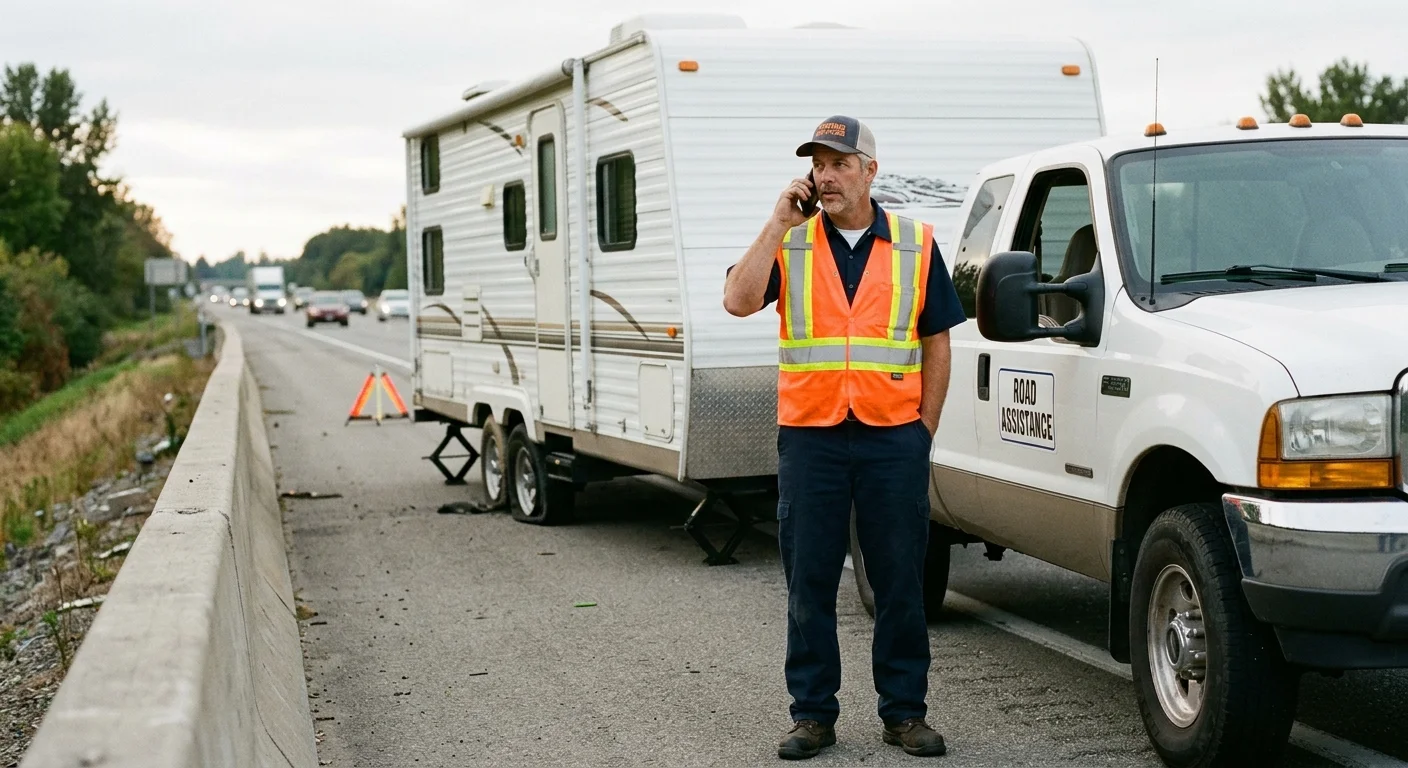
A failed trailer wheel may call for roadside help or a complete tow. The right choice depends on the trailer, its load, the damage, and its location. Good trailer breakdown towing starts with those details, not a guess.
Identify the trailer and what it’s carrying
Start by telling dispatch what kind of trailer has stopped. A utility trailer, enclosed cargo trailer, boat trailer, and travel trailer present different problems. Their dimensions, weight, body shape, and contents can affect which operator accepts the call.
Give the trailer’s make and model when available. Share its approximate length and number of axles. A photo of the identification plate may help if you can reach it safely. Don’t guess at a weight rating you can’t confirm. Read the plate or registration instead.
Then describe what’s inside or attached to the trailer. A nearly empty utility trailer isn’t the same as one carrying landscaping equipment. An enclosed trailer may contain furniture, tools, or commercial cargo. A travel trailer may hold water, propane, batteries, and personal belongings.
Tell dispatch whether the load has shifted. Don’t open a door if the contents appear pressed against it. Don’t enter a tilted trailer or try to rearrange cargo beside traffic. Simply describe what you can see from a safe position.
These details help dispatch contact an operator that handles the specific trailer type. Not every towing provider accepts every trailer. Our RV and trailer towing service connects callers with independent operators based on the information provided.
For a broader look at larger towable vehicles, read our San Diego RV towing guide. It explains why vehicle details matter before an operator heads out.
Describe the tire, wheel, and axle condition
“Flat tire” doesn’t fully describe a trailer wheel failure. Dispatch needs to know what remains attached and what looks damaged. Clear photos can be more useful than trying to name a broken part.
Look from a safe distance. Say whether the tire is inflated, shredded, missing, or separated from the rim. Note whether the rim appears bent or is touching the pavement. Tell dispatch if the wheel sits straight, leans inward, or points away from the trailer.
Also report anything unusual around the hub and axle. That includes visible separation, loose pieces, scraping, smoke, or signs that the trailer body dropped toward the wheel. Don’t touch a hot wheel assembly. Don’t crawl beneath the trailer to inspect it.
Mention what happened immediately before stopping. A sudden vibration, loud impact, dragging sound, or visible tire failure gives useful context. Avoid diagnosing bearings, hubs, brakes, or axles unless a qualified person has confirmed the problem.
The trailer’s present position matters too. Tell dispatch whether it still sits level. Mention if one corner has dropped, the hitch is twisted, or another wheel looks overloaded. These observations don’t determine equipment by themselves. They help the operator ask better questions.
If the wheel or axle condition is uncertain, describe only what’s visible. Our article about broken axle towing details covers the information dispatch commonly needs without asking you to make a roadside diagnosis.
Decide whether roadside help may fit
Roadside assistance may fit when the problem appears limited and the trailer remains stable. A qualified provider still needs to review the trailer details before confirming service. Don’t assume a spare tire automatically makes roadside service possible.
Tell dispatch whether the trailer has a usable spare. Say where it’s stored and whether it appears accessible. You can also mention visible damage around the wheel opening. Don’t loosen hardware, raise the trailer, or attempt a repair beside moving traffic.
A tow becomes the more suitable conversation when damage extends beyond the tire. Examples include a bent-looking rim, a displaced wheel, visible axle trouble, or a trailer resting unusually low. Towing may also be considered when the condition can’t be identified safely.
The roadside assistance service is the relevant starting point for a limited wheel issue. The RV and trailer towing page is more useful when the whole trailer may need transport. Dispatch can compare the situation with operators who accept that trailer type.
If you’re stopped on a freeway, location and exposure may outweigh convenience. Don’t continue moving a trailer simply to reach a preferred shop when the wheel condition is unknown. Share your exact position and explain whether you’re in a traffic lane, shoulder, ramp, or parking area.
NHTSA roadside safety guidance also recommends carrying basics such as a charged phone, flashlight, water, and first aid supplies. Those items support communication and waiting. They don’t replace professional assessment.
Explain the pickup location and available clearance
A trailer wheel failure on Interstate 8 creates a different pickup than one at a campground. San Diego County includes tight coastal streets, steep inland roads, freeway shoulders, and low-clearance parking areas. Dispatch needs a precise description before matching the call.
Share the road, direction of travel, and nearest exit when possible. On Interstate 5 or Interstate 805, include whether you’re northbound or southbound. On Interstate 8, state whether you’re eastbound or westbound. A dropped map pin can prevent confusion around ramps and frontage roads.
For private property, identify the type of location. It might be a driveway, storage lot, campground, repair shop, or shopping center. Say whether a gate, overhang, narrow turn, slope, soft ground, or parked vehicle limits access.
Measure clearance only when you can do so safely. Otherwise, send photos showing the entrance and space around the trailer. Include the trailer, tow vehicle, hitch area, damaged wheel, and path toward the street. Don’t move other people’s property or direct traffic yourself.
La Mesa and nearby inland communities often involve hills, compact lots, and busy connections near Interstate 8. Our La Mesa RV towing guide explains how those local pickup details shape a dispatch conversation.
Freeway, mountain, backcountry, and Camp Pendleton corridor locations can take longer to reach than the urban core. Quick Tow SD doesn’t publish an arrival window. The operator accepting the job provides an estimate for the exact location.
Confirm the trailer’s destination
Dispatch also needs to know where the trailer should go. Choose a destination that can receive the trailer and address its problem. That may be a trailer repair facility, tire shop, RV service center, storage property, campground, or another approved location.
Call the destination before confirming the tow. Ask whether it accepts your trailer type and can receive it in its current condition. A shop that services travel trailers may not handle cargo trailer axles. A tire shop may not accept a trailer with broader wheel assembly damage.
Confirm the business name, street address, entrance, and receiving instructions. Ask about current hours directly. Business hours and access rules can change, so they shouldn’t be assumed from an old listing.
Distance also belongs in the first dispatch conversation. A trailer stranded in Chula Vista may need a nearby shop. Another trailer may need transport toward El Cajon, La Mesa, Oceanside, or another county destination. The operator sets the price, so confirm the current charge directly before authorizing service.
If you don’t have a destination yet, say that clearly. Dispatch may still gather the trailer and pickup details while you contact suitable facilities. Don’t select a location only because it appears close on a map.
Keep the tow vehicle in the conversation as well. Tell dispatch whether it runs, whether it remains connected, and whether it also needs help. The trailer destination and tow vehicle destination may differ.
When to call us
Call when the wheel condition is unclear, the axle may be involved, or roadside repair doesn’t fit the location. We’ll use your trailer, load, damage, pickup, and destination details to seek an independent licensed operator that handles the requested work. Call (858) 923-5787 to reach dispatch.