A collision on I-805 can leave you unsure what kind of help to request. Handle injuries and traffic hazards first, then describe the vehicle and exact location. Those details determine whether the job starts with towing or accident recovery.
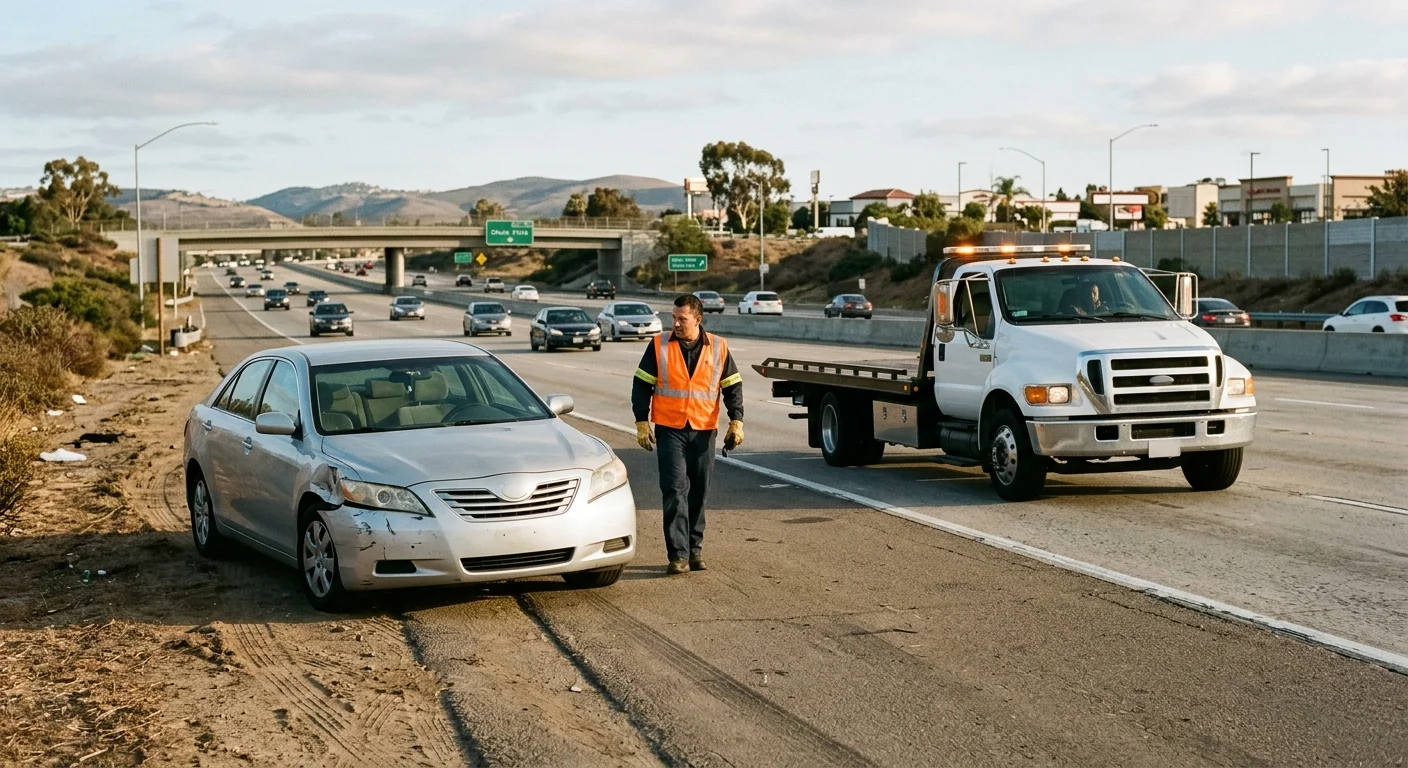
Handle immediate hazards before arranging a tow
Call 911 first if anyone is injured or the crash presents an active roadway danger. Tell the emergency dispatcher about fire, smoke, visible fluid, blocked lanes, or people near traffic. Follow directions from the authorities managing the scene.
A towing dispatcher can’t replace emergency response or direct traffic. The towing conversation should begin after immediate hazards have been reported. If responders move the vehicle or direct you to another location, share that updated position when arranging the tow.
Keep your phone available for emergency calls and location sharing. The National Highway Traffic Safety Administration recommends keeping a phone and charger in a roadside emergency kit. After a crash, battery power may be needed for several calls.
Report what you can see without moving or testing the vehicle. That includes broken glass, smoke, fluid on the pavement, deployed airbags, or bodywork touching a tire. Say when a condition is unknown. The operator needs accurate information, not a confident guess.
An active crash scene may also change while authorities work. A lane can reopen, or the vehicle may be moved from the collision point. Update dispatch if that happens. For a broader checklist, read what to do after a car accident in San Diego.
Share your direction and nearest safe reference point
“On I-805 in Chula Vista” isn’t precise enough for dispatch. Start with northbound or southbound. Then state whether you’re on the main freeway, a connector, an exit ramp, or a nearby surface street.
Use the closest visible exit or overpass as a reference. H Street, Telegraph Canyon Road, Olympic Parkway, and Main Street are useful landmarks along the Chula Vista corridor. If you’re near the SR 54 interchange, include the route and travel direction. These details separate similarly named ramps and nearby frontage areas.
Describe the vehicle’s position within the scene. It may be on a right shoulder, near a center divider, beside an off-ramp, or beyond the paved roadway. Say whether another damaged vehicle, a barrier, or emergency equipment limits access. Don’t assume a map pin communicates those conditions.
A location-sharing pin is still helpful. Send it with a short written description, such as “southbound I-805, past H Street, right shoulder.” If authorities moved the car onto a local street, give the new location instead of the original impact point.
Chula Vista includes dense central streets, newer eastern neighborhoods, and busy freeway connections. A dispatch request near Broadway isn’t the same as one near Otay Ranch. Direction, roadway type, and the closest landmark help the operator understand the actual pickup.
Describe whether the vehicle can roll or steer
The dispatcher needs to know how the crash affected movement. “It won’t drive” leaves several important questions unanswered. Explain whether the wheels appear able to roll and whether the steering responded after impact.
Report any wheel that looks folded, pushed backward, turned sharply, or trapped by damaged bodywork. Mention a flat tire, broken suspension parts, or a bumper dragging on the pavement. If responders already moved the vehicle, say how it behaved during that move.
Also describe the steering and transmission status. Tell dispatch whether the keys are present, the vehicle starts, and the shifter moves, if you already know. Don’t restart the car or force a control simply to complete the checklist. “Unknown” is a useful answer after a collision.
Vehicle details matter too. Provide the year, make, model, and approximate size. State whether it’s gasoline, hybrid, or electric. Manufacturers publish model-specific guidance for damaged electric vehicles, so the exact model helps the operator review the appropriate instructions.
Mention passengers, pets, mobility devices, and important cargo that remain with the vehicle. If a wheel is blocked by debris or pressed against a barrier, describe that relationship. Photos can also help when taken from the position authorities have directed you to use.
A car that rolls isn’t automatically ready for ordinary transport. Roll and steering details describe its loading condition, not whether it should return to the road. The operator sent out will assess the vehicle before moving it.
Understand the tow-versus-recovery decision
A standard tow usually begins with a vehicle that’s accessible and ready for loading. Accident recovery adds another step. The vehicle must first be stabilized, freed, or repositioned before transport can begin.
A sedan sitting upright on an open shoulder may need towing only. A vehicle against a divider, down an embankment, across a curb, or resting on damaged wheels may need recovery work first. The same can apply when the car is upright but can’t roll or steer into a loading position.
Crash severity alone doesn’t settle the question. A heavily damaged car may remain accessible. A car with limited visible damage may be stuck in a difficult position. Scene access, wheel condition, steering, and the vehicle’s resting position guide the decision.
When requesting accident recovery in Chula Vista, describe the position before asking for a specific truck or technique. The operator taking the job selects the approach based on those details. Conditions found at the scene may change that assessment.
Our accident recovery and winch-outs service is intended for vehicles that need controlled repositioning or extraction. If the vehicle is already accessible but can’t continue, review the emergency towing service instead.
Recovery and towing can also be parts of the same job. The first step gets the vehicle into a transportable position. The next step moves it to the confirmed destination. Giving dispatch a complete description helps identify that sequence before the operator is sent.
Confirm the destination before dispatch
Choose the intended destination before the operator starts toward the crash scene. Possible destinations include a body shop, repair facility, dealership, home, or storage location. The right choice depends on who will accept the damaged vehicle.
Call the receiving location and confirm its current instructions. Ask whether it will accept the vehicle, where it should be left, and what access information the operator needs. Don’t rely only on a business name. Provide the full street address.
Local direction matters here too. A destination near Eastlake sends the vehicle in a different direction from one near Broadway. “A shop in Chula Vista” can still describe several possible places. A precise address prevents confusion after pickup.
Tell dispatch if an insurer, repair facility, or responding authority has given you specific instructions. If no destination has been confirmed, say so before authorizing the job. Quick Tow SD doesn’t operate an impound lot or release police-held vehicles.
The independent operator performs the work, sets the price, and receives payment directly. Confirm the operator’s quoted terms before authorizing transport. No single local rate can be stated for every crash because the vehicle, recovery work, pickup conditions, and destination differ.
The destination affects what happens after the roadway scene ends. Our guide to what happens to your car after an accident tow explains the next handoff. Keep the operator’s information and the destination address with your crash records.
When to call us
Collision damage needs a professional towing operator when the vehicle can’t move normally or must be recovered from a barrier, slope, median, or difficult position. We’ll take the details and match you with an independent licensed operator for accident recovery in Chula Vista. Call (858) 923-5787 to reach dispatch.