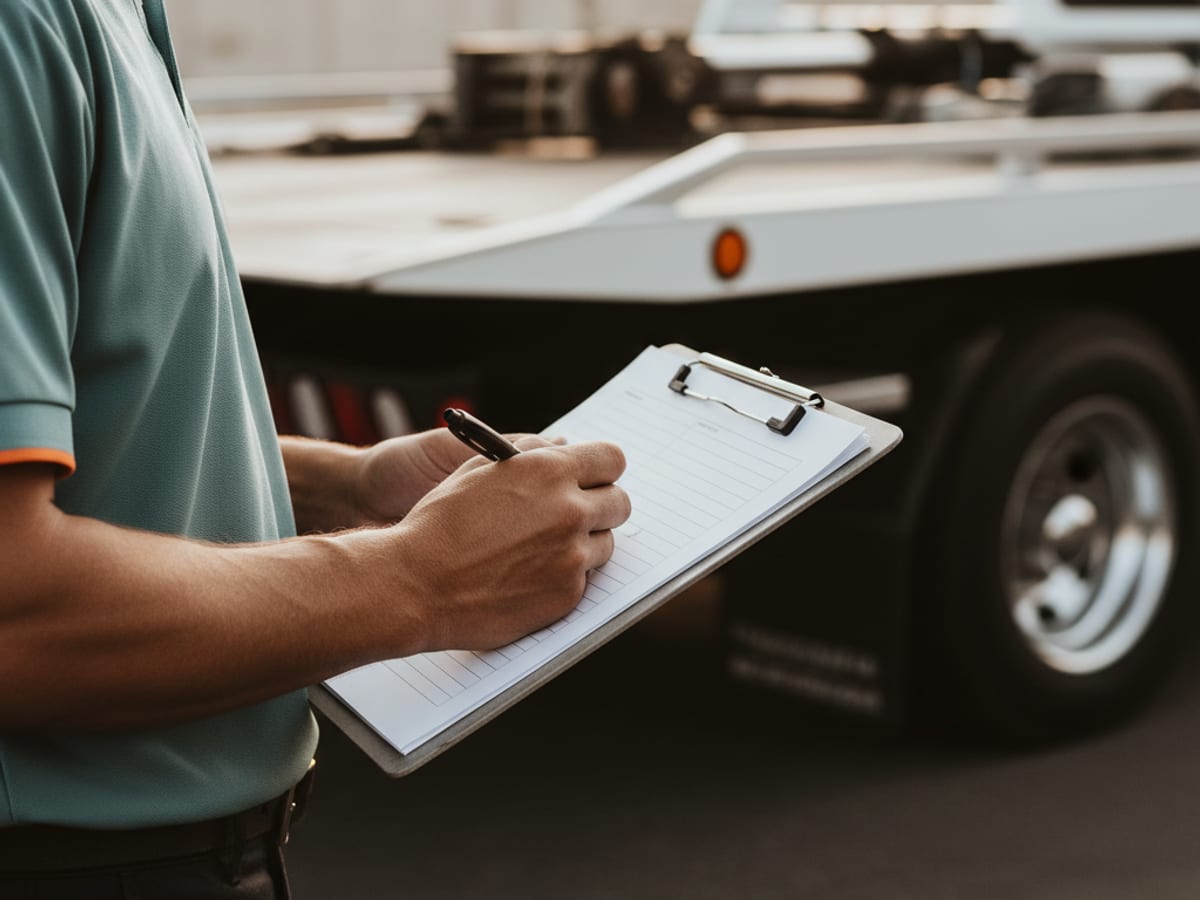
The more specific the details, the more accurate your tow car quote will be. Give dispatch the vehicle, its condition, exact pickup and drop-off points, access limits, and requested timing. The phone number is still an estimate. The operator confirms the final price after the driver sees the vehicle and actual access.
That distinction matters across San Diego County. An I-8 shoulder near El Cajon is different from a driveway nearby. A downtown parking structure isn’t the same pickup as an open lot. Inland canyon roads also require more location detail than central city streets.
What details produce an accurate tow car quote?
Dispatch needs six parts of the job before estimating the price. Missing one can change the truck, route, or work involved.
| What to share | What dispatch needs to hear |
|---|---|
| Vehicle | Year, make, model, and general size |
| Vehicle condition | Whether it starts, rolls, steers, brakes, and shifts into neutral |
| Pickup point | Address, cross street, freeway direction, exit, or map pin |
| Drop-off point | Exact address, not only the city or neighborhood |
| Access | Garage level, posted clearance, gate, narrow driveway, or blocked wheels |
| Timing | When you need the tow and whether the vehicle can remain there |
Start with the vehicle itself. A sedan, SUV, pickup, and larger work truck may need different equipment. Mention AWD, four-wheel drive, electric power, low clearance, or body damage. Dispatch can then match the job with an operator prepared for those details.
Next, describe what the vehicle can do. “It won’t start” doesn’t explain whether it rolls freely. Tell dispatch if the steering is locked, a wheel is damaged, the keys are missing, or the transmission won’t shift. Those facts can change how the vehicle gets loaded.
Photos can help with unusual damage or tight access. Ask whether dispatch wants images before assigning the job. A clear photo of the vehicle and surrounding space can answer questions that are difficult to explain by phone.
Give exact pickup and drop-off points
A city name isn’t enough for a dependable distance estimate. “El Cajon” could describe a driveway near the city center or an address farther into East County. Use the complete address whenever you have it.
For a freeway pickup, share the route, travel direction, and nearest exit. “Eastbound I-8 near the next exit” is more useful than “on the freeway.” A dropped map pin can help when street signs aren’t visible.
Parking structures need another layer of detail. Give the level, space number, entrance location, and posted clearance. Mention any gate, ticket arm, sharp ramp, or narrow turn between the entrance and the vehicle.
For rural or canyon roads, send the exact pin and nearest cross street. Don’t rely on “just outside town.” San Diego’s urban core, inland roads, and backcountry require different routing.
The destination matters just as much. Give the actual drop-off address before dispatch calculates the distance. If you haven’t chosen a destination, say so. Don’t substitute a neighborhood name and assume the route will stay the same.
Drivers near East County can review the El Cajon towing service area before calling. It provides local coverage context for that part of the county.
Describe the vehicle’s real condition
Two identical cars traveling the same distance can require different work. One may roll normally from an open driveway. The other may have locked steering inside a parking structure.
Use direct descriptions instead of diagnosing the mechanical problem. You don’t need to know why the car stopped. Dispatch needs to know what the vehicle can and can’t do.
A useful condition report sounds like this:
“My sedan doesn’t start. I have the keys. It rolls, but the steering feels locked. All four tires are intact. It’s facing forward in an open driveway.”
That description gives dispatch something concrete. Compare it with “my car is dead,” which leaves several important details unanswered.
Mention collision damage even when it appears minor. Tell dispatch about bent wheels, loose body panels, leaking fluids, or a vehicle sitting below road level. Don’t guess whether special equipment is necessary. Describe what you see and let the operator choose the equipment.
If the vehicle has manufacturer-specific transport instructions, mention them. This is especially useful for electric vehicles and modified cars. Guidance varies by brand and model, so the exact vehicle information matters.
Ask what the estimate includes
Before accepting any tow car quote, ask dispatch to repeat the job details. Confirm the vehicle, both locations, timing, and expected equipment. A misunderstanding is easier to fix before an operator is assigned.
Ask whether the estimate includes each charge the operator expects for the described job:
- Any base or pickup charge
- Mileage to the stated destination
- Equipment requested for the vehicle
- Access or special-handling work you disclosed
- Any timing charge that applies
- Any waiting or destination-access condition already known
This isn’t about forcing one pricing formula onto every operator. Independent operators set their own prices. The goal is to understand what the estimate covers before the truck is sent.
Ask for the estimate by text or email when that option is available. The written message should identify the vehicle and route, not only show a number. Save it with any photos and location details you sent.
For scheduled work, you can also request a written quote. Include the same information you would give by phone.
Why the final price can differ
A phone estimate is based on the conditions described during the call. The operator confirms the final price after the driver sees the vehicle and both access points.
The estimate may need revision when the actual job doesn’t match that description. A driver might find a locked wheel, hidden collision damage, a low ceiling, or a different destination. An incorrect map pin can also change the measured route.
That doesn’t make every price change reasonable. It means the change should connect to a specific difference in the job. Ask the driver to explain that difference before loading begins.
If nothing changed, compare the original description with what the driver found. Keep the written estimate available. Clear records make it easier to resolve a misunderstanding.
A simple script for calling dispatch
You can get a tow price over the phone without knowing towing terms. Read the important details in a steady order:
“I have a [year, make, and model]. It [does or doesn’t] start. It [does or doesn’t] roll, steer, brake, and shift into neutral. The keys are [available or missing]. The pickup is [exact address or map pin]. The car is [in an open lot, driveway, structure, or roadside location]. The drop-off is [exact address]. I need it moved [requested time]. What does your estimate include?”
Add any access issue after the location. Mention the posted garage clearance, gate instructions, steep driveway, damaged tire, or locked steering.
Then ask the operator taking the job for the arrival estimate for that exact location. Quick Tow SD doesn’t publish a general arrival window because urban, mountain, backcountry, and Camp Pendleton corridor calls don’t take the same time to reach.
Compare the estimate with local cost guides
Use the tow cost calculator before calling. It accepts distance and vehicle type, giving you a starting estimate for the conversation.
For a broader towing cost estimate in San Diego, read the San Diego tow cost guide. Distance-specific articles explain the questions behind a 10-mile tow and a 50-mile tow.
Those pages explain what costs can look like. This guide helps you describe the actual job well enough to receive a useful number.
Quick Tow SD takes calls 24 hours a day and covers every city in San Diego County. We connect customers with vetted independent licensed and insured towing operators. The operator performs the work, sets the price, and receives payment directly.
For a breakdown or disabled vehicle, review emergency towing service or call (858) 923-5787. Have the vehicle, route, and access details ready.
Frequently asked questions
Can a towing company give an exact price over the phone?
A phone price is generally an estimate until the driver sees the vehicle and access. The operator confirms the final price based on the actual job. Accurate locations, vehicle details, and photos can reduce uncertainty.
What does a tow company need to know?
Dispatch needs the vehicle, condition, pickup point, destination, access, and requested timing. Mention whether the car rolls, steers, brakes, and shifts into neutral. Also disclose missing keys, damaged wheels, low clearance, or locked steering.
Should I give a cross street or a map pin?
Give the exact address or map pin whenever possible. A cross street, travel direction, and nearest exit help with freeway pickups. In San Diego’s backcountry, a pin is more useful than the name of the nearest city.
Does a towing estimate include mileage?
Ask dispatch whether mileage is included in the stated total. Confirm the exact destination before accepting the estimate. Changing the drop-off point can change the route and final price.
How do I get a tow car quote in San Diego?
Call Quick Tow SD at (858) 923-5787 with the vehicle, condition, pickup, destination, access, and timing. The line takes calls 24/7. We’ll match you with an independent operator serving your location.