A car needs to be at the dealer for a 9 a.m. service slot, or it’s going from a driveway in Clairemont to a body shop after an estimate, or it has to be off the street before street sweeping. None of that is an emergency. It’s a job you can plan a day or a week out, and dispatch can book it that way if you give them what they need.
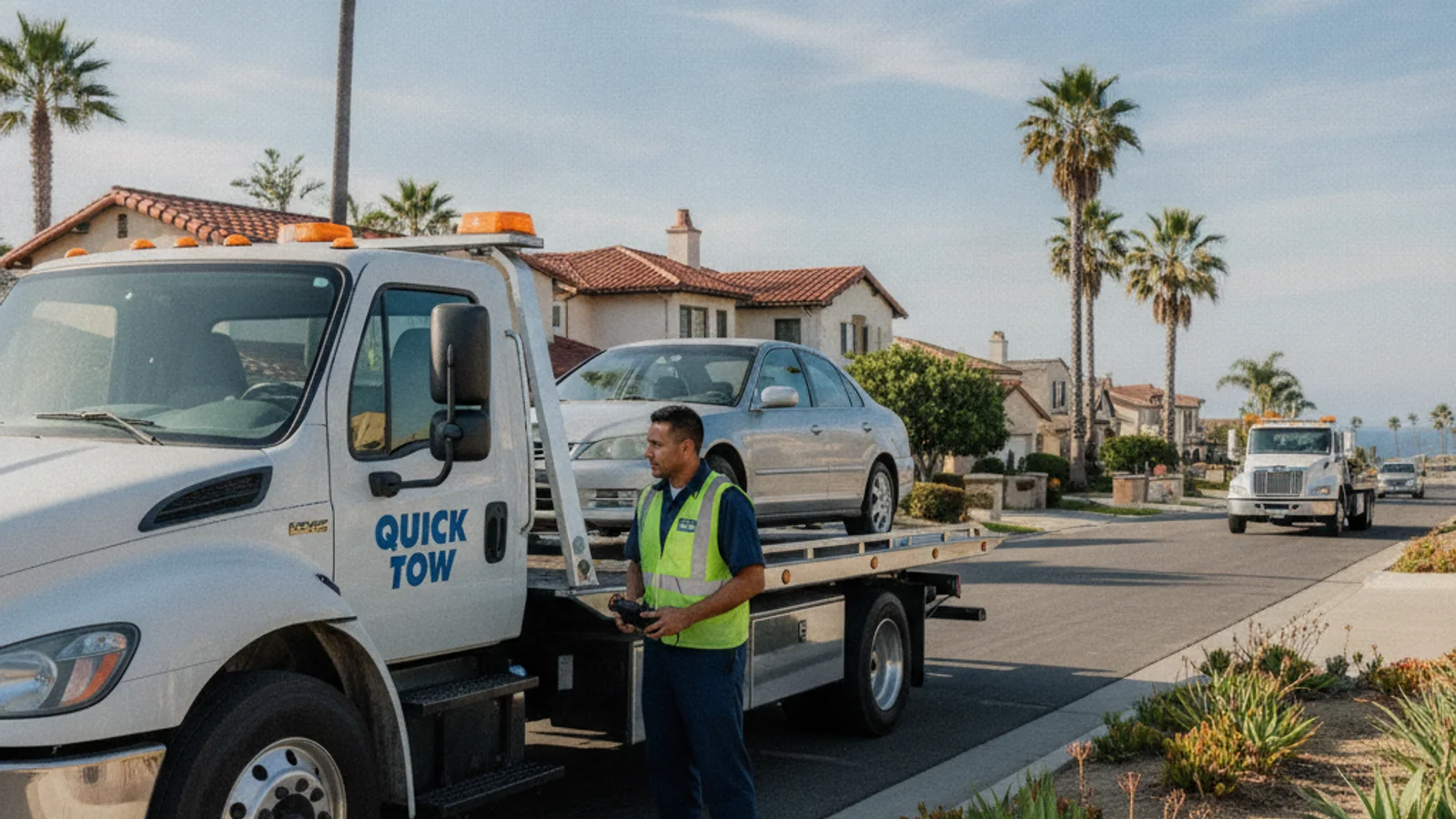
Every other post on this site is about the emergency version
Most of what gets written about towing assumes something just went wrong: a breakdown on I-5, an accident, a dead battery in a parking lot. A planned tow is a different animal. Nobody’s stranded. The car usually runs, rolls, and steers fine. The reason for the tow is a destination, a deadline, or a situation where driving it yourself isn’t the right call, like moving a project car between garages, getting a vehicle to a pre-purchase inspection, or clearing a car off the street before a move-out date or a parking permit deadline.
What dispatch needs to book it
A planned tow gets scheduled cleanly when you can answer these up front, the same categories that matter for an accurate tow quote generally, just with more lead time to gather them:
- Both addresses, exactly. Not a neighborhood, not a cross street if you can avoid it. Pickup and drop-off, both.
- Access at both ends. Gate codes, garage clearance, a narrow driveway, an HOA guest policy, or a locked lot all matter, and matter at both the pickup and the destination.
- Whether the car rolls and steers. A running, driveable car and a dead one need different equipment, even for a planned job with no urgency attached.
- Whether keys exist and where they’ll be. If you won’t be present, say who has the keys and how the driver gets them.
- Who will be present, if anyone. A locked gate with nobody there to open it stops a scheduled job just as fast as an unscheduled one.
- Clearance limits at either address. A body shop bay, a parking structure, or a covered carport can all have height or width limits worth mentioning before the truck shows up.
Where this comes up most in San Diego
Street sweeping enforcement and move-out timing drive a lot of planned tow calls in dense rental neighborhoods like North Park, City Heights, and the College Area near SDSU, where a car with no current driver, a dead battery, or an owner who’s already moved out of state can’t just be moved a few feet before the sweeper or a parking enforcement citation shows up. A pre-purchase inspection tow is a different scenario entirely, common when a buyer wants a specific mechanic in Kearny Mesa or Miramar to look at a car before money changes hands, and neither the buyer nor the seller wants to put miles on a vehicle that isn’t theirs yet. Project car moves between garages, a common request from hobbyists working out of a home garage in East County or the North County inland communities, are usually the most flexible on timing since neither end is running on a business’s clock.
The receiving end’s hours are the real constraint
The part people overlook most: the destination’s own hours matter more than when you’d like the car dropped off. A dealership service department, a body shop, or a storage facility all operate on their own schedule, and a car dropped off outside those hours may sit outside, unattended, or the drop-off may not be accepted at all. Before you schedule anything, confirm with the receiving location what their intake hours actually are and whether they need advance notice of a drop-off. That’s information only they can give you, not something dispatch can guess at.
Why more lead time helps the operator, not just you
Giving dispatch a day or a week of notice instead of an hour means an operator can plan the job around known access constraints instead of discovering them on scene. A driver who knows in advance that the pickup is in a gated community with a call box, or that the destination body shop’s bay only fits vehicles under a certain height, can bring the right equipment or flag a scheduling conflict before a truck is already en route. That same lead time also means a mismatch between what you described and what’s actually there gets caught with time to fix it, rather than during a call from the driveway asking why nobody mentioned the gate.
What to confirm the day before
A few things are worth double-checking once the appointment is close instead of assuming nothing’s changed:
- Both addresses are still correct. Plans shift. Confirm the pickup and drop-off haven’t moved.
- Whoever needs to be present still can be. If the plan depended on someone unlocking a gate or handing over keys, confirm that’s still the plan.
- The receiving location still expects the car. A dealership appointment can move. A body shop slot can get pushed. Confirm before the car is en route.
- Access hasn’t changed. A gate code that worked last week isn’t guaranteed to work today if the property changed it.
Storage and permit deadlines are their own category
Coastal neighborhoods with resident-only parking permits, and inland communities that run seasonal street cleaning schedules, both create hard deadlines that have nothing to do with the vehicle itself and everything to do with a city calendar. If a permit is expiring, a temporary no-parking zone is going up for construction, or a landlord has given a fixed date to clear a shared driveway, treat the deadline date as fixed and schedule the tow with enough buffer that a delay at the destination doesn’t push the pickup past it.
What this isn’t
A planned tow booking still doesn’t come with an arrival window or a specific time slot promise. This site doesn’t publish arrival times for any tow, scheduled or emergency, because the honest answer is that the operator assigned to the job gives you a real-time estimate once dispatch has matched the job to a driver. What scheduling in advance does get you is a job dispatch already has full details for, which tends to move faster on the day than starting from zero. The line itself takes calls 24/7, whether you’re calling to book ahead or calling because something just happened.
When to call us
If the car rolls and steers and you’re just moving it between two known points on your own timeline, describe the addresses, access, and who’ll be present when you call, and dispatch can line up an operator for it. For something with unusual clearance needs, like an exotic or classic vehicle headed to a specialist, or a larger vehicle needing heavy-duty towing, mention that up front so the right equipment gets assigned. Call (858) 923-5787 to reach dispatch.