Roadside assistance in Encinitas depends first on whether you’re stopped on I-5 or Coast Highway 101. Freeway shoulder safety comes first. A surface-street stop may offer more room to assess a battery, tire, lockout, or fuel problem.
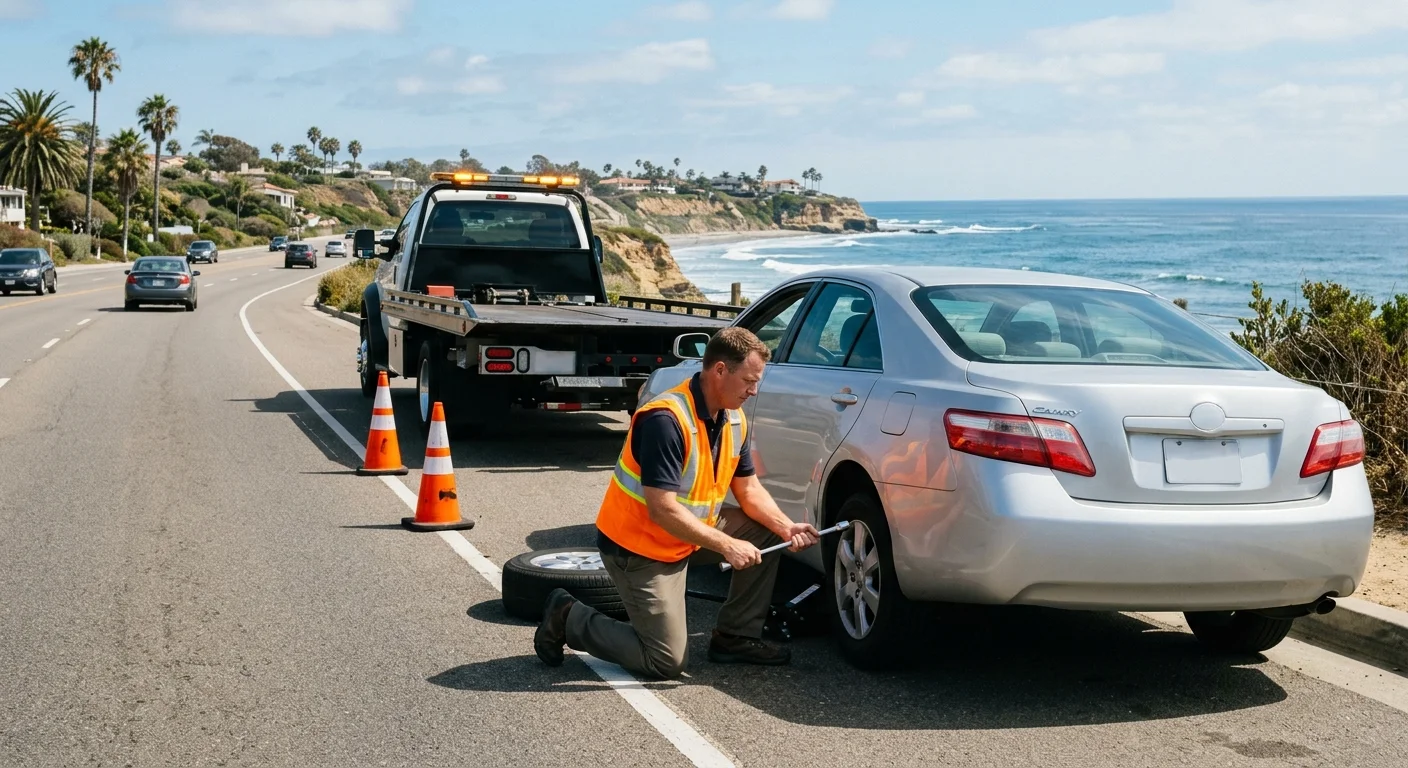
Get clear about your Encinitas location
Start with a dropped map pin, then describe what surrounds you. An Encinitas address alone may not show the safest approach to your vehicle.
On I-5, give your direction of travel and nearest exit. Say whether you’re northbound or southbound. Note whether the car is on the right shoulder, left shoulder, a ramp, or still near a traffic lane. Don’t cross moving lanes to reach a more recognizable landmark.
On Coast Highway 101, share the nearest cross street and travel direction. Add the name of a nearby business, parking lot, or public landmark when visible. Specify whether you’re in Leucadia, downtown Encinitas, or closer to Cardiff. Map results may also display North Coast Highway 101 or South Coast Highway 101.
A nearby arterial can narrow the location further. Encinitas Boulevard, Santa Fe Drive, La Costa Avenue, and Manchester Avenue lead to different parts of the city. The exact intersection matters more than a general neighborhood name.
Dispatch also needs the vehicle’s color, make, model, and plate. Describe what happened before it stopped. Mention a flat tire, warning light, lost key, empty fuel tank, collision damage, smoke, or leaking fluid.
Tell dispatch if the vehicle blocks traffic or sits near a blind approach. Report injuries, fire, or immediate roadway danger to emergency services first. Clear location details help us match your call with an independent operator suited to the situation.
What changes between I-5 and Coast Highway 101
An I-5 breakdown places you beside fast-moving freeway traffic. Shoulder width, barriers, ramps, and the vehicle’s position can limit safe working space. A simple roadside task may become unsafe when the operator can’t work away from passing vehicles.
Stay in the safest available position. Follow instructions from law enforcement or emergency responders at the scene. NHTSA roadside safety guidance also tells approaching motorists to move over for stopped vehicles displaying warning lights. If moving over isn’t safe, drivers should slow down.
Your direction and nearest exit shape freeway access. A driver approaching from the wrong side may need a different route. Dispatch can’t determine that from “I-5 in Encinitas” alone. Our San Diego freeway breakdown guide explains the information that matters during a freeway call.
Coast Highway 101 is a surface street, but that doesn’t make every stop easy. Parked cars, business entrances, intersections, cyclists, and pedestrian activity can restrict access. A vehicle beside the curb presents a different job from one stopped in a travel lane.
A parking lot can offer more separation from traffic. It may also add gates, height restrictions, tight turns, or assigned spaces. Tell dispatch about those conditions before an operator accepts the job.
The key difference isn’t simply freeway versus coastal road. It’s the space around the vehicle and whether roadside work can happen safely. Our broader Encinitas towing guide covers route considerations when the car already needs transport.
When roadside assistance may solve the problem
Roadside assistance fits problems that may be corrected where the vehicle sits. The car must also be in a safe, accessible position.
Common situations include:
- A battery problem that may respond to a jump start.
- A flat tire when the car has a usable spare.
- An empty fuel tank without signs of mechanical damage.
- A lockout when nobody faces an emergency inside the vehicle.
Each situation still needs basic screening. A damaged wheel isn’t solved by replacing the tire. A missing or unusable spare changes a tire call into a possible tow. A jump start also won’t repair an underlying charging or electrical problem.
Tell dispatch what happened immediately before the car stopped. Mention clicking sounds, dim lights, warning messages, impact damage, unusual smells, or rising temperature readings. Don’t guess at the cause. A short description of what you saw is more useful than an uncertain diagnosis.
Location can overrule the repair itself. A tire change might be reasonable in a spacious parking lot. The same task may be unsafe beside freeway traffic or on a narrow stretch of Coast Highway 101. Don’t begin a roadside repair when it puts you near moving lanes.
Roadside help isn’t a promise that the car will continue safely. It addresses a specific immediate problem. If the vehicle starts or receives fuel but still shows serious warning signs, shut it down and discuss towing with the operator.
When the vehicle should be towed
Towing is the better path when a simple roadside task can’t make the vehicle roadworthy. It’s also appropriate when the stopping location doesn’t provide safe working space.
Conditions that may point toward towing include:
- Collision damage or a wheel sitting at an unusual angle.
- Visible fluid loss, smoke, or a burning smell.
- Steering or braking problems.
- Repeated overheating after the vehicle has cooled.
- A damaged tire without a usable spare.
- A vehicle that won’t remain running after a jump attempt.
- Undercarriage contact that makes further driving uncertain.
Don’t keep driving solely to reach an exit or parking lot when the vehicle can’t be controlled safely. Continuing can place the vehicle and nearby traffic at greater risk. If it’s exposed to traffic, explain that clearly when requesting emergency towing.
Electric vehicles, all-wheel-drive cars, motorcycles, and low-clearance vehicles need accurate identification. Transport directions can differ by manufacturer and model. Give dispatch the full vehicle details so the operator can choose suitable equipment and check the applicable manufacturer instructions.
The destination matters too. Decide whether the vehicle should go to a repair shop, dealership, tire shop, or another lawful location. If you’re unsure which destination can accept it, confirm that before transport begins.
An operator may inspect the situation and recommend towing after arriving. That can happen when the visible damage is worse than expected or safe access is limited. Roadside triage should never force a repair in a location where the work can’t be completed safely.
What to confirm before help is dispatched
A clear dispatch call prevents avoidable confusion. Have the following details ready:
- Your map pin, road name, travel direction, and nearest exit or cross street.
- The side of the road and the vehicle’s position.
- The vehicle’s year, make, model, color, and plate.
- The problem you observed and any attempted roadside fix.
- Whether the keys are present.
- Whether the wheels appear able to roll.
- Any collision damage, leaking fluid, smoke, or roadway danger.
- Your preferred destination if towing may be needed.
- Parking gates, garage clearance, steep access, or tight turns.
The independent operator performs the work, sets the price, and receives payment directly. Before accepting the dispatch, ask the operator to confirm the requested service and current charge. If towing may be needed, provide the destination so the job can be discussed accurately.
We don’t publish a citywide price or arrival window. The operator accepting the job provides the current charge and an arrival estimate for your exact location. Confirm those details directly before work begins.
Keep your phone available after dispatch. The operator may need a better landmark, gate instructions, or clarification about the vehicle. If law enforcement or emergency responders move you to a safer location, update dispatch promptly.
Our line takes calls 24 hours a day, seven days a week. We connect callers throughout Encinitas with vetted independent operators. The details you provide help identify whether the call needs roadside help or vehicle transport.
When to call us
Call when the vehicle can’t be made roadworthy with a safe, simple roadside fix, or when its position requires a professional towing operator. Call (858) 923-5787 to reach dispatch.