A breakdown on I-5 requires different help than one near Cedros. Highway 101, Lomas Santa Fe Drive, and coastal side streets also present distinct pickup conditions. Clear location details help dispatch match you with the right local operator.
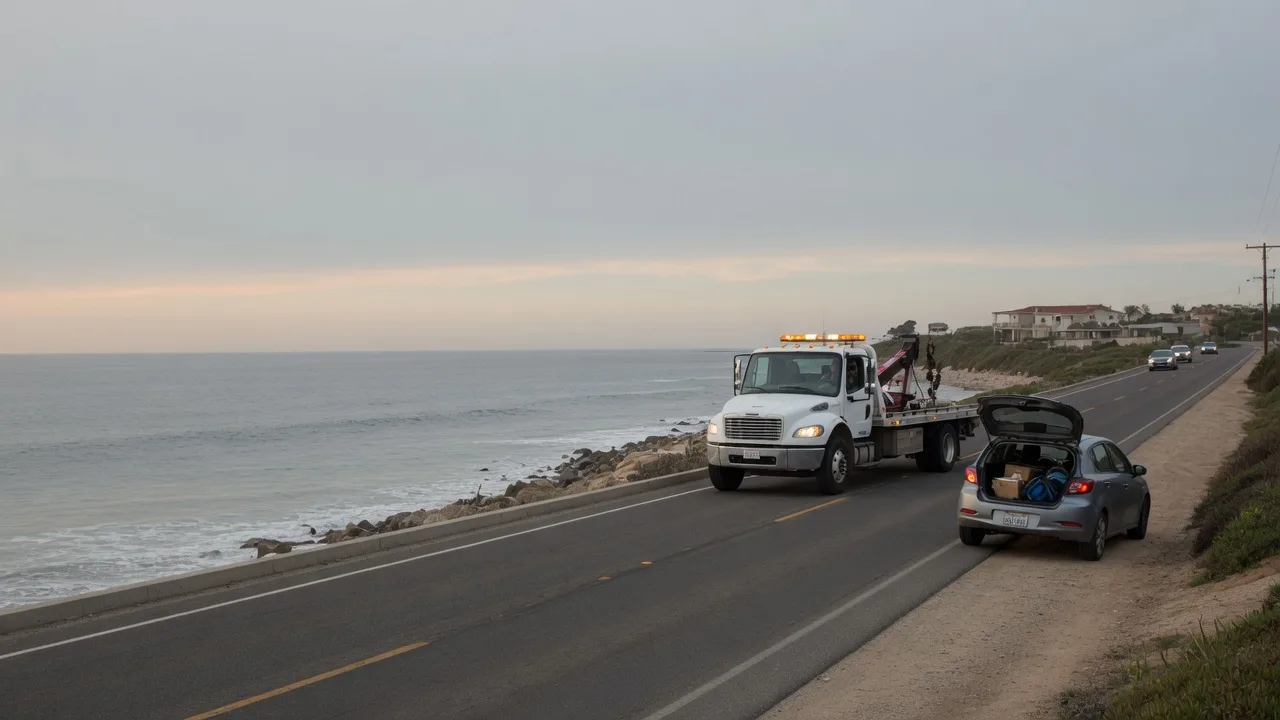
Share whether you are on I-5, Highway 101, or a side street
Start with the road name and your direction of travel. “Solana Beach” alone doesn’t tell dispatch where the vehicle sits. An I-5 shoulder, a Highway 101 curb, and a side-street parking space require different approaches.
On I-5, share whether you’re traveling north or south. Give the nearest exit, sign, overpass, or visible landmark. Say whether the vehicle is on the right shoulder, left shoulder, or partly in a traffic lane. Don’t cross moving freeway lanes to inspect the car.
On Highway 101, provide the nearest cross street or business address. Also describe where the car stopped. A legal curb space differs from a travel lane, driveway, or restricted lot.
For a side street, send the full address when possible. Include the nearest intersection if building numbers aren’t visible. A map pin can help, but say what you see as well. Pins sometimes land behind a building or on the wrong side of a divided road.
Tell dispatch if the car can roll, steer, and shift into neutral. Mention collision damage, a locked steering wheel, missing keys, low clearance, or damaged wheels. These details matter when arranging emergency towing.
Quick Tow SD connects callers with independent licensed tow operators. The operator taking the job sets the price and provides an arrival estimate for your exact location.
What changes near Cedros, Lomas Santa Fe, and the coast
Solana Beach towing calls can look similar on a map but differ at street level. Traffic exposure, available working space, vehicle position, and property access all affect the pickup.
Near Cedros, give the exact street and nearby address. Tell dispatch whether you’re parked at a curb, inside a lot, or near an entrance. Don’t assume a driver can enter every lot or loading area. Property access may depend on gates, posted restrictions, traffic, and permission from whoever controls the space.
Lomas Santa Fe Drive calls need a precise cross street and direction. Also say whether the vehicle is near I-5 or farther toward the coast. If the car is blocking traffic, state that first. Don’t attempt to push it through an active intersection.
Along the coast and Highway 101, explain the available space around the vehicle. Mention a narrow shoulder, tight curb parking, a steep driveway, or traffic passing close to the driver’s side. Don’t promise yourself that a beach-adjacent lot will accommodate a tow truck. Let the dispatched operator assess access.
Regional context also prevents location mistakes. A breakdown north of Solana Beach may fit our guide to towing in Encinitas on I-5 and Coast Highway 101. A stop south of town may be closer to the conditions covered in towing around Del Mar, I-5, and the fairgrounds.
When roadside help may be enough
Not every disabled vehicle needs transportation. A simple roadside service may solve a dead battery, empty fuel tank, locked door, or flat tire when the car is otherwise usable.
Describe the symptoms without diagnosing the problem. Say whether the engine cranks, the dashboard lights work, or you heard an unusual sound. For a flat tire, confirm whether you have an inflated spare and the required wheel-lock key. If you’re locked out, tell dispatch whether a child, vulnerable person, or animal is inside.
Location still controls what’s practical. A service that makes sense in a safe parking space may not be suitable beside fast traffic. The operator must consider working room and roadside exposure. Don’t stand next to traffic to investigate a tire or open the hood.
San Diego County’s Freeway Service Patrol provides free help on covered freeway segments. The program is run by SANDAG with Caltrans and the California Highway Patrol. Available help includes a gallon of gas, a jump start, radiator water, and a flat tire change. Drivers can request it by calling 511 and saying “Roadside Assistance.” Service depends on its published operating schedule and covered routes.
For help outside that program, Quick Tow can connect you with roadside assistance in San Diego County. Explain the symptoms first. Dispatch can then determine whether roadside help or towing better fits the call.
When arranging a tow makes more sense
A tow usually makes more sense when the vehicle can’t safely continue. Examples include collision damage, steering trouble, a wheel that won’t turn, fluid loss, or repeated overheating. Persistent warning lights may also require professional assessment before driving.
Stop driving if continuing could increase damage or create a traffic hazard. Don’t crawl along Highway 101 or Lomas Santa Fe Drive simply to reach a preferred parking space. If you’re already somewhere protected, leave the vehicle there until the operator gives instructions.
Tell dispatch about any unusual vehicle requirements. Give the year, make, model, and drivetrain when known. Mention whether it’s electric, all-wheel drive, lowered, modified, or carrying a trailer. Manufacturer transport instructions can vary by model. The towing operator needs accurate vehicle details before choosing equipment.
The destination matters too. Decide whether the car should go to your home, a repair shop, a tire shop, or another authorized location. Confirm that the destination can accept the vehicle. An after-hours drop may require instructions from the property or repair facility.
A tow may also be necessary when roadside service doesn’t solve the original problem. A jump start can reveal a deeper charging issue. Replacing a flat with a spare won’t help if a wheel or suspension part is damaged. Let the operator assess what can be done safely at the scene.
What to confirm before dispatch
A useful dispatch call covers the vehicle, location, condition, access, and destination. Keep your registration or vehicle details nearby if they’re safely accessible.
Share these details:
- Your exact road, direction, and nearest cross street or exit
- Whether the car is in a lane, shoulder, curb space, or lot
- The vehicle’s year, make, model, and drivetrain
- Whether it rolls, steers, brakes, and shifts into neutral
- Any collision damage, leaking fluid, locked wheels, or missing keys
- Parking height limits, gates, narrow access, or posted restrictions
- Your requested destination and its drop-off instructions
Ask the operator to state the price before you approve the job. Quick Tow doesn’t publish a brand rate card because the independent operator performs the work, sets the charge, and receives payment directly.
You should also ask what payment methods the operator accepts. If the vehicle is in a controlled lot, confirm whether the property requires permission or special access. Don’t assume a tow request overrides a locked gate or property restriction.
Keep your phone available after the call. Dispatch or the driver may need a clearer landmark or updated vehicle position. If you move the vehicle, tell dispatch immediately.
The phone line takes calls 24 hours a day, seven days a week. Quick Tow serves every city in San Diego County through its network of licensed and insured operators. Availability, equipment, pricing, and arrival estimates depend on the operator assigned to your specific call.
When to call us
Call when the vehicle can’t move safely, roadside help hasn’t solved the problem, or traffic exposure makes a DIY attempt unsafe. Quick Tow SD will connect you with a local professional towing operator based on your location and vehicle details. Call (858) 923-5787 to reach dispatch.