The coupler dropped, the receiver cracked, or the trailer is sitting at a wrong angle behind the truck. On I-8 east of El Cajon, I-15 through Escondido, or a two-lane toward Julian, that is a stop, not a patch job. The call is whether roadside assistance can stabilize the scene, or whether the trailer itself needs a dedicated RV and trailer tow.
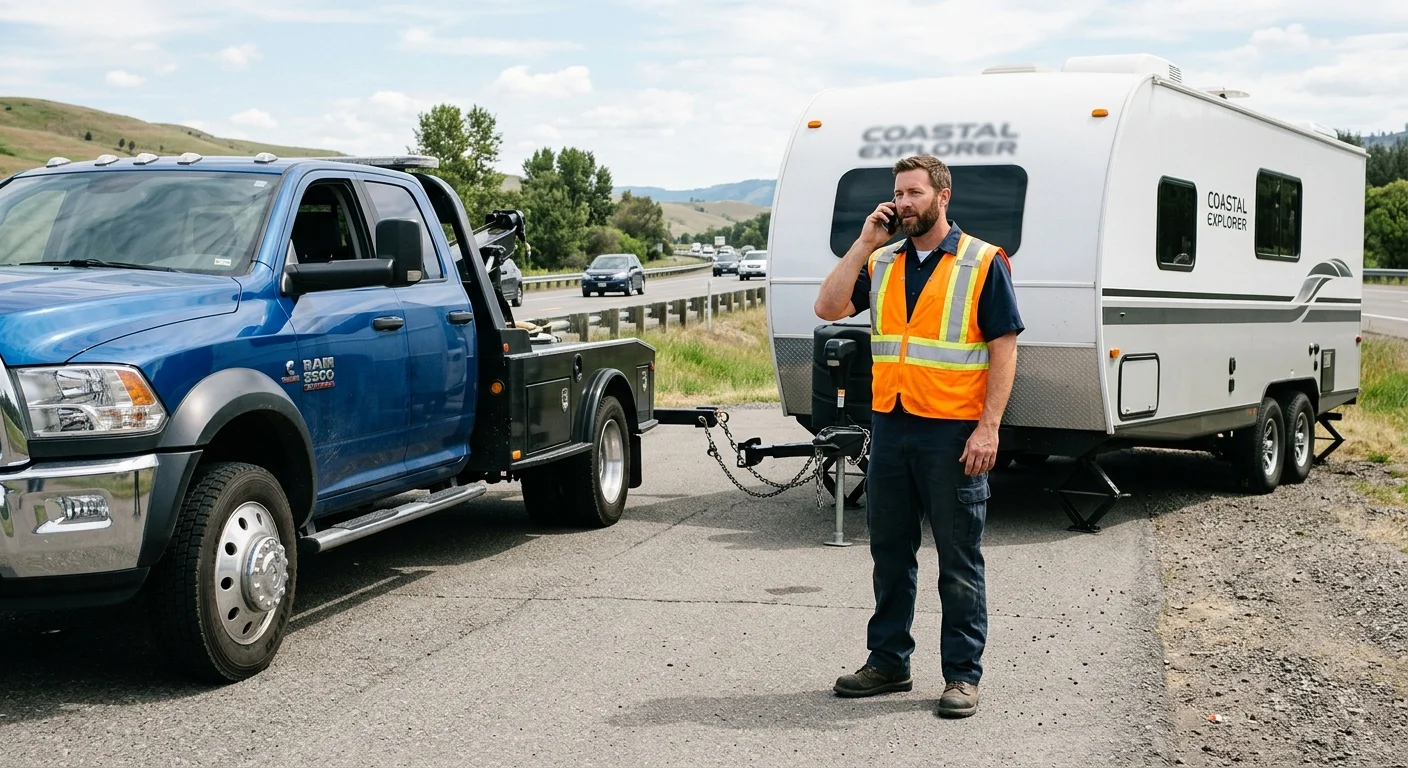
Identify the trailer and towing vehicle
Dispatch cannot guess the rig from “trailer, somewhere on the 5.” Say what is behind the hitch: a small utility trailer, a boat trailer, a travel trailer, a fifth-wheel, a toy hauler, or a car hauler. Length and how loaded it looks matter more than a brand you cannot read in the dark.
Name the towing vehicle too. A half-ton pickup in Mission Valley is a different recovery than a dually on the I-8 grade toward Alpine. If the truck still drives, say so. If the failure bent the bumper, receiver, or plug, say that before anyone assumes the truck can just pull away.
Where you are sitting changes the job. A boat ramp at Mission Bay or Chula Vista Marina is tight, sloped, and often wet. A shoulder on I-5 through Oceanside is high-speed and narrow. A pullout on SR-78 toward Julian or SR-67 through Lakeside is a two-lane with little room to stage a second truck. Coastal salt around Shelter Island and East County heat on the Alpine climb wear hardware in different ways. The dispatch question stays the same: what is attached, what is pulling it, and can either one still roll on its own.
If you are not sure of ratings, read the labels that are still visible. Hitch class, tongue rating, and GVWR plates are facts on the equipment. They are not something a phone operator should invent. Skip internet rules of thumb. The operator taking the job needs the lowest rating you can actually see, plus an honest load picture: empty, household cargo, water in the tanks, or a boat still on the bunks.
A bumper-pull utility trailer and a travel trailer are not interchangeable. Fifth-wheel pins and gooseneck balls fail in different places than a square receiver. You do not need to diagnose the metal. You do need to say which connection you have, and whether the trailer is still attached, partly attached, or fully separated.
We serve every city in San Diego County. A hitch failure in National City industrial streets is still the same decision as one on a Palomar two-lane. The local detail is what the operator uses to pick the truck, not a reason to keep rolling.
Describe the hitch problem without moving the setup
Leave the rig where it sits unless a first responder tells you to move. A trailer hanging on by a chain or a bent latch can come off the second you roll. If it is in a live lane, blocking an exit, or about to be hit, call 911. Follow NHTSA roadside safety guidance: get people out of traffic when that is safe, stay off the traveled way if you can, and wait for help.
Describe what you see, not what you plan to fix. Common hitch failures look like a cracked or bent receiver, a ball mount that is no longer straight, a coupler that will not sit on the ball, a latch that will not lock or will not release, a pin or clip that sheared, or a fifth-wheel plate that is no longer seated. Unusual play, grinding, or a sudden change in how the trailer tracked before you stopped are useful too. Do not crawl under a loaded tongue on a slope to confirm it.
Do not recouple, hammer a latch, or drag the trailer on chains to a wider shoulder. That is not roadside first aid. It is a second failure, especially on the I-8 climb where grade and heat already stress the connection. If the hitch will not release, say that plainly. Forcing a stuck coupler in a rest area or a Kearny Mesa lot can drop the tongue on pavement or on the truck’s bumper.
Safety chains, breakaway cables, and wiring may be the only things still holding the trailer. Mention whether those are intact, dangling, or already broken. Mention whether the tongue is on the ground, on the ball, or hanging. Mention whether lights and trailer brakes still respond. None of that is a repair checklist. It is the picture the operator we dispatch needs so they do not send the wrong truck.
Other drivers have a separate duty once help is on scene. California Vehicle Code 21809 requires a lane change when it is safe, or a slow to a reasonable speed, when approaching a stationary tow truck with amber lights. That protects the stop. It does not mean you should stand in the lane to flag traffic.
When roadside assistance may fit
Roadside help is the right first call when the towing vehicle is the disabled piece and the trailer connection is still sound. A dead battery, a flat on the truck, or an empty tank on I-15 in Rancho Bernardo does not automatically become a trailer recovery. If the hitch is locked, the trailer is tracking true, and you only need the truck brought back to life, say that.
SANDAG’s Freeway Service Patrol, requested through 511 as “Roadside Assistance,” is free help on patrolled San Diego freeways. SANDAG publishes an average dispatch of about nine minutes. Hours are weekdays 5:30-9:30 a.m., 9:30 a.m.-2:30 p.m., and 2:30-6:30 p.m., and weekends 10 a.m.-6 p.m. It does not run on federal holidays. Midday and weekend patrols skip SR 905 and SR 11. FSP can bring a gallon of gas, a jump start, radiator water, or a flat-tire change. It is not a hitch-repair crew, and it is not disabled travel trailer towing.
Roadside may also fit when you need a professional look at whether the connection can be made safe enough to unhook in place. That is still the operator’s call after they see the hitch. Do not assume a jack, a spare ball, or a different mount will be on the truck. Those details were not verified for your trailer, and inventing them on the phone does not help.
If only the towing vehicle needs to leave, and the trailer can sit legally where it is, say so. A private driveway in Santee is different from a CHP-controlled shoulder on I-5. Do not leave a trailer in a travel lane. Do not assume a shopping-center lot will tolerate an overnight drop. When in doubt, the trailer moves with a proper tow, not with a hope that the hitch will hold for a few miles to a shop in El Cajon.
A hitch that only sounds noisy is not a green light to keep driving. If you already felt a change in control, treat it as a stop.
When a trailer tow may make more sense
A trailer tow is the safer path when the hitch, coupler, or receiver can no longer carry the load. Visible cracks, a bent ball mount, a coupler that popped off, a trailer sitting on the pavement, or a fifth-wheel that came unlocked are not roadside tweaks. Continuing to pull that setup, even slowly down Harbor Drive, puts the trailer in other people’s lanes.
This is the same kind of decision as a trailer wheel failure: if the part that makes the trailer controllable is done, the trailer itself is the patient. The truck may still drive. The trailer cannot follow it. The operator we dispatch may take the trailer, the truck, or both. That depends on damage, access, and where each piece needs to go.
Boat trailers at Shelter Island, Mission Bay, and Oceanside Harbor add ramps, tide, and tight turns. A travel trailer on a grade toward Pine Valley adds length and thin shoulders. A utility trailer in a Chula Vista industrial park is usually simpler, unless the load shifted when the hitch let go. Tell dispatch if cargo is live, loose, or hanging off the back.
Do not ask for a wheel-lift on the truck and a guess about the trailer. Trailer recovery is its own job. RV towing in San Diego covers the longer, heavier, and odd-shaped cases: toy haulers, fifth-wheels, and coaches that will not follow a damaged connection. Exact equipment is chosen after the operator has year, length, loaded weight if you know it, hitch style, and whether the trailer can roll. No page here can name a truck type without those facts.
We do not publish a hitch-replacement price. A trailer shop or hitch installer sets that after they inspect the receiver and coupler. A tow dispatch is not a repair quote, and no verified county figure for that work appears in our claims file.
Confirm access, load, and destination before dispatch
Before anyone rolls, confirm six things: trailer type, hitch condition, towing vehicle condition, whether the wheels still turn, how the operator reaches you, and where each piece is going.
Access is the quiet killer of trailer jobs. A full-size travel trailer on a cul-de-sac in Carmel Valley, a dirt pullout off SR-94, or a campground spur in the Cuyamacas may not have a straight backup path. Say if there is a curb, a slope, a low tree, a gate, or only one way in. Mountain, backcountry, and Pendleton-corridor addresses take considerably longer to reach than the urban core. The operator taking the job gives the arrival estimate for that exact pin.
Load and destination decide the truck. An empty utility trailer headed back to a house in National City is not the same job as a loaded travel trailer going to a dealer in Kearny Mesa or a storage lot in El Cajon. If water, propane, or a boat is still on board, say that. If you need the truck at one shop and the trailer at another, say that too.
Ownership and keys matter. The operator needs to know who can authorize the move. If the trailer is rented, the rental company may have its own recovery rules. That is their policy, not a county rule this site can recite.
Call with the cross-street, the freeway mile marker if you have one, and the direction of travel. “Northbound I-15 at Pomerado” is usable. “Somewhere near Poway” is not. If CHP or local police are already on scene, say so. The California Highway Patrol handles many freeway stops. Their presence changes how the operator stages.
Quick Tow SD is a referral line. We match you with an independent licensed operator. That operator performs the work, sets the price, and is paid by you. The line takes calls any time, day or night. Do not wait for the hitch to finish failing in traffic.
When to call us
Call when the hitch, coupler, or receiver can no longer hold the trailer safely, or when you cannot tell from the shoulder. Do not recouple, drag, or nurse a damaged connection to a shop. Call (858) 923-5787 to reach dispatch.