A breakdown in Cardiff starts with one key detail: your exact road. An I-5 shoulder, Highway 101 curb, coastal lot, and neighborhood grade each create a different pickup.
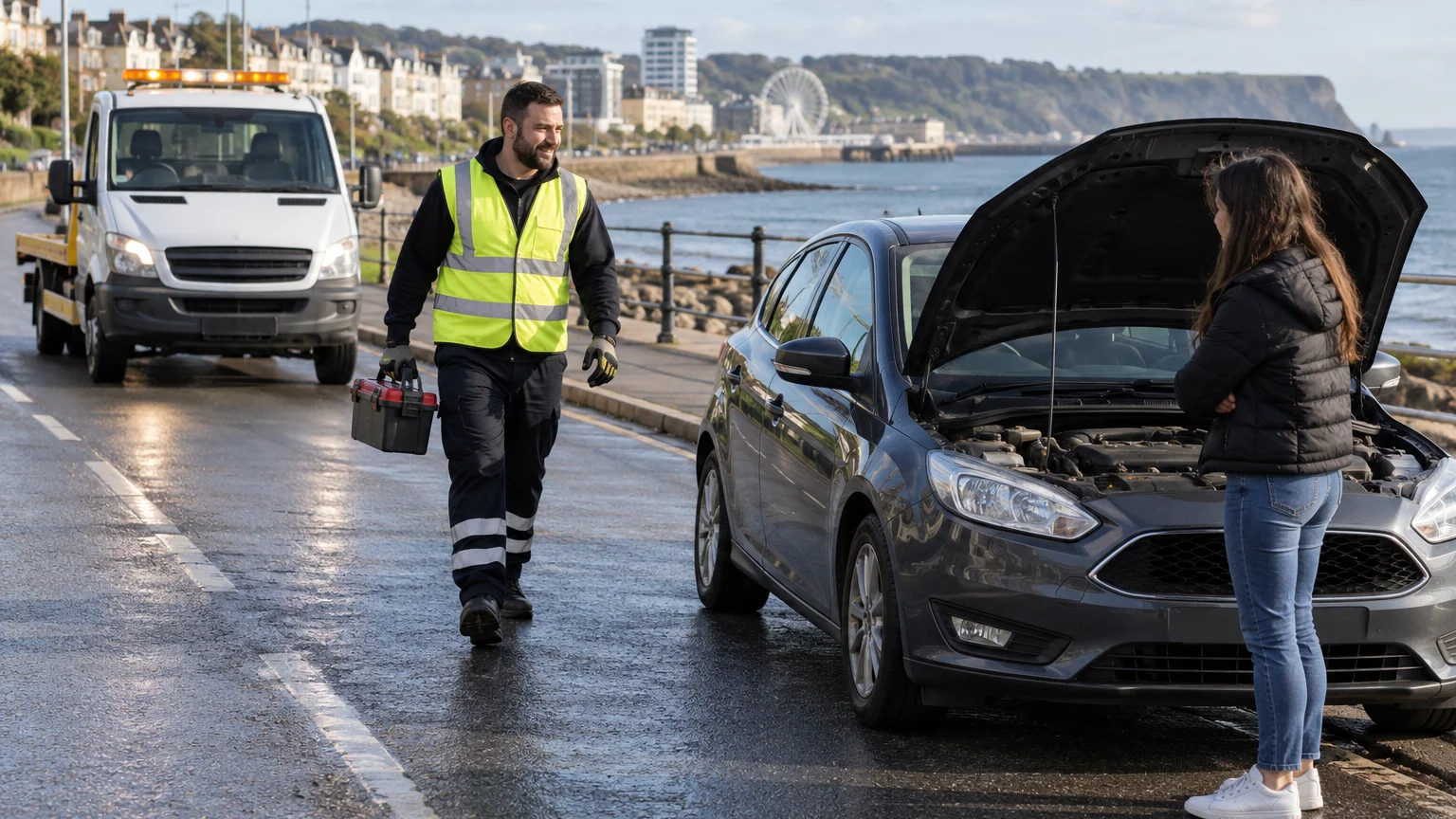
Share whether you’re on I-5, Highway 101, or a side street
Start with the road name and your direction of travel. “Cardiff” alone doesn’t give dispatch enough information to place you.
On I-5, share whether you’re traveling north or south. Give the nearest exit, sign, overpass, or visible landmark. If you recently entered from Birmingham Drive, say so.
Your safety comes first. Stay aware of passing vehicles and follow any instructions from law enforcement. NHTSA roadside safety guidance advises drivers approaching a stopped vehicle with flashing lights to move into a nonadjacent lane. If moving over isn’t safe, slow down.
On Highway 101, describe which side of the road you’re on. Include the nearest cross street and your direction. Traffic, parked cars, cyclists, pedestrians, and curb access can affect where a driver can approach.
A side-street pickup needs different details. Send the street name, nearest intersection, and address if one is visible. Mention whether the car blocks a driveway or travel lane. Also report gates, tight turns, or limited curb space.
Quick Tow connects stranded drivers with local operators. For emergency towing, clear location details help the dispatched operator understand the pickup before accepting the job.
What changes near coastal lots and neighborhood grades
A Cardiff towing request near the coast can involve more than a street address. Coastal parking areas may have narrow entrances, marked spaces, curbs, pedestrian traffic, or access controls. Don’t assume every service vehicle can enter every lot.
Tell dispatch whether the vehicle is in a public street space, private lot, garage, driveway, or access lane. Describe any posted clearance sign, gate, pay station, or locked entrance. If a property manager controls access, confirm how the driver can enter.
Don’t promise that someone can open a gate after hours. Instead, get the current access instructions from whoever manages the property. A tow operator can’t complete a pickup from an area they can’t legally or physically reach.
Neighborhood grades need another set of details. Say whether the car faces uphill or downhill. Report whether the wheels turn, the steering is locked, or the transmission can shift.
Ground conditions also matter. Tell dispatch if a wheel is against a curb, off the pavement, or settled into sand or soft ground. These facts help the operator decide whether the request is a standard tow or a recovery situation.
Cardiff’s mix of coastal access and sloped residential streets differs from nearby communities. Drivers farther north can review the Encinitas I-5 and Highway 101 guide. Southbound drivers can use the Solana Beach towing guide for that pickup area.
When roadside assistance may fit
Not every disabled car needs transportation. A basic roadside problem may be resolved where the vehicle sits, provided the location is safe and the vehicle has no signs of serious damage.
A dead battery, simple lockout, empty fuel tank, or usable spare tire may point toward roadside assistance. Describe the symptoms instead of diagnosing the problem yourself. “The dash lights come on, but the engine won’t turn” is more useful than guessing that the starter failed.
Location can change the decision. A service that makes sense in a roomy parking area may be unsafe beside moving traffic. If you’re on I-5, tell dispatch that first. The operator can assess whether roadside work is appropriate at that location.
San Diego County’s Freeway Service Patrol provides free roadside help on covered freeway segments during its operating periods. It’s run by SANDAG with Caltrans and the California Highway Patrol. Drivers can request assistance by calling 511 and saying “Roadside Assistance.” Service isn’t available on federal holidays, and coverage depends on the route and schedule.
Freeway Service Patrol can provide a gallon of gas, a jump start, radiator water, or a flat-tire change. Confirm current coverage through 511 rather than assuming your exact location qualifies.
Share any fuel smell, smoke, leaking fluid, or severe mechanical noise with dispatch.
When arranging a tow makes more sense
Arrange a tow when the vehicle can’t be made roadworthy at the pickup point. Collision damage, steering trouble, wheel damage, transmission problems, overheating, or repeated stalling can make further driving unsafe.
A tow also makes sense when a roadside attempt has already failed. Tell dispatch what was tried. If another provider attempted a jump start, say so. If the vehicle starts but immediately shuts off, include that detail.
Don’t drive simply because the engine restarts. Warning lights, rising temperature, grinding sounds, or a tire that won’t hold air can signal a problem that roadside help won’t resolve. The safer destination may be a repair shop, tire shop, dealership, or another location chosen by the vehicle owner.
The operator sets the price and receives payment directly. Before accepting the job, confirm the pickup, destination, vehicle details, and quoted charges with that operator. Quick Tow doesn’t publish a Cardiff rate card because the trip and operator determine the charge.
For an I-5 pickup, share whether law enforcement or another responder is already present. Follow their directions at the scene. Don’t arrange competing service vehicles if an officer has already taken control of the incident.
A Cardiff tow truck request should also identify the vehicle accurately. Give the year, make, model, drivetrain if known, and current condition. Mention collision damage, missing wheels, locked steering, or keys that aren’t available.
Confirm access, clearance, and the destination
Before dispatch, walk through three points: access, clearance, and destination. This prevents avoidable confusion after an operator accepts the request.
For access, explain where the vehicle sits and how it can be reached. Mention a gated lot, narrow driveway, underground area, steep approach, or crowded curb. Read any posted height limit exactly as shown. Don’t guess.
For clearance, report visible changes to the vehicle. Lowered suspension, body damage, a flat tire, broken wheel parts, or a car resting against a curb can affect loading. Give facts and photos when requested. The operator can determine the suitable approach.
Electric vehicles need exact identification. Provide the year and model, along with battery or collision damage. Manufacturer transport instructions vary. Don’t assume one towing method applies to every electric or all-wheel-drive vehicle.
For the destination, get the full address before calling. Confirm that the repair shop, dealership, tire shop, or residence can receive the vehicle. Ask the destination about key handling and after-hours placement. Quick Tow can connect you with an operator, but it can’t authorize a drop on someone else’s property.
If the destination isn’t decided, say that at the start. The trip distance and final location are part of the job details. Changing them after pickup may change what the operator can accept.
Keep your phone available after placing the request. If you move to a safer nearby location, tell dispatch where you went. Don’t leave the vehicle without sharing how the driver can identify it and access the keys.
When to call us
Call when the vehicle can’t be safely driven or a roadside fix isn’t suitable. Quick Tow will connect you with a local towing operator who can review the vehicle, pickup access, and destination.
Call (858) 923-5787 to reach dispatch.