A breakdown near Tierrasanta can require roadside help or a full tow. The right choice depends on your location, the vehicle’s condition, and whether a simple service could let you leave safely. Quick Tow SD connects stranded drivers with local independent operators.
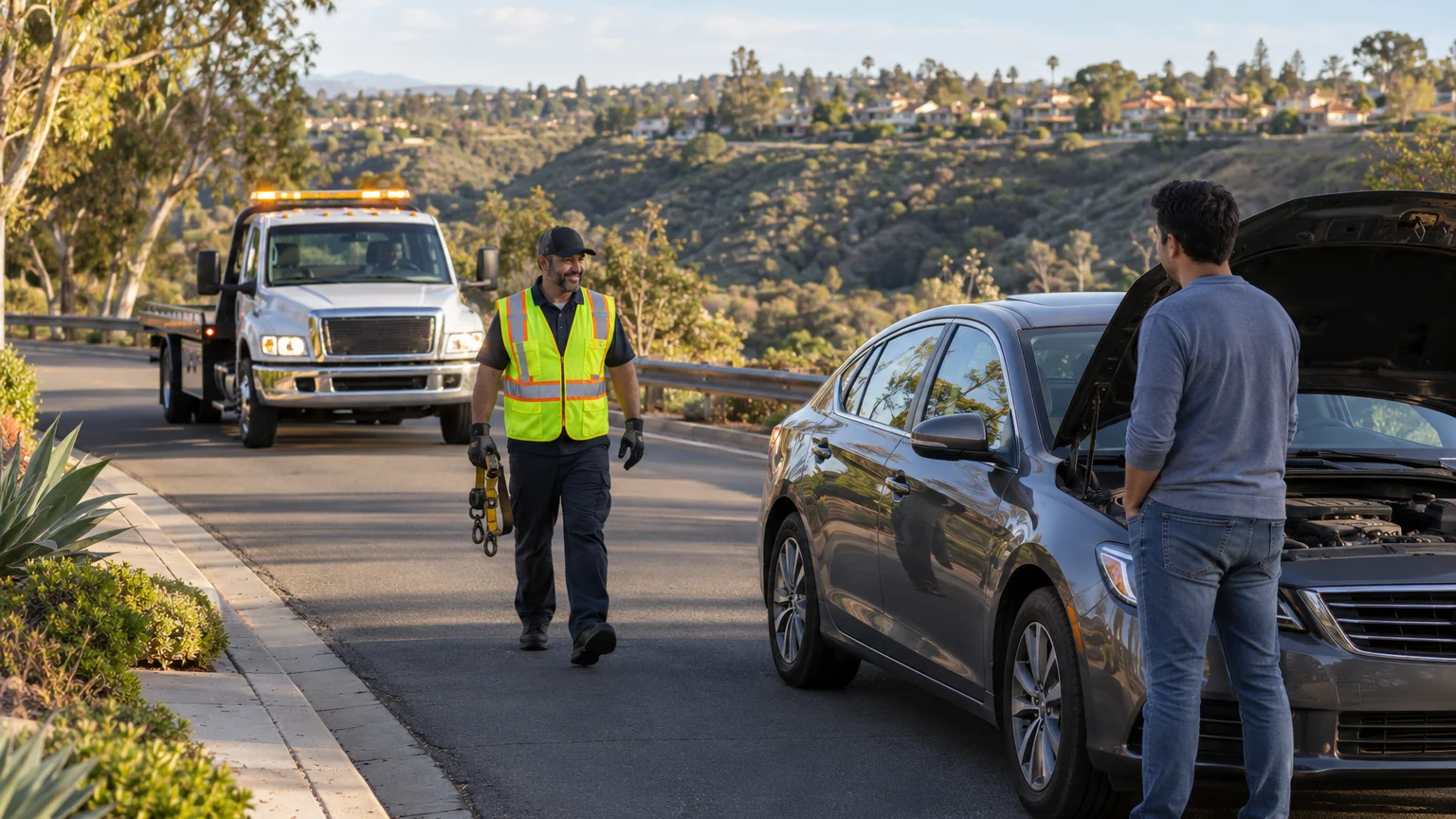
Share whether you’re on SR 52 or a neighborhood street
Start with the road you’re actually on. “Near SR 52” isn’t precise enough for dispatch. Say whether you’re on the freeway, an entrance or exit ramp, Santo Road, Tierrasanta Boulevard, or another neighborhood street.
On SR 52, share your direction of travel and the last exit you passed. Give the nearest visible sign when you can read it safely. Your phone’s map pin may help confirm the location, but tell dispatch if the pin appears inaccurate.
A neighborhood call needs different details. Give the street address, nearest cross street, and the vehicle’s exact position. Say whether it’s at the curb, in a driveway, inside a parking area, or beside a canyon access point. Include any gate, height restriction, steep grade, narrow turn, or unpaved approach.
If the car is exposed to moving traffic, there’s a fire, someone is injured, or you face immediate danger, call 911. The NHTSA roadside safety guidance can help drivers prepare before another breakdown.
Our phone line takes calls around the clock. The independent operator accepting the request provides an arrival estimate for your exact location. No fixed response time can be promised for either SR 52 or Tierrasanta’s neighborhood streets.
Describe what happens when you try to start or move
Tell dispatch what you observe without trying to diagnose it. Useful descriptions include silence when you turn the key, clicking, dashboard lights, an engine that cranks without starting, or an engine that starts and then stops.
Mention warning lights, smoke, unusual smells, leaking fluid, or visible damage.
Explain whether the vehicle can roll, steer, and shift normally. Say whether the parking brake releases and whether any wheel looks damaged. These details help the operator assess the request. They don’t replace an inspection, and they shouldn’t be treated as a diagnosis.
Dispatch also needs the vehicle’s year, make, model, and drivetrain if known. Mention whether it’s an electric vehicle, hybrid, motorcycle, pickup, van, or vehicle carrying a trailer. Manufacturer transport instructions can differ by exact model and condition.
If the car won’t start in a residential or commercial parking area, our guide to a car that won’t start in a parking lot explains what information matters. Avoid taking the vehicle apart while waiting. A short, accurate description is more useful than guessing which component failed.
When roadside assistance may fit
Roadside assistance may fit when the vehicle is safely accessible and the problem appears limited. Common requests include a jump start, help with a flat tire, fuel delivery, or a vehicle lockout. The accepting operator must confirm the service and assess the conditions.
A jump-start request isn’t a promise that the vehicle will remain running. A tire request also depends on the spare, wheel condition, safe working space, and vehicle instructions. Tell dispatch if there’s no spare, the wheel is damaged, or the vehicle sits close to moving traffic.
For a lockout, explain whether a child, vulnerable person, or pet is inside. An immediate safety threat belongs with emergency authorities.
Drivers on a San Diego freeway may also encounter the Freeway Service Patrol. SANDAG runs that free roadside program with Caltrans and the California Highway Patrol on covered routes during published operating periods. Services can include a jump start, one gallon of fuel, radiator water, or a flat-tire change. Coverage depends on the route, schedule, and holiday rules, so check the current program details through the California Highway Patrol.
AAA benefits depend on current membership terms. The approved information confirms service-call allowances and towing-distance differences by tier, but it doesn’t confirm that a nonmember can request member service. Ask AAA directly before relying on that option.
When arranging a tow makes more sense
A tow may make more sense when a roadside service won’t make the vehicle safe to drive. Examples include collision damage, steering trouble, damaged wheels, repeated stalling, or a vehicle that can’t shift or roll normally. Describe the symptoms and let the accepting operator assess the transport method.
Don’t drive simply because the engine starts again. Warning lights, leaking fluid, smoke, or damaged steering can signal conditions that need professional attention. The operator can transport the vehicle, but a repair facility determines what failed.
Tell dispatch if the car sits on an SR 52 shoulder, blocks traffic, or occupies a narrow access point. Also mention missing keys, low clearance, locked steering, damaged suspension, or wheels that can’t rotate. These facts can affect the operator’s equipment assessment.
Electric vehicles need exact model information. Manufacturer procedures aren’t universal. For example, verified Tesla Model 3 and Ford Mustang Mach-E instructions require all wheels off the ground during transport, while permitted methods and loading steps differ. Give the operator the exact year, model, damage condition, and access details so the correct manufacturer procedure can be checked.
Quick Tow SD provides emergency towing connections through independent operators. The operator accepting the job sets the price, confirms payment terms, and gives the arrival estimate. Ask for those details before authorizing the service.
Confirm canyon access and the destination
Tierrasanta pickup details shouldn’t end with a street name. Canyon-adjacent roads, private parking areas, gates, slopes, and narrow approaches can change how an operator reaches the vehicle. Say whether the car remains on pavement and whether a normal service vehicle can approach it.
If the vehicle left the paved surface, don’t describe the request as an ordinary roadside stop. Share how far it traveled, which wheels are off the road, and whether the ground appears soft or unstable. The operator must assess access, vehicle position, and required equipment.
Send a map pin when possible, then confirm it with a written location. Include the nearest address, cross street, gate instructions, parking level, or recognizable entrance. If you’re near Santo Road or Tierrasanta Boulevard, state which roadway you’re actually on and your direction of travel.
Choose a destination before authorizing a tow. It might be your home, a repair facility, a tire shop, a dealership, or another lawful location that has agreed to receive the vehicle. Confirm the destination address and whether it’s open. Don’t assume a closed facility accepts unattended vehicles or after-hours key drops.
For an SR 52 stop, review our San Diego freeway breakdown guide while staying focused on immediate safety. Clear pickup and destination details reduce confusion when the independent operator reviews the request.
When to call us
Call when a disabled vehicle can’t be handled safely with a simple roadside step, or when an operator needs to assess whether towing is appropriate. Quick Tow SD connects you with vetted, licensed and insured independent operators, while the operator performs the work and sets the price. Call (858) 923-5787 to reach dispatch.