What is considered blocking a driveway in California is any vehicle stopped or parked in front of a public or private driveway, under California Vehicle Code 22500(e). “In front of” covers the apron, the sloped curb cut leading up to the driveway, and it covers a partial overhang: a bumper across part of the opening is still an obstruction. There is no legal allowance for leaving a gap wide enough to squeeze past.
People ask two different questions when a car sits near their driveway. One is what to do about it, which is covered in the companion guide on what to do when a car is blocking your driveway in San Diego. The other, the one this post answers, is whether the car is actually breaking a rule in the first place. The apron, a partial overhang, and a car parked in front of your driveway on the sidewalk side are three separate situations, and they don’t all count the same way.
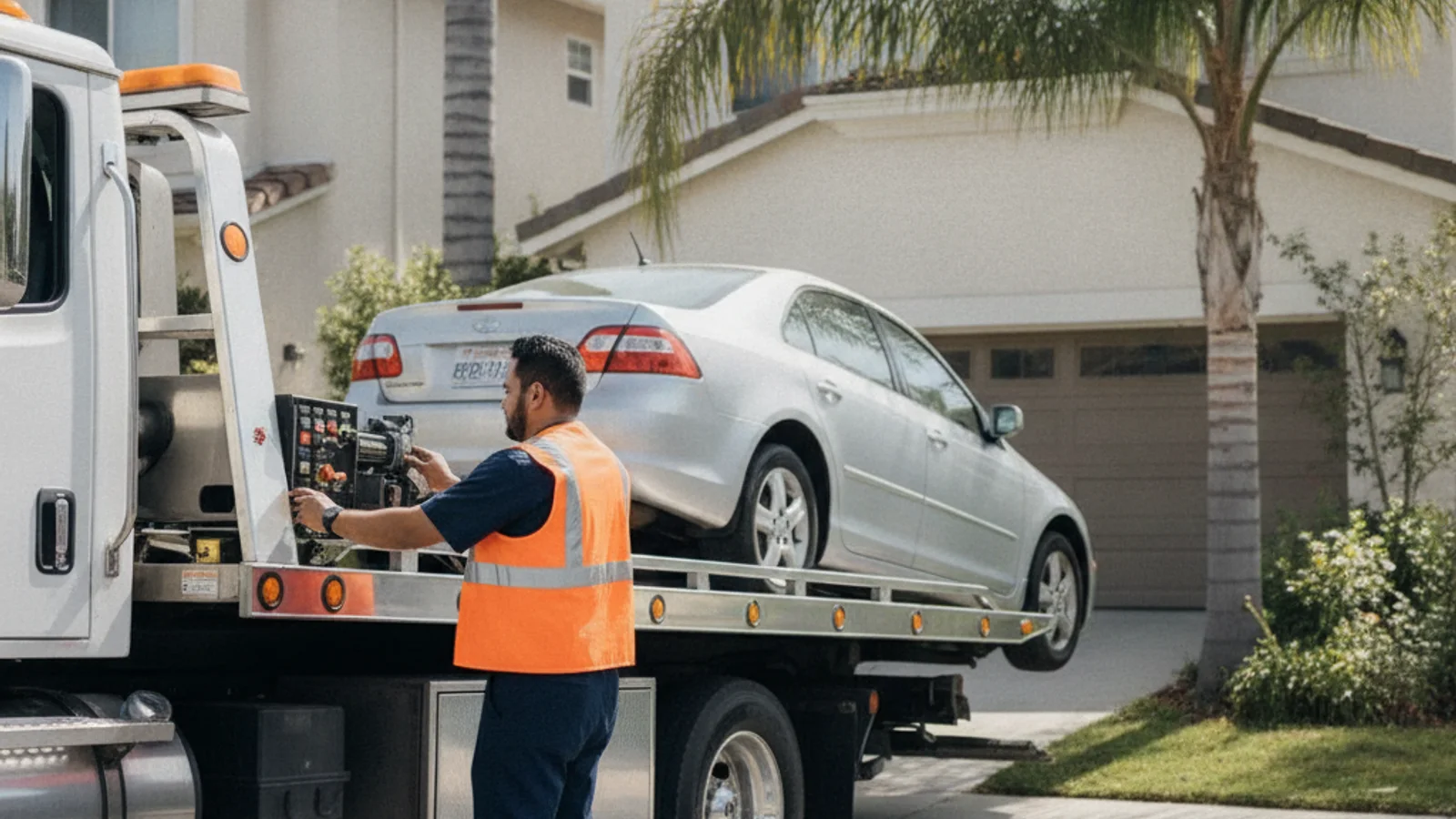
The apron counts, not just the garage door
The driveway apron, the paved curb cut that slopes from the street up to your driveway, is part of what the law protects. California Vehicle Code 22500(e) makes it illegal to stop or park in front of a public or private driveway, and that includes the apron area, not only the space directly in front of the garage. A car that’s parked so its bumper sits over the curb cut, even if the rest of the car is on the street, is sitting in the protected zone.
A partial overhang is where this gets less clear-cut in the reading, but not in the outcome. If any part of a vehicle blocks the driveway approach enough that a car can’t reasonably pull in or out, it counts as blocking, whether the car is fully across the apron or just clipping the edge of it. Where exactly a partial overhang crosses the line into “blocking” isn’t published anywhere as a fixed measurement, in inches or in percentage of the driveway width. That call sits with whichever agency responds, whether that’s SDPD Tow Administration for a police-ordered tow or the local police department handling the call. If you’re not sure whether a partial overhang qualifies, that’s a question for the responding agency, not something you can measure with a tape measure and settle yourself.
Blocking the sidewalk in front of a driveway is the same violation
A car doesn’t have to sit in the driveway itself to block it. If a vehicle is parked across the sidewalk directly in front of your driveway approach, so that a car exiting the driveway would have to stop in the sidewalk or can’t clear the parked car’s front or rear bumper, that’s still a 22500(e) situation. The law is about whether the driveway is usable, not about which exact square footage the offending car occupies. Officers responding to this kind of call, and the officers who can order a tow under CVC 22651(d) when a car blocks a driveway from the public street, look at whether the driveway is actually passable, sidewalk included.
Shared driveways and corner lots complicate the picture
A shared driveway serving two or more homes raises a version of this question that a single-family lot doesn’t. If a neighbor’s car sits across the shared section in a way that blocks your side but not theirs, the driveway is still legally protected under 22500(e), but sorting out whose access was actually cut off can take more explanation than a single-owner case. Be specific when you describe the situation to a responding officer or dispatcher: name which portion of the shared driveway is blocked and whether you personally can’t get a vehicle in or out, rather than describing the car as generally “in the way.”
Corner lots add a different wrinkle. A driveway that opens onto a side street can have its apron partly obscured by a car parked near the corner, and the same 22500(e) protection applies there regardless of which street the driveway technically faces. What sometimes confuses people on a corner lot is a nearby stop sign or crosswalk with its own separate parking restriction; a car illegally parked too close to that corner for a different reason isn’t automatically “blocking your driveway” in the legal sense, even if it happens to sit near your property line. Those are two different violations that can look similar from your window.
You can’t be towed off your own driveway
This one surprises people. If your own car is parked in a way that blocks your own driveway, there’s no violation to report and nothing for a city agency to enforce. The driveway-blocking rules exist to protect a property owner’s access from someone else’s vehicle. You can’t call the police on yourself, and there’s no mechanism for a private-property tow under CVC 22658 against your own car, since that statute is built around an unauthorized vehicle on someone else’s property. If your own parking habits are the problem, moving the car is the only fix; no agency is going to order a tow of a car the property owner parked there themselves.
Red curb versus an unmarked apron, and a city street versus a private road
A curb painted red marks a separate no-stopping zone, and that marking does its own work regardless of whether a driveway happens to be nearby. An unmarked driveway apron doesn’t need paint to be protected. CVC 22500(e) applies whether or not the curb is painted, because the rule is about the driveway, not about signage. Don’t assume an apron without red paint is fair game; it isn’t.
Where the vehicle is sitting also matters. A car blocking a driveway from a public city street is generally a police matter, handled under 22500(e) and 22651(d). A car sitting on a private road inside a gated community or HOA property is a different framework, closer to the private-property rules under CVC 22658, and enforcement runs through the property owner or the HOA rather than a city patrol car. If you’re not sure which situation you’re in, that’s worth confirming with SDPD’s non-emergency line or your HOA management before you assume either rule applies.
Once the question is answered
Knowing that a car qualifies as blocking your driveway is only the first step. What you actually do about it, who you call, whether you need signage in place first, and how a private tow gets arranged, is a separate question with its own process. Our companion guide on what to do when a car is blocking your driveway in San Diego picks up exactly where this one leaves off, once you’ve confirmed the car in front of you actually counts.
When to call us
Once you or an agency has confirmed a car is genuinely blocking access and needs to move, getting it off the property or off the apron is a job for a licensed operator, not something to attempt yourself. Call (858) 923-5787 to reach dispatch.