A collision near I-15 can leave you shaken and unsure what comes next. Before requesting accident recovery in Scripps Ranch, handle immediate dangers and collect a few useful details. That information helps dispatch find an operator suited to the vehicle and scene.
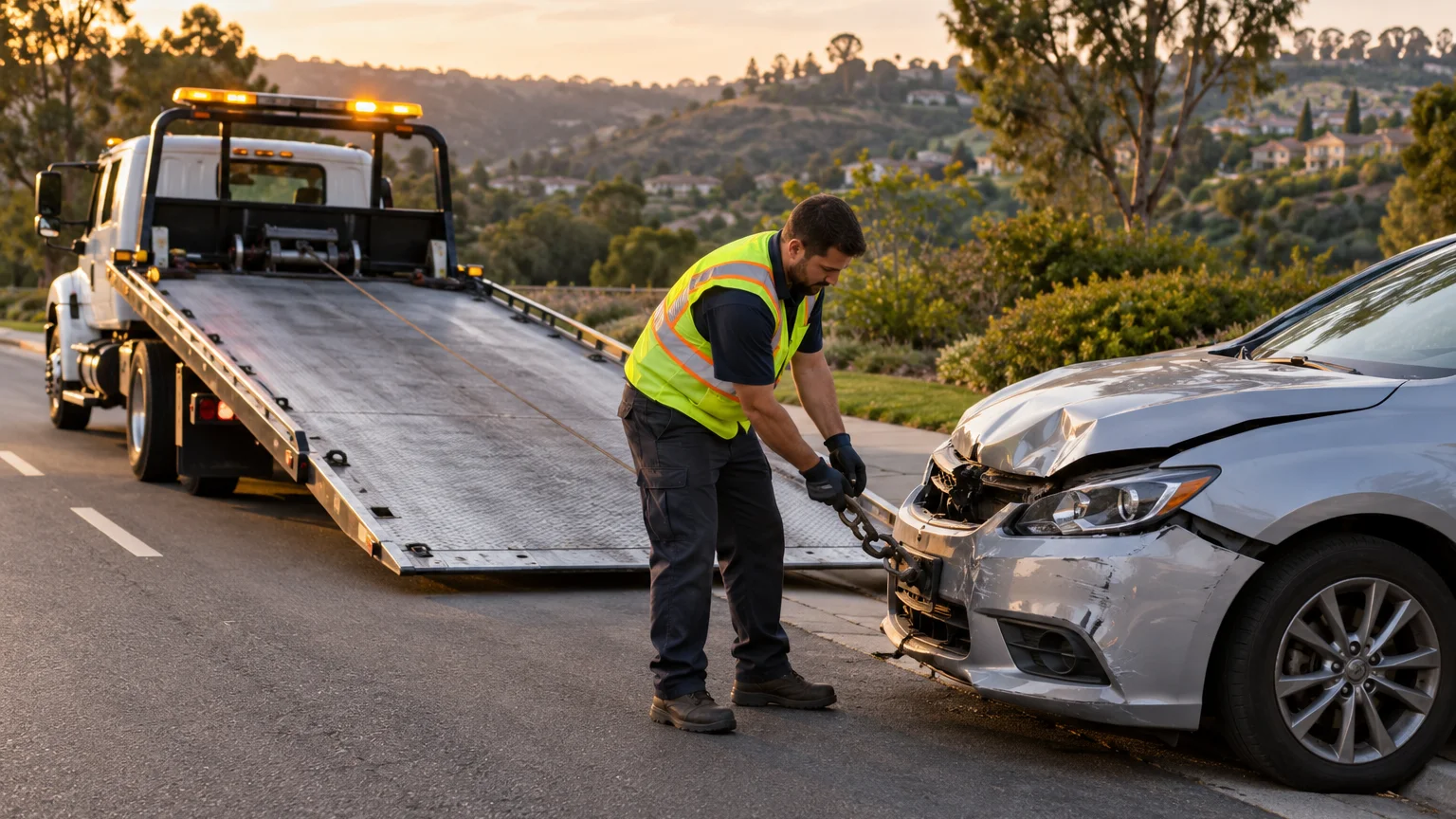
Handle immediate hazards before arranging recovery
Injuries and active roadway hazards come before vehicle recovery. Call 911 if anyone may be hurt or the crash creates an immediate danger. That includes fire, smoke, exposed traffic, or a vehicle blocking moving lanes.
Follow instructions from emergency personnel at the scene. Don’t walk through freeway traffic to inspect damage. Don’t stand between damaged vehicles or near an unstable vehicle. If authorities direct you to a safer location, tell dispatch where you moved.
Turn on the hazard lights if they still work. Keep yourself away from traffic while you wait. The National Highway Traffic Safety Administration also advises approaching drivers to move over when possible or slow down around stopped vehicles.
A crash on an I-15 shoulder needs different handling from one inside a parking lot. The same applies when a vehicle rests against a curb, median, embankment, fence, or another car. Share those conditions before anyone is sent.
Quick Tow SD connects callers with local independent operators. The operator taking the job will give an arrival estimate for the exact location. We don’t publish a general response time because access and scene control differ after every collision.
If emergency authorities are still managing the roadway, say so during the call. Dispatch needs to know whether the vehicle is ready for removal or remains inside an active scene.
Share your direction and nearest safe reference point
“Scripps Ranch near the freeway” isn’t enough for accurate dispatch. I-15 has traffic moving in two directions, separate ramps, and locations that may look similar from a map pin. Start with your direction of travel and the side where the vehicle stopped.
Read nearby signs without stepping into traffic. A ramp name, exit sign, street sign, business entrance, or visible address can narrow the pickup point. If you see signs for Scripps Poway Parkway or Pomerado Road, repeat the wording exactly. Don’t guess which road you’re on.
Confirm your position using a map application if it’s safe. Check whether the pin sits on the freeway, a ramp, a frontage area, or a nearby street. Send the pin only after checking it against a visible reference point.
For crash towing in Scripps Ranch, useful location details include:
- Northbound or southbound travel
- Main lanes, shoulder, ramp, or surface street
- The nearest readable road or exit sign
- Whether the vehicle is before or after that reference
- Any gate, median, barrier, or narrow entrance
- Where you’re safely waiting
A caller near Pomerado Road shouldn’t assume the operator will approach from I-15. Likewise, a freeway map pin may not show which shoulder holds the vehicle. Clear directions reduce avoidable confusion during the handoff.
For a nearby collision outside the neighborhood, our guide to accident recovery towing in Poway explains the same dispatch details in that area. Always confirm the current route names and access point using road signs or your mapping app.
Describe whether the vehicle can roll or steer
Visible body damage doesn’t tell dispatch whether a vehicle can be loaded normally. Describe what changed after the impact, even when the engine still runs. A damaged car shouldn’t be driven just because it starts.
Tell dispatch whether the vehicle can roll, steer, and shift into neutral. Mention wheels that point in different directions, sit at an unusual angle, or touch damaged body panels. Also report flat tires, missing wheels, leaking fluid, deployed airbags, broken glass, or parts dragging underneath.
Don’t test the steering or force the transmission if doing so feels unsafe. Don’t crawl under the vehicle to inspect it. A simple description from a safe position is more useful than a risky diagnosis.
The position of the keys also matters. Say whether they’re with you, locked inside, missing, or being held by emergency personnel. If the vehicle uses a keyless system, identify the exact year, make, and model when possible.
Photos can help the operator understand the scene. From a safe position, capture the vehicle’s overall position, wheel condition, nearby obstacles, and available approach. Don’t enter a traffic lane for a better angle.
These details help dispatch distinguish routine transport from accident recovery and winch-out service. They don’t guarantee a particular recovery method or result. The operator must assess the vehicle, damage, and access before proceeding.
How a tow differs from a recovery request
A tow request usually involves a vehicle resting on a stable, accessible surface. The vehicle still may not run, but its position allows the operator to plan ordinary loading and transport.
A recovery request involves another problem before transport can begin. The vehicle may be off the pavement, pressed against an object, facing the wrong direction, or unable to roll. Collision damage may also prevent normal loading.
That distinction matters when requesting a tow truck near I-15 in Scripps Ranch. Saying “I need a tow” doesn’t explain that the front wheels are locked beside a barrier. Describe the position first, then explain the damage you can safely see.
Dispatch may ask whether every wheel remains on the pavement. You may also be asked about slope, soft ground, curb height, clearance, and nearby obstacles. Answer only what you can confirm. “I can’t see that safely” is better than guessing.
Don’t attempt to pull, push, or straighten a collision-damaged vehicle yourself. Hidden damage can affect the wheels, steering, suspension, or high-voltage components. Give the exact vehicle year and model, especially for an electric or hybrid vehicle.
If the car is accessible but unsafe to drive, emergency towing may fit the request. If it must first be moved from a difficult position, explain that during the initial call. Dispatch can then share the facts with an operator who evaluates the scene.
Confirm access and the destination before dispatch
Vehicle recovery in Scripps Ranch involves two locations: the crash scene and the delivery point. Confirm both before dispatch whenever circumstances allow. A complete request prevents confusion after the vehicle is loaded.
Start with access. Tell dispatch about locked gates, parking structures, steep driveways, narrow lanes, security checkpoints, or blocked entrances. If the vehicle is inside a garage, provide the posted clearance. Don’t estimate it from memory.
If police, firefighters, property staff, or another authority controls the scene, say who currently has access. Don’t promise that a gate will open or a roadway will clear. Provide the contact or instructions you were given, without inventing details.
Next, choose a destination. It might be a repair facility, dealership, body shop, residence, or another authorized location. Confirm the name, street address, entrance, and current acceptance instructions directly with that destination. Don’t assume a closed facility will accept an unattended vehicle.
Ask whether the destination has a specific drop-off area. Confirm who can authorize delivery if you won’t travel with the vehicle. Keep personal property, medication, house keys, and needed documents with you when authorities allow access.
The operator performs the work, sets the price, and receives payment directly. Quick Tow SD makes the connection and doesn’t operate a storage yard. If you’re unsure what happens after removal, read what happens to your car after an accident tow.
Before ending the dispatch call, repeat the pickup point, vehicle description, access limits, and destination. Correct any detail that doesn’t match the scene.
When to call us
Call when collision damage makes driving unsafe or the vehicle needs professional recovery before transport. Quick Tow SD connects you with a local towing operator and takes calls day or night. Call (858) 923-5787 to reach dispatch.