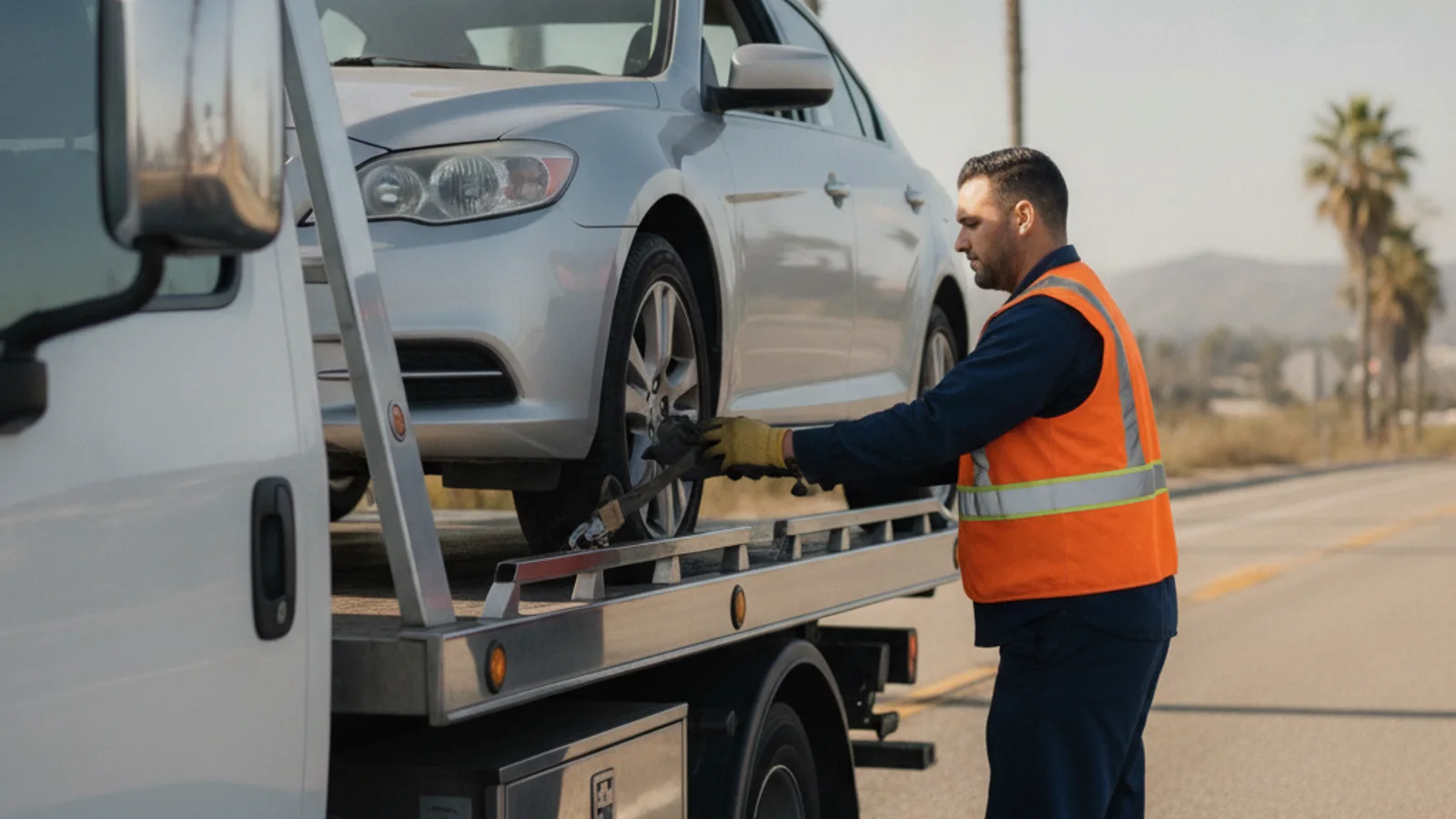
A tow truck backs up, hooks the lift arm to your bumper, and you’re still in the driver’s seat with the engine off. It happens more than people expect: a lot gets cleared while someone runs back to move a car, or a driver returns mid-hookup instead of after.
What we can actually confirm
California Vehicle Code 22658, the statute governing private-property tows, gives an owner a specific right: if you return before the tow truck leaves the property, the vehicle must be released to you immediately upon request. That right is tied to timing, the truck leaving the lot, not to whether you were ever inside the car. Our CVC 22658 breakdown covers that release right and the signage rules that have to be in place for the tow to be valid in the first place.
California Vehicle Code 22651.07 adds separate consumer protections once a vehicle is in storage: an itemized invoice, the right to inspect the vehicle and retrieve personal property at no charge during business hours, and payment method rules for the storage facility. Neither of those sections, in the sources we can verify, directly addresses what happens the moment a tow driver hooks up to a car with a person still sitting inside it.
What isn’t settled here
We looked specifically for a California statute or agency guidance that answers “can a tow proceed once someone is inside the vehicle.” We didn’t find one in the sources this site’s claims are built from. That doesn’t mean no rule exists anywhere, only that we can’t confirm one, and this page won’t guess at what a court or an officer would rule in that exact moment. If that question matters to your specific situation, the California Highway Patrol and your local police or sheriff’s non-emergency line are the right places to ask, since they’re the agencies that actually enforce towing law on the ground.
What is confirmed is the release right once you return before the truck leaves, and the fact that operators must notify law enforcement within a set window after removal under 22658. Those are procedural facts about timing and paperwork. They aren’t the same question as what a driver is legally allowed to do the instant a vehicle is occupied.
What changes once the wheels are actually off the ground
Practically, the moment matters more once a vehicle is lifted than while it’s simply hooked but still resting on the ground. A car with its drive wheels raised isn’t something you can safely drive away in, occupied or not, and trying to start the engine or shift gears at that point risks damaging the vehicle or the tow equipment, on top of whatever the legal question turns out to be. We don’t have a verified source describing what a driver is required to do at that specific stage, so we won’t state a rule here that we can’t back up.
Why this question comes up so often
Most of the situations that raise this question aren’t dramatic standoffs. They’re ordinary mix-ups: a lot getting cleared for an event while a driver is still inside finishing a phone call, a repossession attempt where the vehicle’s owner happens to be sitting in it, or a private lot enforcement sweep that starts before someone realizes their car is the target. In nearly all of these, the honest answer is that the situation resolves through a conversation, not a legal showdown in the parking lot. That’s a separate question from repossession specifically; if a lender’s agent is involved rather than a tow company, our guide on whether a repo agent can come onto private property in California covers that distinct legal question.
What a driver is realistically going to do
In practice, most tow operators don’t want a confrontation with an occupied vehicle any more than you do. A driver who realizes someone is inside the car is likely to stop and talk rather than continue the hookup, both because of liability exposure and because most operators would rather resolve it than escalate it. That’s a realistic expectation based on how these situations generally play out, not a guaranteed legal outcome, and it isn’t a substitute for knowing your actual rights once the tow yard mails you a notice. Our guide to your rights during a San Diego tow covers what happens after a tow is already underway.
The practical script if it happens to you
- Stay calm and stay in the vehicle unless the operator asks you to move for safety reasons.
- Don’t argue physically or try to block the equipment. That escalates a situation a phone call can resolve later.
- Ask the operator directly to state their name, the towing company’s name, and the truck number.
- Take a photo of the truck, the license plate, and any signage on the property if it’s safe to do so.
- Once the situation is resolved, whether the tow proceeds or stops, write down the time, location, and what was said while it’s fresh.
- If you believe the tow was improper, dispute it afterward through the property owner, the towing company, or a post-storage hearing if it was a police-ordered tow, rather than trying to settle it on the spot.
Documenting calmly protects you far better than winning an argument in the moment does.
Where to actually get the answer to this question
If you want a definite legal answer for your specific situation rather than a general read, the two places that can genuinely give one are the California Highway Patrol, for anything on a state highway or involving a CHP-regulated tow operator, and your local police or sheriff’s department, for anything on city streets or private property within their jurisdiction. Neither of those agencies is us, and we don’t run an impound lot or employ tow drivers, so we can’t speak for what a specific officer or company would do in your exact case. What we can tell you is what’s actually written into the statutes we’ve verified, which is the release-timing right under 22658 and the storage protections under 22651.07, and nothing beyond that.
If the situation already happened and you’re trying to sort out what comes next, whether that’s disputing a tow or figuring out how to get the car back, our broader guide on knowing your rights during a San Diego tow is the better next read, since it covers the full sequence rather than this one narrow moment.
When to call us
If your car has already been towed and you need it moved again once it’s released, or you’re dealing with a breakdown that’s putting you at risk of an unwanted tow, that’s a situation for a licensed operator to sort out, not something to handle roadside on your own.
Call (858) 923-5787 to reach dispatch.