An unfamiliar car has been sitting outside your San Diego home. Before seeking a tow, determine whether it’s on a public curb, private property, or blocking legal access. Those situations follow different paths.
Separate a public curb from private property
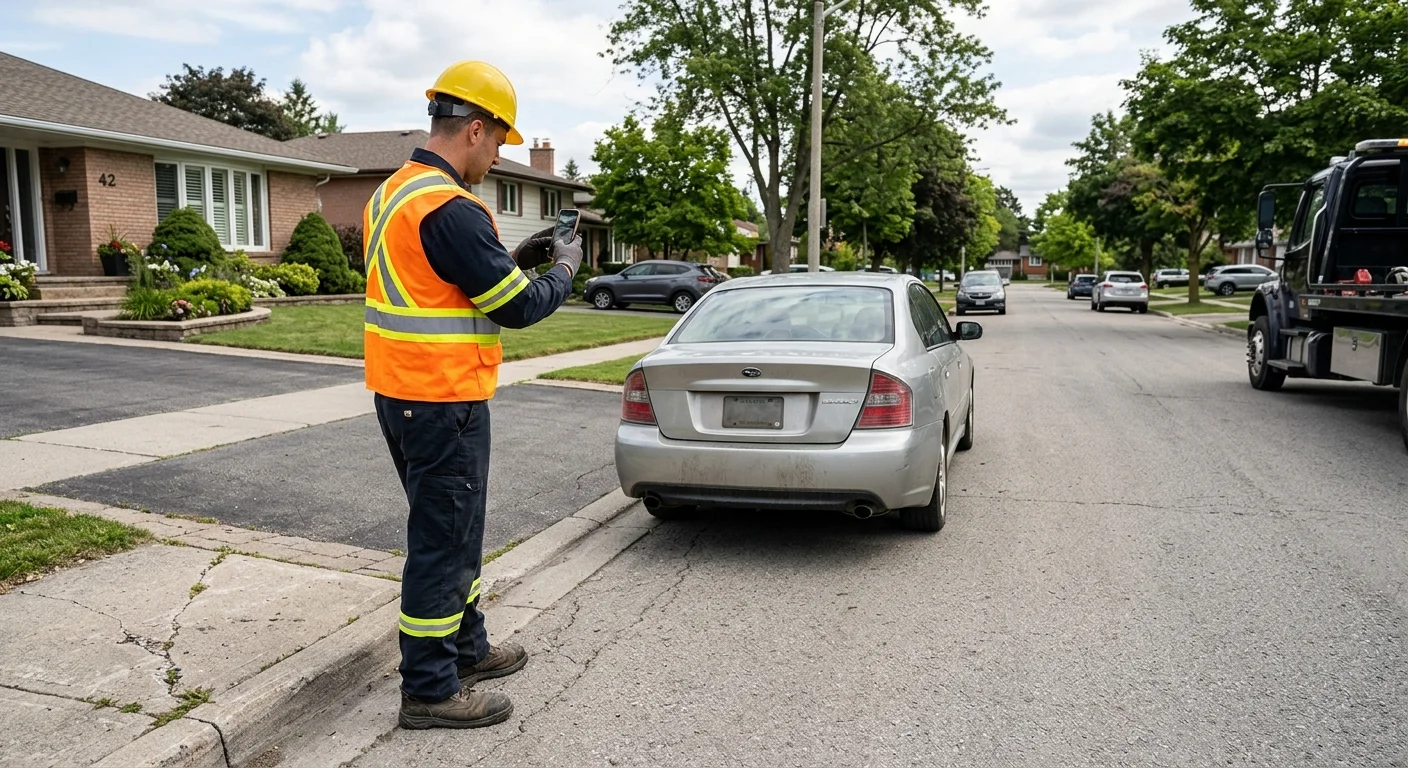
A car beside your house isn’t necessarily on your property. Start by locating the curb, driveway apron, property entrance, and any posted parking signs. Don’t rely on where your fence, lawn, or mailbox appears to end.
This distinction matters across San Diego County. Curb layouts in North Park and City Heights differ from larger residential lots in Poway or El Cajon. Coastal neighborhoods such as Pacific Beach also have dense curb parking that can make an unfamiliar vehicle feel unusually close.
A rule allowing a homeowner to order a private tow merely because a vehicle occupies the public curb outside could not be confirmed. Ask the authority responsible for that street to review the facts. Don’t represent the curb as private property when contacting a towing operator.
A driveway, assigned parking space, apartment lot, and shopping-center lot present different questions. Our guide to a car parked in your assigned space explains why possession or management authority matters.
California Vehicle Code 22658 governs qualifying private-property removals. It includes detailed requirements involving authorization, signs, notice, and vehicle storage. Read the current text of California Vehicle Code 22658 before treating a private lot like a public street.
If the vehicle is clearly inside property you control, review the private property towing process before arranging anything. A property manager or homeowners association may also control the decision in a shared community.
Check whether the vehicle blocks legal access
A vehicle parked near a driveway isn’t automatically blocking it. Look at the actual driveway opening and how the vehicle affects entry or exit. Avoid deciding based only on inconvenience, preferred curb space, or how close the bumper sits to your property line.
California Vehicle Code 22500(e) prohibits stopping or parking in front of a public or private driveway. Under CVC 22651(d), police may tow a vehicle blocking a private driveway from the street. That authority belongs with police, not a homeowner ordering an ordinary private-property tow from the public roadway.
The physical details still matter. Photograph the curb line and driveway opening together. Capture both ends of the vehicle. Include nearby signs, painted curbs, and an address marker when safe. Those images let the responsible authority evaluate the location without relying on a vague description.
Don’t move, push, unlock, or attach anything to the vehicle. Don’t place objects around it to make the parking position look different. Preserve the scene as you found it.
Our guide to what California considers a blocked driveway gives this issue a closer look. If access is genuinely obstructed, follow the steps for a car blocking your driveway in San Diego.
A narrow street can create other access concerns, especially around alleys and hillside roads. A single measurement or towing rule for every such layout could not be confirmed. Describe the location accurately and let the appropriate public authority assess it.
Document the location without confronting the driver
A short, factual record helps separate a recurring problem from a single parking event. Note when you first observed the vehicle and whether its position changed. Record the make, model, color, plate, and visible condition from a lawful vantage point.
Take wide photographs that show the street context. Include the driveway, curb, intersection, signs, and vehicle in the same frame when possible. A tight photo of one bumper rarely explains whether access is blocked.
Don’t open the vehicle, touch its contents, cover its windows, or leave threatening notes. Avoid confronting anyone who returns to it. Your goal is to give the responsible authority accurate information, not to settle a dispute at the curb.
Separate observations from assumptions. “The vehicle hasn’t moved since Tuesday evening” is an observation. “The owner abandoned it” is a conclusion that may require review by a public agency.
Visible damage, missing parts, accumulated debris, or a long period without movement may raise an abandoned-vehicle question. They don’t give a resident automatic authority to remove a vehicle from a public street. Our San Diego abandoned vehicle removal guide explains the distinction between reporting a vehicle and arranging a private pickup.
If the vehicle is unwanted but located on property you control, ownership paperwork may also affect the next step. Junk car and abandoned vehicle removal applies to authorized removals, not taking a stranger’s car from a public curb.
Keep your notes concise. A plate number, location, visible condition, and clear access issue are more useful than guesses about the owner.
Find the authority responsible for that location
The correct contact depends on where the vehicle sits. First identify whether the location is a public street, private parcel, managed community, or Port District tideland. Don’t start with a towing company and expect its operator to decide who controls the land.
For a public street, contact the parking or police authority responsible for that jurisdiction. San Diego County contains incorporated cities and unincorporated communities, so the authority may change across municipal boundaries. A San Diego mailing address doesn’t always identify the agency responsible for the roadway.
Within a private apartment, condominium, or commercial property, contact the property manager or authorized owner. Ask who controls parking enforcement and whether the space or lane is part of the private parcel. Shared drive aisles and assigned spaces can involve lease terms or association rules beyond what’s visible.
Port District tidelands require another jurisdiction check. Harbor Police patrol Port District tidelands in San Diego, Chula Vista, National City, Coronado, and Imperial Beach. That doesn’t mean every street in those cities falls within Port jurisdiction.
Give the authority neutral facts. State the exact location, plate, vehicle description, observed dates, and whether access is blocked. Ask which current rule applies and what reporting process it requires.
If you can’t confirm who controls the location, check the parcel or street jurisdiction before requesting removal. For a disputed boundary, ask the city, county, property manager, or qualified counsel. A towing operator shouldn’t be asked to resolve a property-line dispute at pickup.
Where to verify the current towing rule
Parking restrictions and agency procedures can change. Verify the rule with the authority that controls the exact location before arranging a tow. Ask for the current public page, posted rule, or written policy supporting the next step.
For a public curb, start with the responsible city or county parking authority or police agency. Ask whether the vehicle’s location, condition, or parking duration qualifies for review. A single countywide waiting period for this exact public-curb scenario could not be confirmed. Don’t rely on a number from a forum or neighborhood post.
For private property, consult the current version of CVC 22658 and the person authorized to act for the property. The statute provides several alternative grounds and detailed procedural requirements. One compliant fact doesn’t erase the other requirements that apply to a particular removal.
For an apparently abandoned vehicle, confirm the local reporting process with the responsible authority. Don’t assume ownership paperwork gives a resident permission to remove a stranger’s vehicle.
Before accepting instructions, write down the agency name, contact date, and guidance received. If the answer remains unclear, request written direction or speak with qualified counsel. That extra check is especially useful when the curb boundary, vehicle ownership, or property authority is disputed.
The safest answer to “who to call about a parked car” starts with jurisdiction. Public authorities review public-street concerns. Authorized property representatives handle qualifying private-property situations.
When to call us
Call when an authorized private-property removal needs a professional operator, or when you need help moving a vehicle you own. Public-curb enforcement should first go through the authority responsible for that street. Call (858) 923-5787 to reach dispatch.