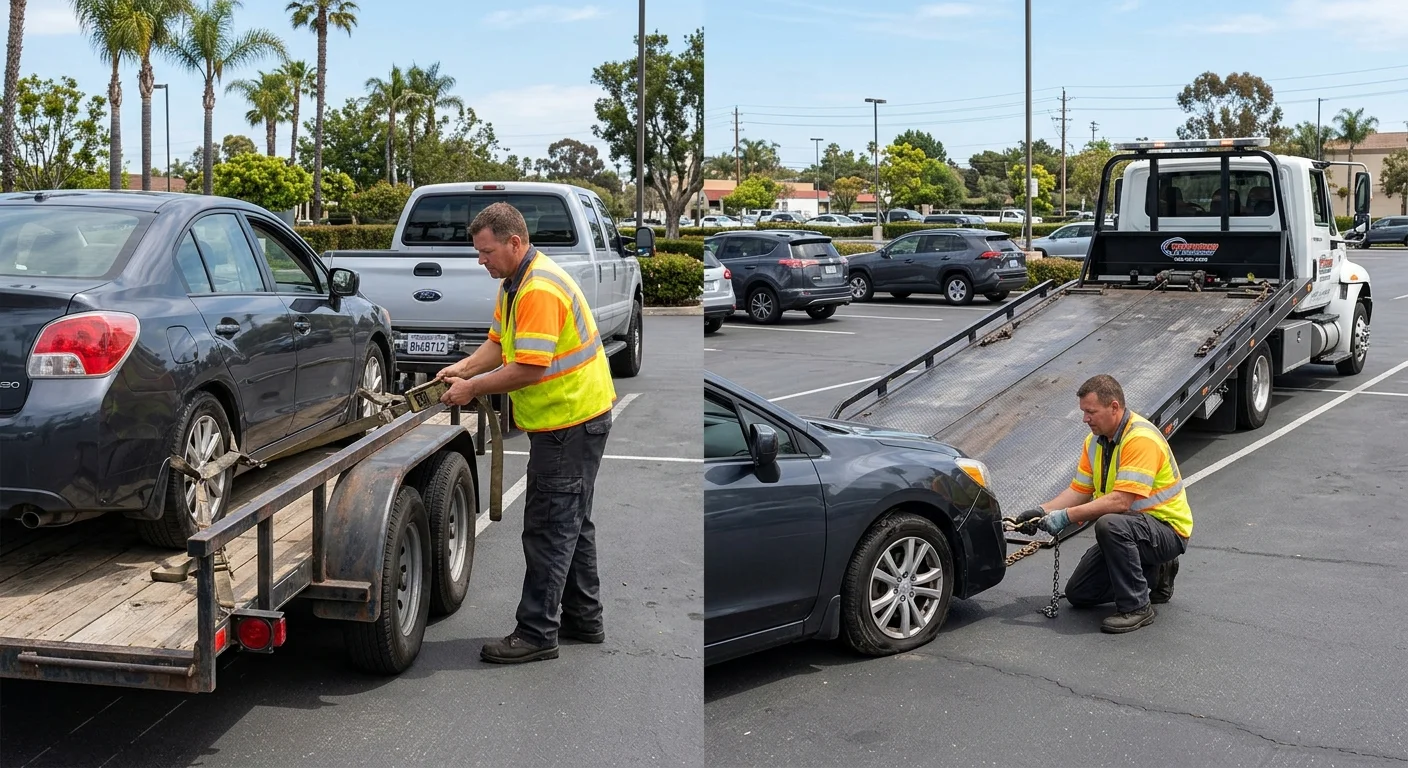
For a non-running car, a professional flatbed tow truck is usually the practical choice when the vehicle is stranded, damaged, or difficult to move. A flatbed trailer for towing a car makes sense when you already have a confirmed tow setup, enough loading space, and instructions for that exact vehicle. If any part is uncertain, don’t improvise the move.
Start with the car’s condition and location
The decision begins with what the car can still do. Tell dispatch whether the vehicle rolls, steers, and shifts into neutral. Mention missing keys, locked wheels, damaged suspension, flat tires, loose body panels, or visible collision damage. These details help the operator decide how the car can be handled.
Location matters just as much. A disabled car in an open driveway presents a different problem from one inside a Downtown San Diego parking structure. City Heights alleys, hillside streets near La Mesa, and crowded lots around Mission Valley can restrict loading space. A freeway shoulder along Interstate 5, Interstate 8, Interstate 805, or State Route 163 leaves no room for experimenting with a rented trailer.
If the car is exposed to moving traffic, focus on getting professional help. NHTSA roadside safety guidance recommends keeping a phone and charger, flashlight, first aid kit, water, jumper cables, and nonperishable food in the vehicle.
Quick Tow SD takes the call and matches customers with independent operators. The operator evaluates the vehicle and pickup location before choosing equipment. Our San Diego towing service page explains how that referral process works within the city.
When a flatbed trailer may not fit the job
A car carrier trailer is transport equipment that must be paired with a suitable tow vehicle and loading plan. Trailer availability alone doesn’t confirm that the full combination works for your car. The rental company, tow-vehicle manufacturer, trailer provider, and vehicle manual should agree on the setup.
A non-running car can complicate loading. It may not roll, steer, or shift normally. Collision damage can also leave a wheel out of position. Loading under those conditions may require recovery equipment and training. That isn’t a good place for trial and error.
Space can rule out a trailer before the trip begins. The pickup and destination both need enough room for the complete combination. Tight garages, narrow alleys, steep approaches, and packed apartment lots may not provide it. The same concern applies when the car must be collected beside fast traffic.
People also compare a tow dolly vs car carrier. A dolly and a full car carrier don’t support a vehicle in the same way. The correct choice depends on the specific car, its condition, and its manufacturer’s transport instructions. For a closer look at professional equipment, read our guide to flatbed versus wheel-lift towing.
How a professional flatbed tow protects a disabled car
A professional flatbed tow combines transport equipment with an operator who handles recovery and loading. The vehicle rides on the truck’s deck instead of relying on a customer to assemble and manage a separate towing combination.
The word “flatbed” isn’t a guarantee by itself. Proper handling still depends on the vehicle’s condition and manufacturer instructions. The operator needs to know whether the wheels move, the steering works, and the car has collision damage. Low clearance, missing wheels, or a blocked transmission can change the approach.
Electric vehicles need model-specific attention. Tesla’s Model 3 towing guidance says Tow Mode should be enabled before the car is winched onto a flatbed. It also says that when a flatbed isn’t available, all four wheels must be kept off the ground using wheel lifts and dollies. Those instructions apply to that model and shouldn’t be treated as a universal rule for every vehicle.
Our guide to vehicles that may need flatbed towing covers more situations without assuming one method fits every car. When a flatbed is appropriate, Quick Tow SD can connect you with an independent operator through our flatbed towing service.
Questions about loading, clearance, and drivetrain
Give dispatch a clear description before equipment is assigned. Helpful details include:
- Whether the engine starts
- Whether the car rolls and steers
- Whether the key or key fob is present
- Whether any wheel is missing, locked, or visibly damaged
- Whether the vehicle has low ground clearance
- Whether it’s electric, hybrid, all-wheel drive, or modified
- Whether collision damage affects the body or suspension
- Whether the pickup is inside a garage or behind a gate
- Whether the destination can accept a trailer or tow truck
Don’t crawl beneath a damaged car to investigate. Don’t try to force the transmission, steering, or wheels. Describe what you can see from a safe position and let the operator assess the rest.
We couldn’t confirm a universal rule requiring flatbed transport for every all-wheel-drive vehicle. Manufacturer instructions vary by brand and model. Check the owner’s manual or contact the manufacturer, then share that guidance with dispatch.
Clearance also needs context. A lowered car may require a different loading approach than a standard sedan. A parking structure may restrict truck access even when the car itself has normal clearance. Photos of the vehicle, entrance, and surrounding space can help the operator understand the situation. They don’t replace an on-site assessment, but they can expose access problems before equipment is selected.
What to confirm before choosing either option
Before renting a trailer, confirm the tow vehicle, hitch setup, trailer, disabled car, and route as one complete combination. Ask the rental provider to review the exact vehicle details. Check the car manufacturer’s transport instructions as well. If either source raises a concern, don’t guess.
For a professional tow, provide the pickup address, destination, vehicle year and model, condition, key status, and access limits. Tell dispatch if the car sits on an incline, inside a garage, behind a controlled gate, or near moving traffic. Mention a long trip at the start so the operator can evaluate it correctly.
Ask the assigned operator to state the price and what it covers before dispatch is finalized. Quick Tow SD doesn’t publish a towing rate card. The independent operator sets the price and receives payment directly from the customer.
Distance can shift the decision. Moving a disabled car across one neighborhood isn’t the same as transporting it from San Diego to another county. Our long-distance towing service explains when a dispatched carrier may be more practical than arranging a trailer yourself.
The simplest rule is to stop when the plan depends on an assumption. Unknown drivetrain instructions, locked wheels, collision damage, restricted access, or an unconfirmed tow setup all deserve professional review.
When to call us
Call when a non-running car can’t roll normally, has collision damage, sits near traffic, or occupies a location with limited loading space. Quick Tow SD’s line takes calls 24/7, and we’ll connect you with an independent licensed and insured towing operator serving San Diego County. Call (858) 923-5787 to reach dispatch.