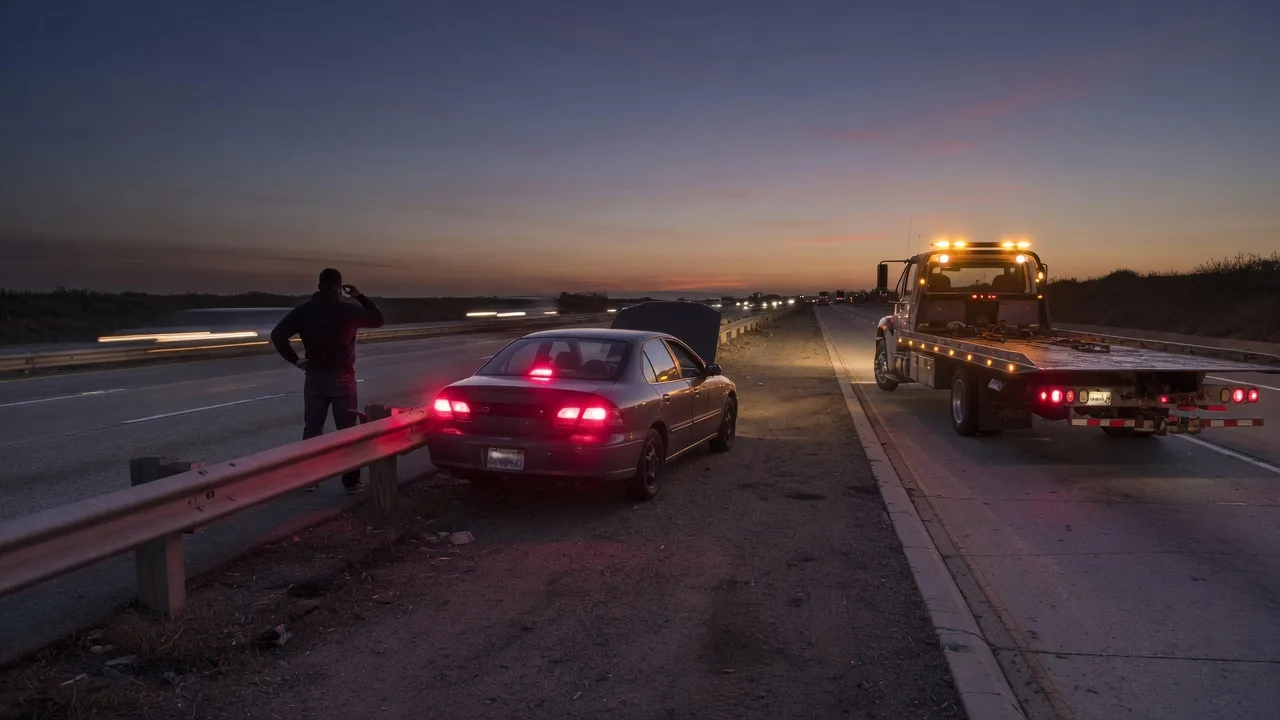
There’s no verified standard tow truck wait time for San Diego. The operator accepting your job should provide the current arrival estimate based on your location, vehicle, access, and nearby truck availability.
Why there is no single wait time
A useful tow truck ETA must come from the operator handling that specific call. Quick Tow SD connects callers with independent operators, but we don’t own trucks or publish an average arrival time.
Current availability matters more than a generic online estimate. The closest suitable truck might be finishing another job. It may also be traveling from another part of San Diego. A truck near Mission Valley isn’t automatically the right choice for every vehicle or pickup.
Traffic can change that estimate after dispatch. I-5, I-805, SR-163, and I-8 connect large parts of the city, but congestion or a blocked ramp can affect the approach. Surface streets through Downtown, North Park, Pacific Beach, and La Jolla present different routing problems.
Distance also matters across San Diego County. Central neighborhoods are different from Alpine, Ramona, Pine Valley, or other backcountry locations. Mountain, backcountry, and Camp Pendleton corridor addresses can take considerably longer to reach than the urban core.
The vehicle and its condition affect truck selection. A movable passenger car in an open lot is a different assignment from a damaged vehicle, motorcycle, RV, or truck. Locked wheels, collision damage, missing keys, and limited clearance may change what the operator sends.
No fixed wait becomes “too long” in every situation. Compare the actual wait with the arrival estimate provided for your call. If that window passes, contact dispatch for an updated location and status.
What changes on a freeway versus a driveway or garage
A freeway pickup needs precise direction and access information. “I’m on I-8” isn’t enough. Dispatch needs your direction of travel, nearest exit, shoulder side, and a clear description of the vehicle.
Freeway ramps and divided lanes can force a driver past your position before circling back. I-5 near Downtown, I-805 through central San Diego, and SR-163 through Balboa Park all have approaches that depend on direction. The operator also needs to know whether the car is fully on the shoulder or obstructing traffic.
Read our San Diego freeway breakdown guide for a fuller safety checklist. Follow instructions from emergency personnel at an emergency scene.
A driveway pickup is usually easier to describe, but access still matters. Tell dispatch whether the vehicle faces toward or away from the street. Mention steep grades, tight gates, loose surfaces, and vehicles blocking the approach.
Parking garages require more detail. The driver needs the garage name or address, level, stall area, entrance location, and posted height clearance. Low ceilings, sharp turns, payment gates, and narrow ramps can limit which equipment can reach the car. Underground garages may also weaken phone or location-sharing signals.
Don’t assume the same arrival estimate applies after the pickup location changes. If security moves you, police direct you elsewhere, or the vehicle reaches a safer lot, update dispatch immediately.
Details that help dispatch give a real window
Start with an exact location. Share the street address, cross street, business name, parking level, or freeway direction and exit. A dropped map pin can help, but add written directions when entrances are confusing.
Then describe the vehicle:
- Year, make, and model
- Vehicle color and license plate
- Current position and direction
- Whether it rolls, steers, and shifts into neutral
- Whether you have the keys
- Any visible collision or wheel damage
- Whether it’s an EV, motorcycle, RV, trailer, or commercial vehicle
Tell dispatch what happened without diagnosing the repair. “The front wheel is angled inward” is more useful than guessing that the axle broke. “The car won’t shift out of park” gives the operator something specific to plan around.
Existing photos can clarify wheel position, body damage, ground clearance, and garage access.
Your destination also affects the assignment. Have the repair shop, home, dealership, or other drop-off address ready. Confirm that the destination can accept the vehicle when it arrives.
Our guide to the details needed for an accurate tow quote covers the same facts that prevent dispatch confusion. Complete information helps the operator choose suitable equipment and provide a current arrival estimate for the actual job.
What to do while you wait
Focus first on your surroundings. Follow instructions from emergency personnel or the dispatched operator.
The place to wait depends on the scene. A disabled vehicle in a marked parking stall presents a different situation than one beside fast freeway traffic. Follow directions from emergency personnel at the scene.
NHTSA roadside safety guidance recommends keeping a charged phone, flashlight, first-aid kit, water, food, and jumper cables in an emergency kit.
Keep your phone available and audible. The driver may need help identifying the correct entrance, shoulder, or garage level. Answer calls from unfamiliar local numbers while a truck is assigned.
If your location changes, notify dispatch. The same applies if police, property staff, or another service moves the vehicle. Don’t leave without sharing the update.
Watch for a truck matching the information dispatch provided. Before handing over keys, confirm the operator’s identity and destination. If the wait passes the quoted arrival window, request an update. Ask whether the driver is still assigned and whether conditions changed.
For a battery, tire, fuel, or lockout problem, the correct service may differ from towing. Our separate guide explains how long roadside assistance takes in San Diego without treating every roadside call as a tow.
What to confirm before the truck is sent
Confirm the arrival estimate directly with the independent operator taking the job. Treat it as a current estimate, not a guarantee. Traffic, access, and earlier calls can change conditions while the driver travels.
Ask dispatch to repeat the pickup location. On a freeway, confirm direction, nearest exit, and shoulder. In a garage, confirm the entrance, level, and posted clearance. At a large complex, provide the gate code or security instructions if you’re authorized to do so.
Confirm the vehicle description and its condition. Mention locked wheels, missing keys, low clearance, collision damage, and any trailer attached. Give the exact year and model for an EV. Manufacturer transport instructions vary, so the operator needs enough information to check the correct procedure.
Discuss the destination before dispatch. Confirm the full address and any access limits. A closed repair shop, locked residential gate, or restricted garage can complicate delivery.
The independent operator sets the price and receives payment directly. Ask what the quoted amount includes, what could change it, and which payment methods the operator accepts. Don’t rely on an unconfirmed online average.
If you’re using insurance or a motor club, confirm authorization with that provider. Ask whether you need a claim number, service request, or receipt. Quick Tow SD doesn’t decide policy coverage.
For urgent towing needs, our emergency towing referral service can connect you with an operator serving San Diego County. The phone line takes calls day and night, but the operator handling the job provides the arrival estimate.
When to call us
Call when the vehicle can’t be driven safely, needs professional loading, or is stranded where a DIY fix would create more risk. We’ll connect you with an independent towing operator serving your location.
Call (858) 923-5787 to reach dispatch.