Lemon Grove is small enough that most calls come from the same handful of spots: the SR-94 cut through downtown, a driveway too narrow for a flatbed, or a street-sweeping sign somebody didn’t see. None of that is generic. The city’s shape decides which truck you need.
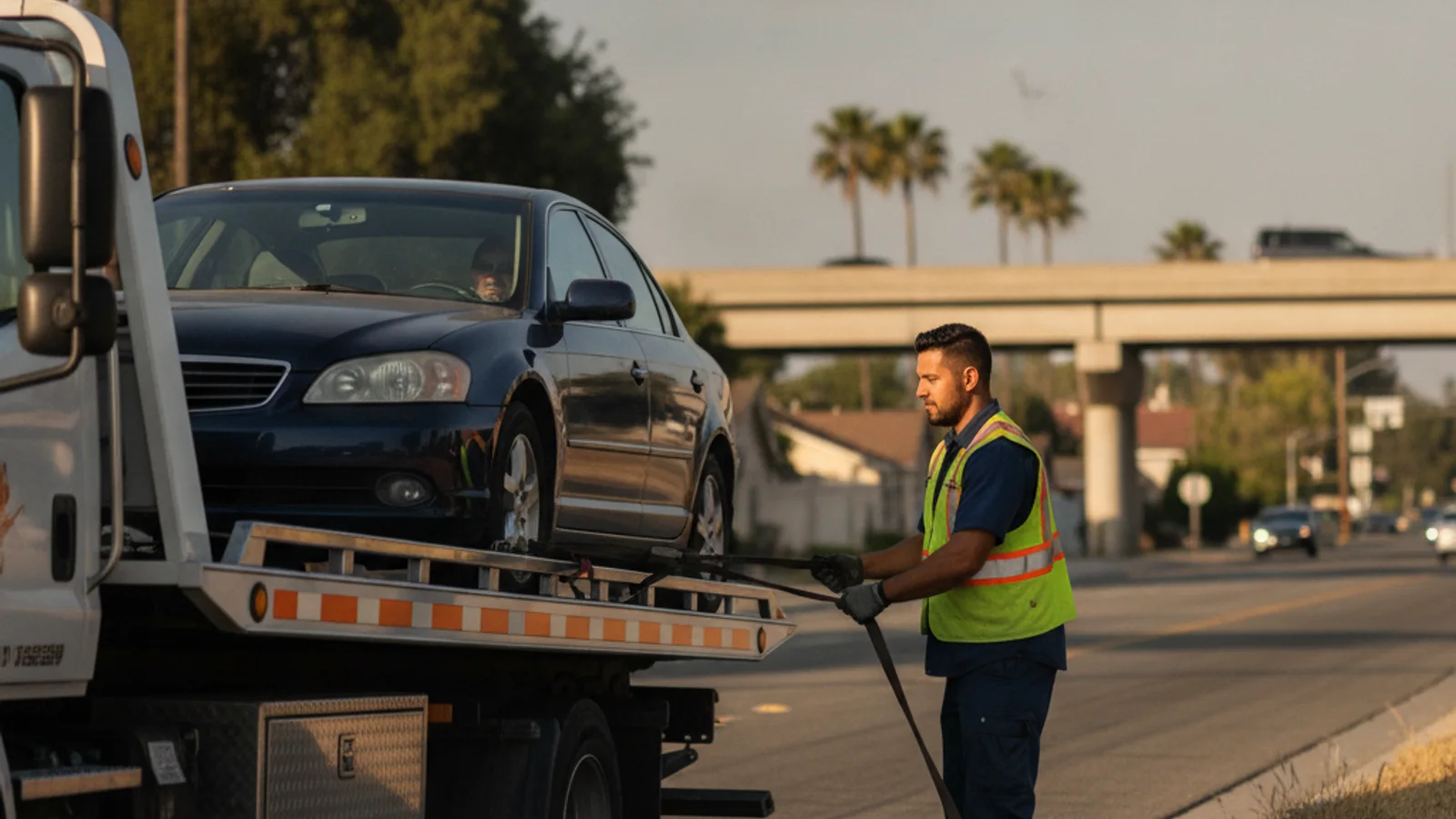
SR-94 doesn’t give you much room
SR-94 runs straight through the middle of Lemon Grove, and through this stretch it behaves more like a wide surface road with freeway speeds than a full freeway with a real shoulder. In several sections the paved shoulder narrows to almost nothing, especially near the Broadway and Federal Boulevard crossings where the road tightens between retaining walls and the trolley right-of-way. A car that dies here doesn’t have the luxury of coasting well clear of traffic the way it might on I-8 a mile away.
If your car quits on SR-94 near Lemon Grove, the safer move is often getting off at the next surface-street exit rather than trying to hug a shoulder that isn’t there. Broadway, Massachusetts Avenue, and the streets feeding Lemon Grove’s small downtown all connect back to SR-94 within a few blocks, so a car that can limp even a short distance usually has a place to land. If it can’t move at all, hazards on, everyone out and away from the traffic side, and call for a tow rather than trying to walk it to safety yourself.
The California Highway Patrol has jurisdiction on the state highway itself, so a disabled car sitting in a live lane on SR-94 is their call to manage traffic around, even while an operator we dispatch is en route to move the vehicle.
The trolley crossings and the lemon landmark change the routing
The Orange Line trolley crosses through Lemon Grove at grade in a few places, and those crossings box in how a tow truck can approach certain blocks. A driver who doesn’t already know the city can lose real time circling around a crossing that’s down for a passing train. Landmark navigation helps here more than an address alone: the big lemon sculpture near Main Street is the informal center of town, and giving dispatch “near the lemon” alongside your actual cross street gets an operator oriented fast.
Lemon Grove’s downtown core sits in a tight grid around Broadway and Main, and it’s walkable in a way that means street parking is scarce and closely watched. A car parked wrong for even a short window near the trolley station or the small business strip is a real tow risk, not a theoretical one.
Narrow driveways and street sweeping catch people off guard
Lemon Grove’s older residential streets, especially the hillside blocks above the SR-94 corridor, were built for smaller cars and less traffic than they carry today. Driveways are shorter and narrower than newer developments elsewhere in the county, and some don’t leave enough clearance for a full-size flatbed to line up straight. That’s one of the more common reasons an operator shows up with a wheel-lift truck instead: it can pull a car out from an angle a flatbed can’t manage on a tight lot.
Street sweeping is the other local trap. Signs on these older blocks aren’t always obvious, and a car left overnight on the wrong side during a sweeping window can get tagged and towed before the owner’s morning coffee. We don’t have a verified citywide schedule to publish here, since sweeping days vary block by block. Check the posted sign on your actual street, not a neighbor’s, before you park for more than a night.
The SR-94/SR-125 interchange and the Spring Valley border
East of downtown, SR-94 meets SR-125 in an interchange that carries a heavy volume of commuter traffic feeding Spring Valley and points further east. A breakdown right at or just before that interchange puts you in a genuinely different situation than one on a quiet residential block: more lanes merging, less room to react, and a longer walk to a safe shoulder if you have to leave the car. If you’re not sure whether you’ve crossed from Lemon Grove into Spring Valley, don’t worry about the line. Give dispatch the nearest exit or cross street and let them sort the jurisdiction.
For calls that start closer to that interchange, our guide to towing in Spring Valley covers the terrain on the other side of it, including the grade problems on Dictionary Hill.
Commute timing makes this stretch worse than its size suggests. Morning and evening rush hours push a steady stream of Spring Valley and East County drivers through this interchange toward downtown San Diego and back, and a stalled car in any of the merge lanes during that window creates backup fast. If you break down here during a commute period, getting the hazards on immediately and staying inside the car with the seatbelt on, unless you can safely reach the shoulder, is the safer call than standing next to the vehicle in live traffic.
What a breakdown on SR-94 actually means
People who don’t drive this stretch regularly assume “pull over” is always an option. Through central Lemon Grove it often isn’t, not in the way it would be on a wider freeway with a consistent paved shoulder. That changes what a disabled driver should realistically do: rather than trying to force the car onto a shoulder that may not exist at your exact location, look for the nearest surface-street off-ramp and aim for that if the car has any remaining momentum. If it doesn’t, staying inside with hazards on and calling for help is safer than getting out next to a live lane.
Dispatch needs your direction of travel and the nearest cross street or landmark, not just “on 94 in Lemon Grove.” Mentioning whether you’re closer to Broadway, the SR-125 interchange, or the trolley crossings near downtown helps an operator plan the safest approach rather than guessing.
Which tow type actually fits Lemon Grove
Given the street width and the interchange traffic, most Lemon Grove calls split two ways: a wheel-lift for tight residential pickups, and a standard flatbed for anything picked up directly off SR-94 or SR-125 where a flat, faster load matters more than maneuvering into a driveway. Neither is universally better here; it depends on where the car actually sits. If you want the general tradeoffs between the two before you call, our flatbed versus wheel-lift comparison breaks down which situations favor each.
What to tell dispatch before the truck rolls
A few details make a real difference for a Lemon Grove call specifically. Mention if your car is on SR-94 itself versus one of the feeder streets, since that changes whether CHP jurisdiction is involved. Say whether you’re on flat ground or one of the hillside blocks above the corridor, since a steep, narrow driveway needs different handling than a flat one. And if you’re not sure of your exact cross street, the lemon landmark near Main Street is a genuinely useful reference point that most local operators recognize immediately.
If your car is blocked in by another vehicle rather than disabled itself, that’s a different kind of call. Our guide on what to do when a car is blocking your driveway covers the private-property and street rules that apply, which matter just as much on Lemon Grove’s tight residential blocks as anywhere else in the county.
When to call us
A car stuck at the SR-94 interchange, blocked in on a narrow Lemon Grove driveway, or tagged for street sweeping all need a truck built for that specific spot, not a generic dispatch. Don’t try to push or roll a disabled car off the highway yourself.
Call (858) 923-5787 to reach dispatch.