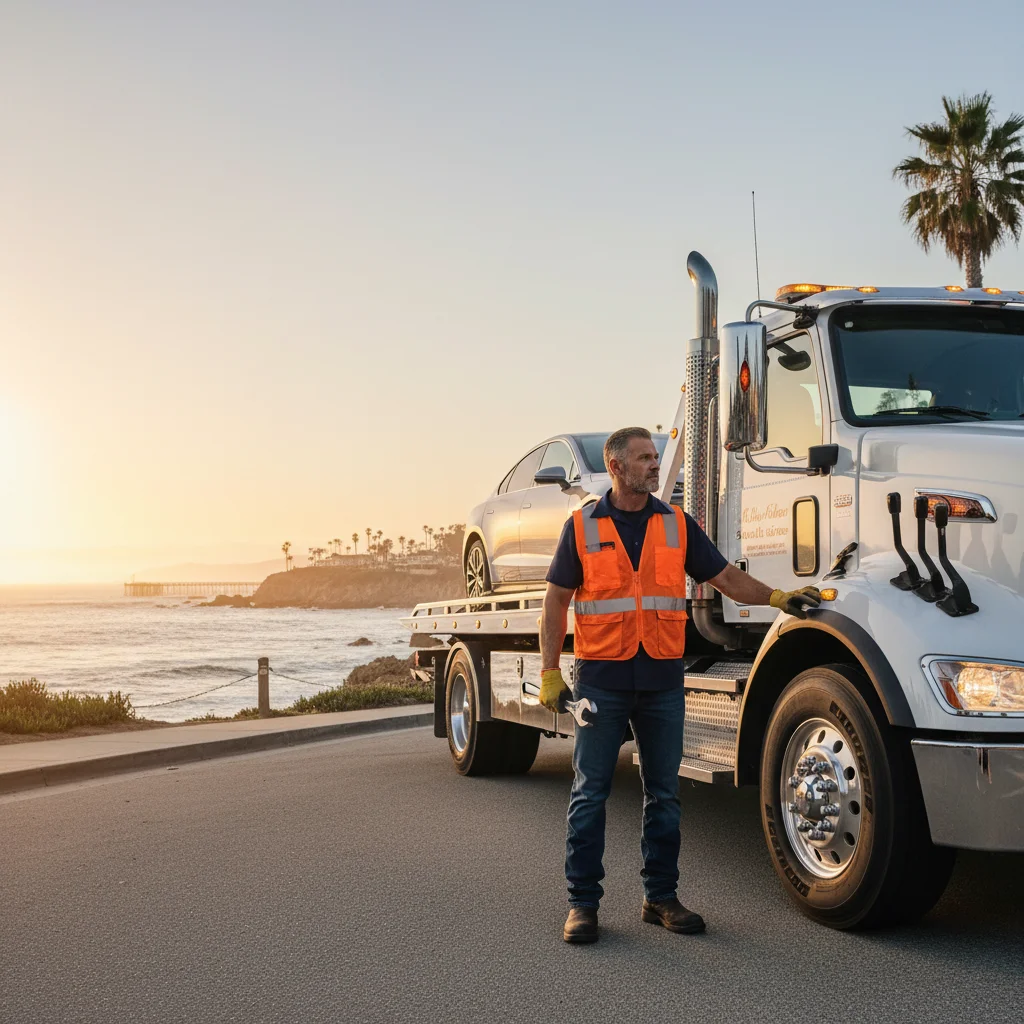
There is no published county cash-pay card. A La Jolla tow is quoted for this vehicle, this pin, and this drop-off, not from a county table. Quick Tow SD is a referral line. The line takes calls 24/7 and matches you with an independent operator who quotes that total and an arrival estimate for your exact location. Call (858) 923-5787.
You’re on Torrey Pines Road climbing toward the Village, leaving a packed lot at La Jolla Shores, or easing down a steep private drive in Bird Rock. The engine overheats on the grade, a tire sinks in sand, or a dashboard light kills the weekend. You need a tow truck in La Jolla that can work tight Prospect Street, crowded beach lots, and those hillside approaches, not a generic dispatch that treats this coast like a freeway shoulder.
When you need a tow truck in La Jolla, what to expect
A breakdown here is rarely a wide, level pullout. Steep drives, narrow Village lanes, and weekend beach lots change which truck can even reach you.
Common breakdown spots in La Jolla
La Jolla’s grades, lots, and Village grid produce a different kind of call than inland freeways.
- Interstate 5 (I-5) corridor: The freeway skirts La Jolla’s eastern edge around Torrey Pines State Natural Reserve and the UCSD exits at Genesee Avenue and La Jolla Village Drive. High speeds and peak commute traffic make a stop here hazardous. Shoulders can be narrow. Get as far off the travel lane as you can, then call.
- Torrey Pines Road and La Jolla Parkway: These are the main climbs from I-5 into the heart of La Jolla. Steep grades and winding sections overheat engines on a warm afternoon. Scenic overlooks are not always safe places to sit for long. Sudden stops on the descent can stack traffic behind you.
- La Jolla Shores Drive and Scripps Pier: Weekend and summer traffic packs this coastal route. Beach lots fill, cars idle, batteries die, and minor lot damage is common. Soft sand at the edges of those lots is its own problem: a wheel-lift cannot always get a clean pull from that.
- The Village and Prospect Street: Tight streets, limited parking, and heavy pedestrian traffic. A disabled car here blocks more than a lane. A larger flatbed may not fit every alley off Prospect. Tell the operator the exact block, not just “the Village.”
- UCSD campus: Parking structures and internal roads are hard for a long deck. Dead batteries after a long day, flats in structures, and low-clearance ramps all show up here. Name the structure and the level when you call.
- Bird Rock, Windansea, and steep residential drives: Winding streets, uneven pavement, and hillside driveways with little staging room. Flats from rough pavement, cars hung up in sand near beach access, and vehicles that cannot roll back up a grade all need the operator to know the slope before they roll.
Wherever you are stuck, move the vehicle to the safest spot you can, turn on hazards, and wait away from traffic if that is safer than staying inside. For freeway-specific steps, see what to do during a freeway breakdown in San Diego.
The right tow truck for your vehicle
The truck class is a safety choice, not a price trick. The wrong method can damage a drivetrain that was fine until someone dragged it.
- Flatbed towing: A rollback lowers a hydraulic bed, and the vehicle is driven or winched on so all four wheels leave the ground.
- Essential for AWD and EVs: If you drive an all-wheel-drive vehicle (many Subarus, Audis, and some Teslas and Rivians) or an EV, ask for a flatbed. Towing AWD with drive wheels on the pavement can wreck the drivetrain. Dragging an EV with motors still engaged can damage the motor and inverter. Check that year’s owner’s manual. When you are unsure, ask for a flatbed.
- Luxury, exotic, and classic cars: Low-clearance cars on Prospect Street or parked near The Cove scrape on a wheel-lift. Independent operators handle exotic and classic car towing with a deck when that is what the car needs.
- Motorcycles and RVs: Bikes need a chock and a deck, not a yoke. Larger RVs may need heavy-duty equipment. See motorcycle towing and RV towing.
- Wheel-lift towing: A yoke lifts one axle; the other two wheels stay on the road. That can work for many standard FWD or RWD cars when the drive wheels are the ones in the air.
- Tight Village streets and garages: Wheel-lift trucks are shorter and can thread UCSD structures, Cove-area garages, and narrow residential blocks that a long deck cannot enter. Compare methods in flatbed vs. wheel-lift towing.
- Heavy-duty towing: Commercial trucks, buses, and large RVs need a wrecker with the right capacity. An RV that dies near Torrey Pines or on the way to a coastal campground is that job. Operators in the network handle heavy-duty towing across San Diego County.
Understanding tow truck arrival times in San Diego
Quick Tow SD publishes no average arrival figure for service calls, because no source for one exists. The brand holds no fleet of its own to measure. The independent operator who takes the job gives you an arrival estimate for your exact pin on the call.
What actually stretches a wait in La Jolla:
- Rush hour: I-5, La Jolla Parkway, and Torrey Pines Road during the commute. SANDAG publishes real-time traffic updates that change how long any truck sits in that flow.
- The pin itself: A visible spot on La Jolla Boulevard is easier than a winding Bird Rock block or a packed Shores lot with one way in.
- Weather: Coastal fog and rare heavy rain cut visibility on the grades.
Mountain and backcountry addresses (Julian, Pine Valley, Borrego Springs) take considerably longer because of distance and terrain. La Jolla sits in the coastal core the line covers.
Navigating roadside emergencies in La Jolla
A tow is not always the job. Sometimes the operator can get you moving where you sit.
Beyond towing: roadside assistance
Independent operators in the network handle common roadside calls in La Jolla, quoted as their own job before anyone rolls.
- Tire changes: A flat on La Jolla Shores Drive or after the Torrey Pines trails is a spare swap if you have a usable spare. No spare, or a car too low to drive, becomes a tow.
- Jump starts: Lights left on after Windansea or a long day at UCSD. If the jump will not hold, the job becomes a tow. See how to jump start your car.
- Fuel delivery: Enough fuel to reach a station, not a fill-up. Easy to misread a gauge in stop-and-go Village traffic.
- Vehicle lockouts: Keys locked in a beach lot after a surf session. Ask how that operator opens that vehicle. Common along this coast in summer, including Pacific Beach and Ocean Beach.
Ask for one written total for the roadside call. If it turns into a tow, ask for the new total before the truck is loaded.
Staying safe on La Jolla roadsides
Curves, hills, and narrow shoulders leave little room to stand.
- Move to safety: On I-5, get as far onto the shoulder as the barrier allows. On Torrey Pines Road, look for a wide pullout or a side street, not an overlook with no runoff.
- Visibility: Hazards on immediately. If it is dark or foggy, use triangles if you have them. The California Highway Patrol publishes roadside safety guidance.
- Where to wait: Stay belted inside if traffic is close. If you exit, go to the passenger side and get behind a barrier. Do not stand between the car and oncoming traffic. NHTSA roadside safety is the federal primer.
- Call for help: Once you are safe, call Quick Tow SD at (858) 923-5787. Give the exact pin, the vehicle, and whether you are on a grade, in a lot, or in a structure. The line matches you with an independent operator for that scene.
On a patrolled freeway, call 911 so CHP has you, then 511 and say “Roadside Assistance” for SANDAG’s Freeway Service Patrol. SANDAG publishes an average dispatch of about nine minutes on patrolled segments. That figure is SANDAG’s, not an ETA for a private tow.
Tow truck costs in La Jolla: what you should know
There is no published county cash-pay card, and this page does not invent one. Operators usually quote a hook-up plus miles, then extras if the scene is hard: a freeway shoulder, a packed beach lot, a steep drive that needs a winch, after-hours, a motorcycle chock, heavy-duty equipment, or a long run toward Los Angeles. A light-duty Village hop and a heavy-duty recovery are different products.
What to ask before anyone rolls
Ask the operator who takes the job:
- Hook-up fee
- Miles included in that hook-up
- Where per-mile billing starts, and the per-mile rate after that
- Truck class: light-duty or heavy-duty, flatbed or wheel-lift
- One written total for this vehicle, this pickup, and this drop-off
- What payment they take, and that you get a receipt
If the person on the phone will not put a total in writing, hang up. Check that number against the invoice at drop-off. For how a quote is built countywide, see tow truck cost in San Diego.
If you have AAA or another motor club, call the membership first and check the current plan. Classic covers a short tow, Plus and Premier cover longer distance, and Auto Club of SoCal caps every tier at four roadside calls a year. A local line is the fallback when you are outside the plan.
Avoiding predatory towing practices
Stress on a shoulder is when bad operators show up.
- No clear pricing: A reputable operator quotes before the truck rolls. Vague fees or cash demanded with no paperwork are a walk-away.
- Aggressive upsells: Extra services you did not ask for, pushed on the scene.
- Cash-only with no receipt: Some operators take cash. It should not be the only option with no paper trail. Ask what they accept.
- Unsolicited offers: If a truck appears and you did not call, decline. Chasers monitor scanners. Unbranded trucks with no company name on the door are a warning, not a bargain.
- No identification: The truck should show a company name. The driver should be able to identify the company you were quoted.
Choosing a reputable operator protects the car and the bill. Read choosing a tow company and red flags to watch for.
Quick Tow SD: a La Jolla referral line
When you need a tow truck in La Jolla, you need someone who already knows Torrey Pines grades, Village width, and how beach lots clog on a Saturday. Quick Tow SD is a referral line. The line takes calls at any hour and matches you with an independent operator covering that pin.
Why call this line for a La Jolla tow
- Local geography: Operators who take these jobs already work the steep grades of Torrey Pines Road, the intersections at La Jolla Village Drive, Children’s Pool, and UCSD garages. The fastest path in is not always the GPS path.
- A line that takes calls 24/7: The line takes calls around the clock and routes the job to the operator covering La Jolla.
- The right truck for the job: Operators in the network run flatbed, wheel-lift, and heavy-duty trucks, from a compact in a Shores lot to an RV, including accident recovery.
- Countywide coverage: Quick Tow SD covers all 67 cities and communities in San Diego County, including coastal neighbors such as Del Mar and Coronado, inland North County, East County, and the mountains. A long-distance tow from La Jolla is one written total for that origin and destination.
- Ask, then confirm: The driver who arrives should match the company you were quoted. Compare the written total to the invoice.
Understanding private property towing in La Jolla
Parking near La Jolla Cove or in Village lots during tourist hours is tight. Cars get towed from private lots here.
California Vehicle Code (CVC) 22658 governs private property towing. Property owners and tow companies have to follow it before a car leaves private land.
- Signage: Signs in plain view at all entrances, not less than 17 by 22 inches, stating unauthorized vehicles are towed at the owner’s expense, with the towing company’s name and telephone numbers, plus the local traffic law enforcement number.
- No general waiting period under 22658: CVC 22658 sets none. The one-hour rule people cite is CVC 22953, which covers only property held open to the public for free parking and expressly exempts residential parking.
- Release (drop) rules: If the owner returns after hookup but before the truck leaves the property, the operator must release the vehicle on request. The drop is capped at half the tow fee.
Independent operators handle private property towing under CVC 22658. For more, see CVC 22658 private property towing or the official California Vehicle Code 22658.
Frequently asked questions about towing in La Jolla
What should I do first if my car breaks down in La Jolla?
Get to the safest spot off the travel lane, hazards on, wait away from traffic if that is safer than staying inside. Then call Quick Tow SD at (858) 923-5787.
How quickly can a tow truck get to me in La Jolla?
Quick Tow SD publishes no average arrival time, because no source for one exists. La Jolla is in the coastal core, which is quicker to reach than the mountains, but I-5 rush hour, a packed Shores lot, or a steep Bird Rock drive can still add time. Ask the operator for an estimate for your exact pin.
Do I need a flatbed for my EV or AWD car in La Jolla?
Ask for a flatbed. Teslas, Rivians, Lucids, Subarus, Audis, and many luxury SUVs can take drivetrain or motor damage if drive wheels stay on the pavement. Check the owner’s manual for that year. When you are unsure, ask for the deck.
How much does a tow truck cost in La Jolla?
There is no published county cash-pay card. Ask for hook-up, included miles, where per-mile billing starts, truck class, and one written total before anyone rolls. Heavy-duty, motorcycle, a winch on a steep drive, and a long run toward Los Angeles are different jobs.
Can the operator help if I only need a jump or a tire change in La Jolla?
Yes, if that is the job. Independent operators handle jumps, spare swaps, fuel drops, and lockouts in La Jolla, quoted as their own total. If the jump will not hold or there is no spare, it becomes a tow, and you ask for that total before the car is loaded.
When a car dies in La Jolla, call (858) 923-5787. Quick Tow SD is a referral line. The line takes calls 24/7 and matches you with an independent operator who quotes one written total and an arrival estimate for your exact location. See emergency towing for the service path.